“Republican Rout? Trump Policies Won’t Be Reversed Overnight” [fn Insight]
- Input
- 2026-11-05 15:35:20
- Updated
- 2026-11-05 15:35:20
[Financial News] “Winning an election to Congress and gaining control over policymaking are entirely different things.” Although the “blue tsunami”—Democrats taking both the House and Senate in the U.S. midterm elections—became a reality, Min Jeong-hun, a professor at the Korea National Diplomatic Academy (KNDA) (pictured), gave a measured assessment. Asked whether Democrats could reverse President Trump’s existing policies, he said flatly, “The chances of overturning them through legislation are very slim.” The obstacle is the veto. What changes, he said, is not the direction of policy but the cost of pushing it through.
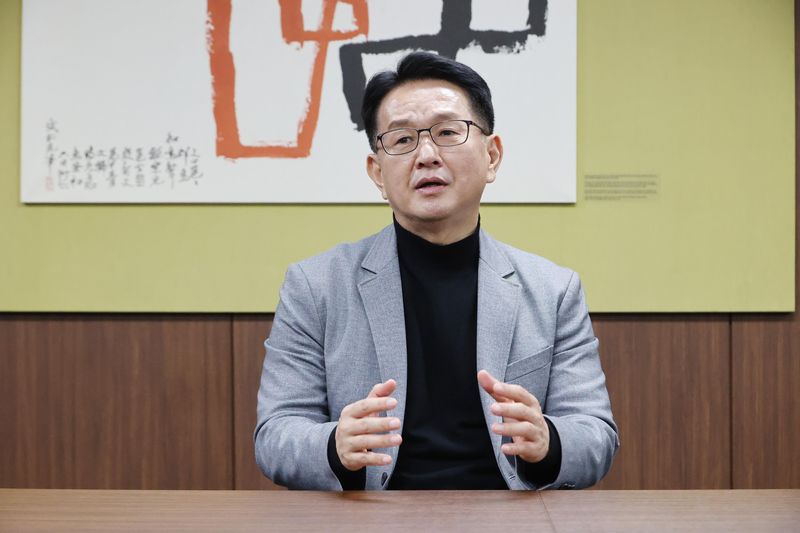
The next point is what matters. When a president is blocked in domestic politics, he turns to areas where he has greater discretion. Professor Min said, “With two years left in his term, the president can produce a lot of results and establish his standing as a great president,” adding that “contentious bills would only create political controversy, so he is ultimately likely to focus on foreign policy, the economy and trade.” That means Korea could still face demands over tariffs, investment in the United States and defense cost-sharing, regardless of the midterm results.
On the 5th, as the election results began to take shape, Financial News chief editorial writer Nodong-il met with Professor Min. Min first cited “affordability”—in other words, the cost of making ends meet—as the issue that determined the outcome of the midterms.
Q: What do you think swung voters?
A: Midterm elections are congressional elections. Economic and social issues are generally the main concerns. This time, it was whether people could afford rising prices. The cash distributed during COVID-19 came back in the form of inflation, and the Iran war in February this year sent oil prices soaring, adding fuel to the fire. For farmers and ranchers who need to run tractors and transport freight, it’s an issue that affects their daily lives.
Q: Did personal resentment toward President Trump also play a role?
A: Three factors came together: affordability, candidate strength and a change of heart among his supporters. President Trump weakened the party’s electoral prospects by replacing a well-performing incumbent Republican senator with a problematic candidate he himself supported. The Democrats, by contrast, put forward candidates respected in their communities. Hispanic voters, whose support shifted toward Trump by around 19% in the 2024 presidential election, pushed back against strict immigration controls. They feel a sense of kinship because their family members or relatives may be undocumented. Traditional supporters don’t vote for the Democrats. The second way to show dissatisfaction is to stay home on election day. That’s why President Trump traveled around Texas and Kansas urging people to vote right up to the end.
Q: If Democrats control both chambers, can they reverse Trump’s policies?
A: The focus will be on checking his power. Ninety percent of bills addressing people’s everyday needs will pass anyway. The problem is the 5–10% of contentious bills, on issues such as immigration, tariffs, AI investment and foreign policy. Even if they just manage to pass a bill reversing a policy, it’s over if the president vetoes it. President Trump said before the election, “I’m going to be Mr. Veto.” It takes 290 votes in the House and 67 in the Senate to override a veto, and the election results put those numbers out of reach. The chances of overturning policies through legislation are very slim.
Q: Then what tools do the Democrats have?
A: House investigative committees, oversight powers and hearings. They can make life difficult for the administration. Conflicts of interest are a particularly significant issue. They can examine whether proper procedures were followed and information disclosed when businesses involving Trump family members and allies took part in government projects. The same applies to matters such as the recent temporary easing of sanctions on Russia when diesel became scarce. But it’s the executive branch, not Congress, that implements policy. It would be extremely difficult to undermine policies by cutting their funding.
Q: Couldn’t they block funding for the Iran war?
A: That would be an extremely drastic political choice. U.S. forces have already been deployed and are fighting the war. If funding is withheld, the Democratic-controlled Congress will be attacked for having abandoned our troops—someone’s sons and daughters—on the battlefield. We’ll have to see whether they’re willing to take that risk. Both the United States and Iran are exhausted and have no desire to escalate the conflict. But Iran will find it difficult to give up control of the Strait of Hormuz, and the nuclear issue is not something it will readily concede. Rather than a quick resolution, protracted negotiations are likely to continue. There may be occasional limited airstrikes and responses, with oil prices fluctuating, for some time.
Q: In domestic policy, the issue Korean investors are most concerned about is regulation of artificial intelligence (AI).
A: Stock prices fell on news of the Democratic victory partly because of those concerns. Data centers use so much water and electricity that local water and power rates go up; there are environmental problems such as noise from generators, as well as fears that they will replace jobs. Many Democrats, from governors and state legislators to members of Congress, were cautious about building data centers. But I see this as an adjustment, not a halt. The United States can’t abandon AI, which is central to its competition with China. It will be difficult for the Trump administration to change course on its effort to establish standards early by championing superintelligence. I think the initial overheating will be corrected, misunderstandings addressed and alternatives developed, so the pace may be adjusted.
Q: Then what will happen to the key issues in U.S.–South Korea relations?
A: The executive branch has near-exclusive authority over foreign policy, security and trade. Congress is largely limited to approving budgets, conducting investigations and holding hearings. The midterm results can only have an indirect and limited effect on foreign policy. Defense cost-sharing is a case in point. Early in the administration, under the banner of modernizing the alliance, South Korea was asked to take a leading role in defending against North Korea, increase defense spending and buy U.S.-made weapons. In return, the cost-sharing issue receded from view. But in the latter half of the term, it could resurface as the administration emphasizes the economic side of managing the alliance and argues that unnecessary costs should be cut. That is President Trump’s choice, not a demand from Congress. It’s a decision aimed at producing results, not one driven by the midterms.
Q: Could tariffs also be up for change again?
A: It’s true that Democrats oppose tariffs, but they have few clear policy alternatives. Even if they draft sanctions bills or resolutions, the president can veto them. In the end, it comes down to political criticism and hearings. Tariffs are President Trump’s top policy priority, and if he changes course, everything will be thrown into disarray, leaving him unable to accomplish anything in the remaining two years. He will continue to keep tariffs as a tool of pressure and support efforts to expand manufacturing capacity through supply-chain restructuring and investment in the United States. The basic framework is likely to proceed as planned.
Q: What about USFK and the transfer of wartime operational control?
A: There is bipartisan support in Congress for deterring China and the U.S.–South Korea alliance. A change in the majority party won’t bring a sudden shift. However, the National Defense Authorization Act could include a provision requiring the maintenance of 25,500 USFK personnel and a report to Congress on a roadmap for transferring wartime operational control. It’s important to remember that the force level could also be adjusted if South Korea and the United States consult and agree to do so.
Q: The Democratic Senate is stricter on nonproliferation. Will that make nuclear-powered submarines, enrichment and reprocessing more difficult?
A: It’s true that we’ll have to deal with a stricter Congress. What we want when acquiring a nuclear-powered submarine is to say, “We’ll build the whole thing ourselves; just give us the enriched uranium.” To do that, we need a basis for military use. The current U.S.–Republic of Korea Agreement for Peaceful Nuclear Cooperation, known as the 123 Agreement, is limited to commercial use. Japan can enrich uranium to below 20% for peaceful and commercial purposes without U.S. approval. Among the major nuclear-power countries where nuclear energy accounts for 35% of electricity generation, South Korea is virtually the only one without that authority. The agreement would have to be revised, and a separate agreement on military use would have to be drawn up; congressional approval is essential for that.
Q: Can the Democrats be persuaded?
A: It’s true that Democratic lawmakers sent a letter late last year expressing concern about nuclear latency. But when you meet with them, their position is surprising. Their complaint is that “the leaders reached a top-down agreement, but there has been no follow-up and no information at all.” They don’t oppose in principle a trusted ally like South Korea having a nuclear-powered submarine; they want information and evidence that will allay their concerns. We need to explain systematically why the submarines are necessary, how much they will cost, what that means in the context of the overall defense budget, and whether they would take resources away from other areas.
Q: How should we view the $350 billion investment in the United States?
A: We need to distinguish between the broad framework and individual projects. $150 billion is for shipbuilding cooperation, and $200 billion is strategic investment. If $55 billion goes to a gas-fired combined-cycle power plant in Texas and about $12 billion to eight nuclear power plants across the United States, that would use up almost all of it. President Trump wants to put the remaining $50–60 billion into liquefied natural gas (LNG) in Alaska, so he has kept promoting the idea. Some said it was for election purposes, and if Alaska’s Republican lawmaker loses, interest is likely to fall off sharply. U.S. officials also say interest could plummet after the election.
Q: What cards do we hold?
A: We need to take a transactional approach. We’re still far too nice, almost too gentlemanly. Trump’s America comes at us almost like a robber, just without a knife. The United States won’t take offense even if we negotiate hard. We have to follow business logic. If we put in our hard-earned money, we should get something just as valuable in return. If we build eight nuclear power plants, we should naturally get the operating rights. Tariffs were the United States’ top priority in negotiations, while security talks were our top priority. If we’ve made progress on investment in the United States, it’s only natural to get something in return. We need to learn from experience to say, “If you don’t give us what we want, we can’t do any more.” An alliance isn’t about keeping each other happy. The best alliance is one in which both sides’ interests are maximized.
Q: The range of people we’ll have to deal with has widened, too.
A: In the past, our focus was the White House, the executive branch and Washington, D.C., think tanks. Now Congress has become important, and with investment in the United States ramping up, we also have to pay attention to state and local governments and state legislatures. South Korea’s embassy in the United States needs to be more active in its “caravan” outreach, visiting investment destinations such as Texas and Georgia to hear local views and build support. With Democrats in control of the Senate, we need to strengthen our Democratic networks while also maintaining ties with Republicans. The trend of the United States demanding greater contributions from its allies will continue even after the Trump administration. We need to build experience and get used to operating in that environment.
[email protected] Han Young-jun Reporter