AI doll uses family voices to ask dementia patients about their memories; Jeju National University students win ministerial award
- Input
- 2026-11-05 14:29:13
- Updated
- 2026-11-05 14:29:13
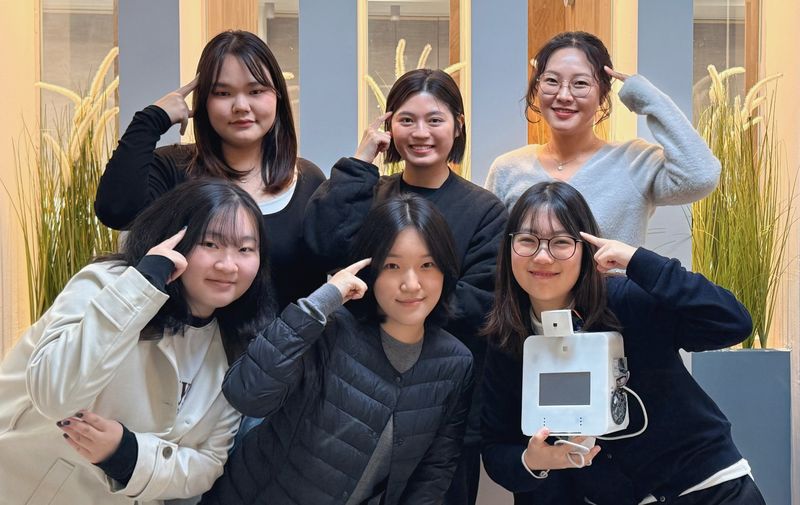
【Financial News Jeju = Reporter Jeong Yong-bok】 Jeju National University students have developed an artificial intelligence (AI) doll that uses family photos and voices to ask people with dementia about past memories and keep the conversation going. The technology, which uses patients’ personal memories as conversation topics and is designed not to send facial video outside the doll, won the Minister of Science and ICT Award.
According to Jeju National University on the 5th, five students from its Department of Artificial Intelligence won the Grand Prize in the credit-linked social contribution category of the “2026 Hanium Dream Up.” They also received a 5 million won scholarship as a prize.
The winning team consists of students Byeon Su-a, Kang Da-yeon, Kim I-seul, Kim So-hui and Kang Da-gyeong, who were advised by Hyojung Ahn, a professor in the Department of Artificial Intelligence. Their project is titled “AI That Connects the Memories of Dementia Patients: My Own Memory Doll.”
The core technology uses the personal experiences of people with dementia in conversation. The students developed the AI doll “Mori” and the caregiver app “Remori” together.
When a family member uploads the patient’s photos, information about family and acquaintances, and past memories to the app, the doll generates personalized questions based on that information. It is designed to continue the conversation in a family member’s voice, focusing on helping patients recall familiar people and experiences.
The doll also has a feature that analyzes patients’ facial expressions and voices. Summaries of conversations and information about changes in their emotions are sent to the caregiver app. The development team said it designed the system so that facial video is processed only inside the doll and is not sent elsewhere.
Unlike existing care robots, which provide the same music or stories to multiple users, this doll is distinguished by conversations built around each patient’s personal memories.
“Reminiscence,” used in the project, is a non-pharmacological cognitive support approach that helps people recall past people, events and experiences. It is used in programs that support the emotional well-being and communication of people with dementia.
Jeju has one regional dementia center and six Dementia Relief Centers in operation. With a system in place to support people with dementia and their families in the community, the potential for applying university-developed AI care technology in the field and the process of validating it are also drawing interest.
Hanium Dream Up is an ICT talent development program run by the Ministry of Science and ICT and the Institute for Information and Communications Technology Planning and Evaluation (IITP). It supports university students and industry experts in forming teams to develop technologies that address real-world social problems.
This year, the credit-linked social contribution category focused on developing information and communications technologies to improve the everyday lives of socially vulnerable groups, including older adults and people with disabilities. The Jeju National University team was recognized for using AI to address challenges in dementia care and family communication.
Professor Hyojung Ahn said, “It was a valuable experience for the students to directly apply the AI technology they learned in the classroom to solving a social problem—dementia care,” adding, “I will continue to nurture AI talent who contribute to society through field-oriented education.”
[email protected] Jeong Yong-bok Reporter