‘Asia Alliance University’ to launch in Busan, bringing together 163 universities from 15 countries
- Input
- 2026-11-05 13:51:04
- Updated
- 2026-11-05 13:51:04
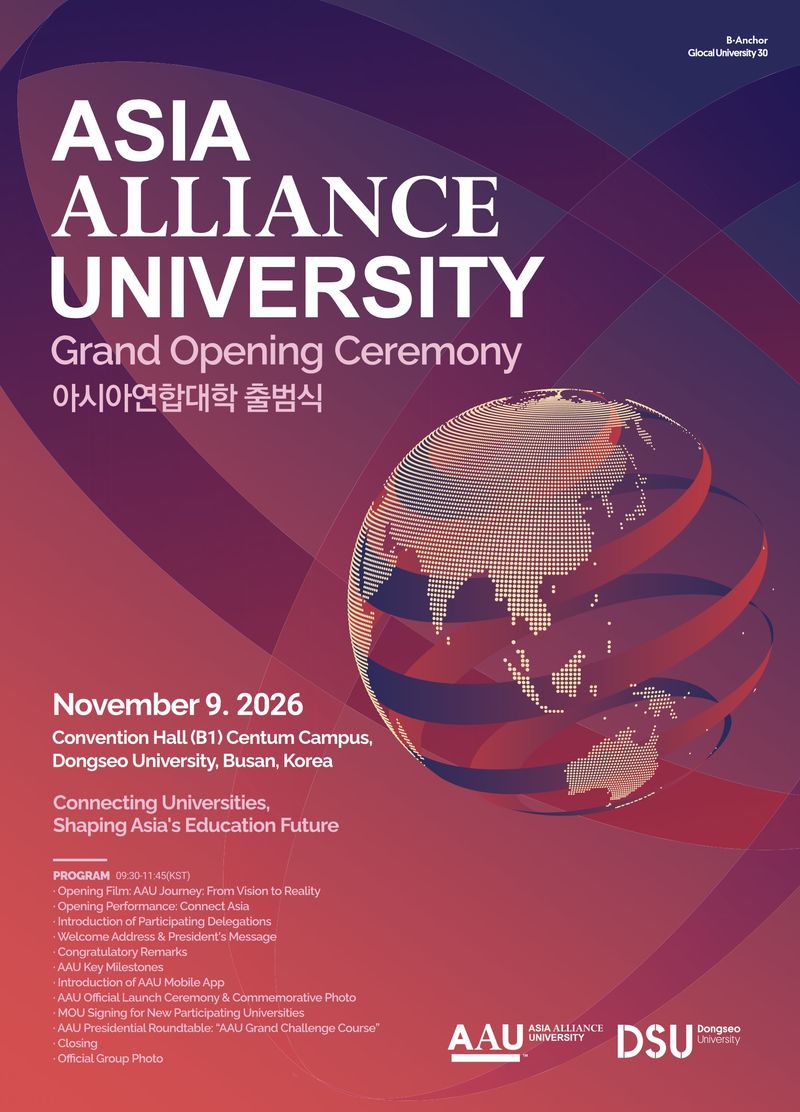
[Financial News] Dongseo University (DSU), led by President Jang Je-guk, is spearheading AAU (Asia Alliance University), an education platform bringing together universities from 15 Asian countries, with 163 universities participating. It will officially launch in Busan on the 9th.
DSU said on the 5th that it would hold the AAU Grand Opening Ceremony at 9:30 a.m. that day in the Convention Hall at its Centum Campus and begin full-scale cooperation to share educational resources and operate joint curricula among Asian universities.
AAU is a new model of university alliance that connects educational resources held by universities across Asia on a single platform, giving students diverse learning opportunities beyond national and institutional boundaries.
Its distinguishing feature is that it goes beyond conventional exchange agreements between universities to bring together initiatives such as sharing lectures, developing joint courses, exchanging credits, offering internships and carrying out joint projects.
■ University presidents from across Asia gather in Busan...Agreement to develop joint courses
Presidents and other key representatives of AAU member universities and strategic partner organizations will attend the launch ceremony.
The program will begin with the opening video ‘AAU Journey: From Vision to Reality’ and the digital performance ‘Connect Asia,’ featuring traditional Korean drums. It will continue with a welcome address by AAU inaugural President Jang Je-guk, congratulatory remarks from representatives of six overseas member universities on the board, a report on key developments, a demonstration of the AAU mobile app, the official launch announcement and the signing of agreements with newly participating universities.
At the launch ceremony, agreements will be signed to jointly develop and operate ‘AAU Grand Challenge,’ one of AAU’s core educational programs.
Seven universities and organizations will take part in the agreements: DSU; Japan’s Asia University; Malaysia’s Asia Pacific University of Technology and Innovation; Thailand’s Bangkok University; Macau’s Millennium College; Indonesia’s Petra Christian University; and the Association of Indonesian Private Universities.
A roundtable on ‘Joint Development and Operation of AAU Grand Challenge Courses’ will also be held after the launch ceremony. President Jang Je-guk will deliver the keynote presentation and moderate the discussion, while DSU Professor Sean O'Malley is scheduled to introduce the operating structure for the joint courses.
■ One platform, all of Asia as a campus
At the heart of AAU is the sharing and joint use of educational resources, currently dispersed across individual universities, on a single platform.
The plan is to reduce duplication in curricula and expand students’ learning options by opening each university’s areas of specialization and educational strengths to students at other member universities.
AAU’s main areas of cooperation include △2+2 joint curricula △credit exchange △joint classes and research △capstone projects △hackathons △micro-internships △semester-long credit-recognition exchanges △summer and winter training programs.
This will allow students to take courses at other member universities that their own institutions may find difficult to offer, work on joint projects with students from overseas universities and participate in hands-on training.
In particular, AAU’s flagship educational program, ‘Grand Challenge,’ will bring multiple universities together to jointly develop and run courses around a single theme. Board member universities can plan courses and lead their delivery, while other member universities can contribute by providing lectures, mentoring projects and arranging field learning.
Courses will run for periods ranging from eight weeks to a semester and will combine online lectures, joint projects and field experiences. At the end of each course, a joint capstone session is planned where students will present their project results and receive evaluations from faculty and outside experts.
■ First joint course, ‘Asia Responding to the Climate Crisis,’ to launch in March 2027
AAU’s first jointly developed course is ‘Asia Responding to the Climate Crisis’ (Climate-Resilient Asia), which is targeted to launch in March 2027. Centered on the climate crisis confronting countries across Asia, the program will see faculty members from diverse fields—including science, technology, policy, economics and social studies—jointly develop and deliver the curriculum.
Students will first take online lectures in various fields from faculty at member universities, then visit sites to discuss and conduct field research with students from across Asia. Drawing on this work, they will jointly explore ways to address the climate crisis that can be applied in local communities and present the results of their projects.
AAU plans to pilot its first course on a small scale, analyze its results and then gradually expand the number of jointly offered courses and participating students.
AAU President Jang Je-guk said, “No single university can provide every lecture, perspective and experience, but by working together, we can open the door to more opportunities. Students at smaller universities should also have access to a broader world of learning. The resources of a university may be limited, but students’ potential should not be.”
■ Beyond simple exchanges, toward a platform for sharing educational resources...Aiming to be an ‘Amazon for universities’
AAU is distinct from existing models of international cooperation among universities in that it aims to be a platform for the joint use of educational resources themselves. Whereas international cooperation between universities has generally focused on exchange agreements between individual institutions, joint research or student exchanges, AAU emphasizes sharing educational resources on a single platform and jointly developing and operating new curricula across multiple universities.
The key is to go beyond simply opening existing courses to one another: universities in multiple countries will jointly design new courses and have students learn together. The agreement to jointly develop Grand Challenge courses is the first step toward making this model of educational cooperation a reality.
President Jang said, “What we want to create is not simply a consortium of universities, but an innovation that connects the educational resources and opportunities of Asian universities. Just as Amazon connects countless sellers and consumers on a single platform, AAU is an ‘Amazon for universities’ that connects the diverse educational resources of Asian universities with the students who need them.”
■ Built on DSU’s global network...Originated with the 2024 ‘Busan Declaration’
In 2024, DSU hosted the 22nd Asia University Presidents Forum (AUPF) and, in August of the same year, ran the Asia Summer Program, among other initiatives that have expanded its exchanges with universities across Asia.
It has also built experience in international joint education by operating overseas hubs in the United States, Japan and China; running a Korea-China joint university approved by China’s Ministry of Education; and offering 2+2 degree programs with universities in Lithuania, Vietnam and Indonesia.
Discussions on establishing AAU gained momentum after the ‘Busan Declaration’ was announced at the 22nd Asia University Presidents Forum in 2024. At the general assembly of the Association of Indonesian Private Universities in July 2025, more than 70 universities submitted letters of intent to participate. A task force to establish AAU was formed in October that year. The number of participants later grew to 163 universities in 15 countries when the National University of Laos joined in April 2026.
AAU’s launch also comes amid structural changes in global higher education, including a declining college-age population, rising financial pressures on universities and advances in AI technology. DSU concluded that a cooperative model was needed—one in which universities share their strengths and broaden educational opportunities, rather than each institution trying to secure every educational resource on its own.
President Jang emphasized, “In many countries, including South Korea and Japan, the decline in the college-age population is increasing the financial burden on universities, while advances in AI are even reducing the scarcity of knowledge. The answer lies in cooperation among universities.”
After its official launch, AAU plans to address institutional challenges in stages, including establishing a system for credit recognition among member universities, sharing the costs of running joint programs and supporting cross-border student mobility. In the long term, it aims to expand cooperation to include national governments, international organizations and businesses.
President Jang said, “A university’s educational resources may be limited, but students’ potential should not be confined by those limits. I hope AAU, starting in Busan, will become the starting point for connecting all of Asia as one vast space for learning.”
[email protected] Byun Ok-hwan Reporter