Samsung invests 1.2 trillion won in future technology development over 14 years, supporting 916 research projects
- Input
- 2026-11-05 14:00:00
- Updated
- 2026-11-05 14:00:00
[Financial News] Samsung is stepping up its mutually beneficial corporate social responsibility (CSR) initiatives, going beyond simple support to promote growth shared by businesses and society. The aim is to lay the groundwork for sustainable future growth through reciprocal cooperation rather than one-sided charity.
In particular, through its Future Technology Promotion Project, into which it has invested 1.2 trillion won over the past 14 years, Samsung is supporting everything from basic science research to technology startups and working to build Korea's research and development (R&D) ecosystem.
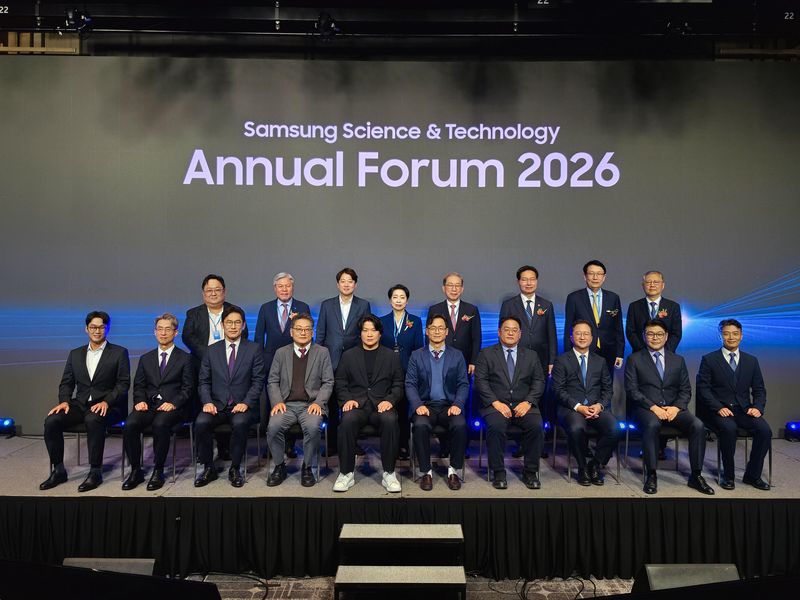
Samsung said it held the Samsung Future Technology Promotion Project 2026 Annual Forum at The Westin Seoul Parnas in Gangnam District, Seoul, on the 5th. Around 450 people from the science and technology community, including researchers, attended the event. They included Koo Hyuk-chae, First Vice Minister of Science and ICT; lawmakers Hwang Jeong-a of the Democratic Party of Korea (DPK), Park Choong-kwon of the People Power Party, Seo Wang-jin of the Rebuilding Korea Party, and Lee Jun-seok of the Reform Party; Park Hong-geun, head of Samsung Electronics' Samsung Advanced Institute of Technology (SAIT); and Jang Seok-hoon, Samsung's president overseeing social contribution.
The Samsung Future Technology Promotion Project is a private-sector-led R&D support program launched in 2013. It identifies and supports creative, ambitious research projects in a range of fields, including basic science, materials, and information and communications technology (ICT). Since 2014, Samsung has held an annual forum where researchers can share their findings and discuss ways to solve technological challenges.
At this year's event, Samsung selected and honored 10 “Outstanding Researchers in the Samsung Future Technology Promotion Project” for the first time since the program's launch. Samsung evaluated 644 completed projects it had supported, assessing research excellence, the potential to build on the results, and impact on academia and industry. A panel of leading scholars from each field conducted a review over about four months and selected four researchers in basic science and six in materials and ICT.
In basic science, the honorees were Sung-Jin Oh, a professor of mathematical sciences at the University of California, Berkeley and the Korea Institute for Advanced Study (KIAS); Lee Hyun-woo, a professor of physics at Pohang University of Science and Technology (POSTECH); Park Jung-won, a professor of chemistry at Seoul National University; and Won-Suk Chung, a professor of life sciences at the Korea Advanced Institute of Science and Technology (KAIST). In materials and ICT, the honorees were Kim Bong-soo, a professor of electronic materials at UNIST; Yoo Chang-sik, a professor of electronic devices at Sungkyunkwan University; Choi Jang-wook, a professor of energy and environment at Seoul National University; Yoo Hong-ki, a professor of bio and medical engineering at KAIST; Kim Jang-woo, a professor of communications and computing at Seoul National University; and Hwang Seong-joo, a professor of AI robotics at KAIST.
The awardees also presented some of their key research findings at the forum. Professor Oh introduced research that mathematically established how solutions to the Yang-Mills equations, which describe the fundamental forces of the universe, change over time. Professor Choi presented work analyzing the causes of performance degradation in aqueous batteries, which have a lower risk of fire, and improving their electrode and electrolyte materials. Professor Kim demonstrated computing technology that uses data processing units (DPUs) to reduce the burden on central processing units (CPUs) and improve processing efficiency at AI data centers.
Samsung plans to provide the awardees with technical advice, opportunities to connect with industry, mentoring on startups and intellectual property (IP), and support for follow-up research. It will also support technical workshops involving researchers in related fields to help bring research findings into industrial applications.
Kuk Young, chairman of the Samsung Science & Technology Foundation, said, “Over the past 14 years, as researchers' creative and ambitious work has accumulated, meaningful achievements that are driving a leap forward in Korea's science and technology have begun to emerge. We will continue to provide strong support so researchers can freely explore new possibilities and expand the horizons of future science and technology.”
Since the launch of the Future Technology Promotion Project, Samsung has provided a cumulative total of 1.2 trillion won in support for 916 research projects. The program has involved around 17,000 researchers, including faculty members, postdoctoral researchers, and master's and doctoral students.
Alongside research funding, Samsung also supports technology commercialization and startups. One prominent example is PROTEINA, an AI-based antibody drug development company that was listed on KOSDAQ last July. Founded by Seoul National University professor Tae-Young Yoon, PROTEINA is pursuing antibody drug development using its proprietary technology to measure interactions between proteins.
MangoBoost, founded in 2022 by Seoul National University professor Kim Jang-woo, is also a startup that grew out of the Future Technology Promotion Project. MangoBoost has developed DPU design technology to address bottlenecks in AI data centers and has recently expanded its business into areas such as software for optimizing AI inference.
Samsung aims to strengthen the self-sufficiency of the science and technology ecosystem through this support system, which extends from research and development to technology commercialization. Rather than limiting its efforts to research funding, it is focused on building a virtuous cycle in which research findings strengthen industrial competitiveness and lead to the creation of new companies.
These activities also align with Samsung's CSR vision, “Together for Tomorrow! Enabling People.” Samsung views social contribution not as one-sided support, but as a reciprocal way for businesses and society to grow together and a growth strategy for a sustainable future. Guided by this vision, it runs youth education programs such as the Samsung Youth SW·AI Academy (SSAFY), Samsung Hope Stepping Stone, and Samsung Dream Class, as well as mutually beneficial cooperation programs that support small and medium-sized enterprises in transitioning to smart factories and include Samsung C-Lab.
Kim Hyun-soo, head of Samsung Electronics' Future Technology Promotion Center and a vice president, said, “The Samsung Future Technology Promotion Project will continue to serve as a partner to researchers who have dedicated themselves to exploring uncharted areas and boldly pursuing new possibilities. We aim to develop it into a continuing forum for exchange that contributes to the advancement of science and technology in Korea.”
[email protected] Lim Su-bin Reporter