[Exclusive] New Supreme Court justices’ chambers to be 20% smaller... 3 on the 12th floor and 1 on the 13th in the main building
- Input
- 2026-11-05 14:21:11
- Updated
- 2026-11-05 14:21:11
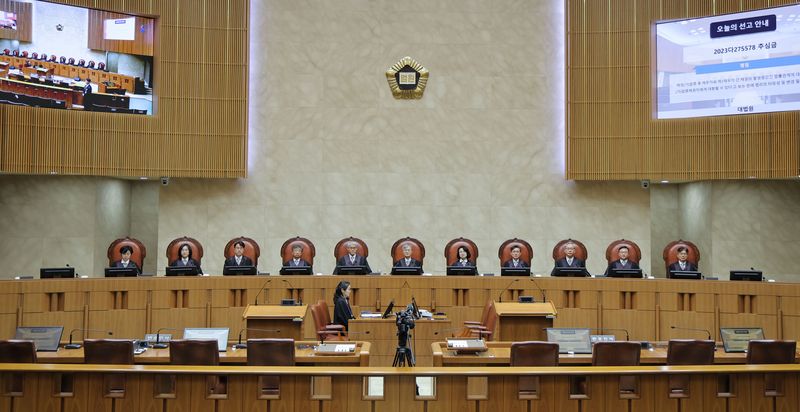
A review by Financial News on the 5th of the National Assembly Budget Office’s “Committee-by-Committee Analysis of the 2027 Budget Proposal” found that the Supreme Court plans to allocate 213 square meters to each additional justice: 113 square meters for chambers, 60 square meters for an office for dedicated judicial research officers, and 40 square meters for a secretariat office. This is 53 square meters less than the 266 square meters currently used by each justice, comprising 133 square meters for chambers, 78 square meters for an office for dedicated judicial research officers, and 55 square meters for a secretariat office. The research officers’ office is calculated for a dedicated two-person team, and the secretariat office for four people, including secretaries.
The floor-by-floor plan has also been fleshed out. Currently, three justices work on each floor from the 7th to the 10th floors of the main building, while judicial research officers use the 12th through 15th floors. The Supreme Court plans to create new chambers for three justices on the 12th floor and one on the 13th during 2027. Some of the judicial research officers who will vacate space on the 12th and 13th floors will move to the East Building of the National Court Administration, while some National Court Administration departments currently on floors 3–5 of that building will move in stages to leased offices outside the courthouse.
The National Assembly Budget Office also provided the office areas of other senior officials for comparison. Under the Enforcement Rules of the Government Complex Management Regulations, a minister-level office measures 165 square meters, including the minister’s office, reception room and secretariat. A National Assembly member’s office also measures 165 square meters, including space for nine aides. At 213 square meters, the space allocated to an additional justice is larger.
The legal community says, however, that a simple comparison is difficult. The area of a Supreme Court justice’s office includes workspace for, among others, a dedicated team of two judicial research officers, essential personnel who support the court’s work. A judicial research officer is a judge at the level of a district court’s presiding judge who investigates, researches and reviews cases handled by a Supreme Court justice. Judges broadly agree that the workload is “brutal,” and that the work differs in nature from that of secretaries assisting ministers and other officials.
A new budget of 9.956 billion won has been allocated for next year’s courthouse reorganization. Of that, 2.251 billion won is for creating Supreme Court justices’ chambers, 2.789 billion won for relocating judicial research officers’ offices, and 4.916 billion won for moving the National Court Administration to off-site premises, with the off-site relocation accounting for half the total.
The increase in the number of Supreme Court justices stems from an amendment to the Court Organization Act, which passed the National Assembly’s plenary session on February 28. Under the law, passed under the leadership of the ruling party, the number of justices will rise from 14 to 26, including the Chief Justice. This budget covers the first four additional justices in 2028. If eight more are added—four each in 2029 and 2030—further relocation costs will arise from the cascading reorganization of judicial research officers’ offices and National Court Administration offices. Rent and maintenance costs for off-site offices are also expected to continue.
[email protected] Kim Dong-gyu, Choi Eun-sol Reporter