Supreme Court: Whether a construction project halted midway caused loss through breach of trust must be judged as of the contract date
- Input
- 2026-11-05 13:37:35
- Updated
- 2026-11-05 13:37:35
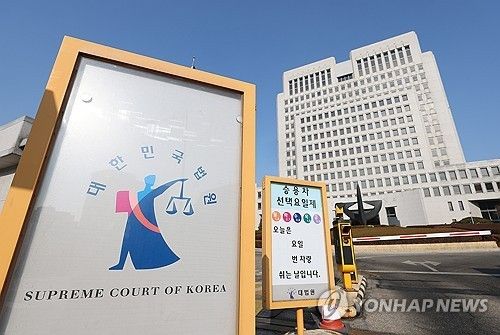
According to legal sources on the 5th, the Second Division of the Supreme Court of Korea, with Justice Park Young-jae presiding, overturned the lower court ruling on the 8th of last month and remanded the case to the Gwangju High Court. The ruling had sentenced A, chairman of a certain clan association, and B, its secretary, to two years and one year in prison, respectively, after they were indicted on charges including occupational breach of trust.
On October 17, 2022, A and others signed a contract setting the construction price at 1,733,100,000 won, commissioning C, an unregistered contractor not qualified for general construction work, to build a three-story building on the clan association’s land in Suncheon, South Jeolla Province, without approval from the association’s general meeting. They were subsequently put on trial on suspicion of causing loss to the association by paying 1.07 billion won by April of the following year.
Since 2020, the clan association had discussed expanding a building on a vacant lot used as a parking area, but had not decided on its size, contractor or construction price. A and others submitted minutes of a general meeting required for a building permit to the relevant authorities after obtaining signatures only from relatives. The first and second floors were designed as a gallery café so B could operate a private gallery there. Under the contract, 200 million won of the 1,733,100,000 won was to be returned to A. C halted construction in July 2023. By then, the exterior of the building was complete, but work on the interior had not even begun.
The first-instance court found A guilty only of occupational embezzlement, forgery of private documents and other charges, sentencing him to one year in prison, and acquitted B. It found A not guilty of breach of trust, ruling that the loss had not been proven because there was no evidence with which to objectively calculate an appropriate construction price. The second-instance court reversed that decision. After prosecutors added occupational breach of trust as an alternative charge on appeal, alleging loss equivalent to “profits from the construction work, the market value of which was unknown,” the court found the defendants guilty, saying that at the time construction stopped, the amount paid exceeded the maximum fee C could claim based on the proportion of work completed.
The issue was when to assess property loss for criminal breach of trust: at the time the contract was signed, or after construction stopped, by comparing the payments with the progress of the work. The outcome differed depending on which point in time was used.
The Supreme Court said that the amount paid around the time construction stopped did appear to exceed the maximum fee based on the work completed. However, it stated, “Whether the construction price can be considered excessive compared with an appropriate level must be determined based on the time the construction contract was signed. Therefore, these circumstances alone are not enough to establish that the contract was concluded at an unjustifiably excessive price.” It also noted that no evidence had been submitted to show what an appropriate construction price would have been in this case.
Citing a February 2018 ruling, the court said, “One must not readily conclude that property loss occurred based solely on the possibility that, had there been no breach of duty, the construction price could have been set at a lower level.” It added that neither awareness nor intent to cause loss had been established, and that the conclusion would be no different even if construction had stopped before work commensurate with the advance payment was completed, despite the advance having been paid.
[email protected] Kim Dong-gyu Reporter