Gains have moderated, but prices keep rising ... Seoul apartment prices up for 91 straight weeks
- Input
- 2026-11-05 14:00:00
- Updated
- 2026-11-05 14:00:00
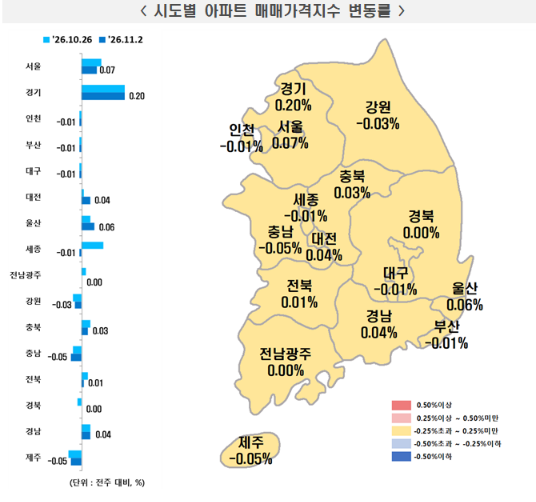
[Financial News] The sales price index, which measures apartment prices in Seoul, rose for the 91st consecutive week. Although the pace of gains has recently slowed, the upward trend has not reversed. Declines have deepened in the three Gangnam districts (Gangnam, Seocho and Songpa), while prices in Seoul’s outskirts have remained on an upward trend, showing little sign of easing.
According to KREB’s weekly apartment price trends released on the 5th, Seoul’s sales price index stood at 0.07% in the first week of November (as of the 2nd). That was down 0.02 percentage points from 0.09% the previous week.
Once again, Seoul’s outskirts were the areas driving home prices in the city. Seodaemun District posted the highest increase, at 0.31%, followed by Seongbuk and Geumcheon districts, each at 0.30%. Jungnang-gu (0.28%) and Gangbuk District (0.26%) also helped drive up Seoul home prices. In Mapo District (0.25%), prices rose mainly in Mangwon-dong and Seongsan-dong, where redevelopment, reconstruction and other renewal projects are in focus. Across these areas, prices rose mainly for mid- and small-sized apartments, properties near transit stations, and major complexes. The sales price index for Seoul’s 14 northern districts has slowed, from 0.22% the previous week to 0.19%.
However, with the pace of gains slowing from the previous week, the market appears to be taking a breather. Nam Hyuk-woo, a real estate researcher at Woori Bank, said, “This appears to be the result of reduced buying capacity amid stringent lending restrictions and increased volatility in the stock market, combined with increased market fatigue after even mid- and low-priced apartments saw sharp short-term price rises.”
The figures for the three Gangnam districts stand out. Gangnam District (-0.39%) and Seocho District (-0.37%) saw their declines deepen from the previous week. In particular, Seocho District followed Gangnam District in posting a negative cumulative price increase for the year. Sales prices in Gangnam and Seocho districts have fallen for 13 consecutive weeks.
Songpa District (-0.17%) saw a smaller decline than the previous week but remained on a downward trend. It has also fallen for nine consecutive weeks. Declines were particularly notable in key areas such as Apgujeong-dong, Gaepo-dong, Banpo-dong and Jamwon-dong. Nam said, “With buyers continuing to hold back and macroeconomic uncertainties, including policy uncertainty and interest rates, still in play, the slowdown in transactions and weakness in prices in these areas are likely to continue for the time being.”
The same trend was evident in actual transactions. A 49-square-meter unit in the general-sale portion of Seongwon Daechi Complex 2 in Gaepo-dong, Gangnam District, sold for 2.025 billion won on October 6, on the ninth floor, but traded for 1.4 billion won on the first floor about three weeks later. A 59-square-meter unit at Lake Palace in Jamsil-dong, Songpa District, sold for 2.705 billion won on the ninth floor in August, but fetched 2.499 billion won on the first floor on October 24, marking a steeper decline.
KREB said, “Lower-priced transactions occurred as some complexes saw price-adjusted listings come onto the market,” adding, “Price increases and declines were mixed across regions, with higher-priced contracts being signed mainly in large complexes and areas near transit stations, where demand remains strong.”
Gyeonggi Province remained strong, rising 0.20%. Southern Gyeonggi Province led gains in the Seoul metropolitan area. Giheung-gu in Yongin rose 0.60%, the largest increase nationwide. It was followed by Gunpo in Gyeonggi Province (0.57%), Dongan District in Anyang (0.55%), Dongtan-gu in Hwaseong (0.49%) and Yeongtong in Suwon (0.43%). Gains in Yeongtong have eased somewhat, but the area continues to post a high figure.
With gains in the Seoul metropolitan area exceeding those in Seoul, the trend is thought to indicate that actual homebuyers are looking at southern and western Gyeonggi Province. Nam said, “As prices remain strong in popular residential areas in southern Gyeonggi Province that serve the semiconductor industry, including Suwon, tenants whose leases are coming due and buyers with reduced purchasing power are moving to nearby areas and seeking to buy homes. This appears to be spreading the trend of strong prices.”
Jeonse prices in Seoul rose 0.17%. The increase was driven largely by the city’s outskirts. Seongbuk District posted the largest rise, at 0.41%, followed by Nowon District (0.37%) and Dongdaemun District (0.29%).
[email protected] Jeong Gyeong-su Reporter