Defense Ministry, ADD Hold K-MOSA Results-Sharing Event on Strategy for New Technologies, Designs and Development
- Input
- 2026-11-05 14:13:57
- Updated
- 2026-11-05 14:13:57
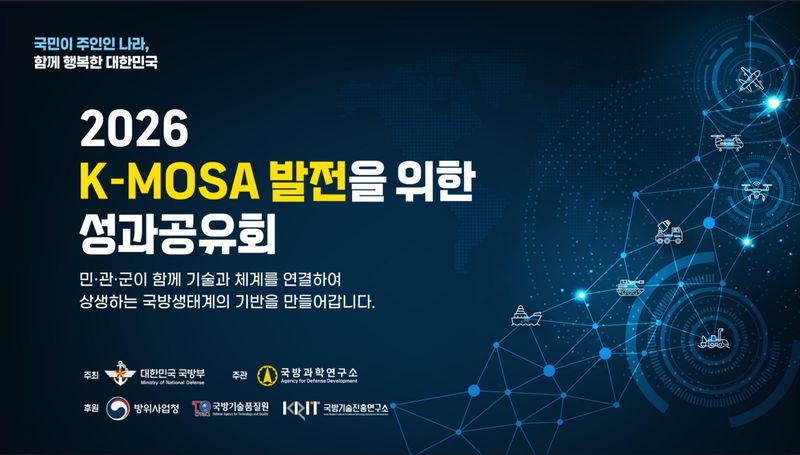
The Ministry of National Defense and the Agency for Defense Development (ADD) held the “2026 Results-Sharing Event for the Advancement of K-MOSA” on the afternoon of the 5th at Peace & Park Convention at the War Memorial of Korea in Seoul. The event was organized to bring the results of the Korean Modularization and Standardization of Autonomous Systems (K-MOSA) policy, which had until now remained at the research stage, into actual defense acquisition and R&D, and to discuss future directions for standardization and institutionalization. Around 300 people attended, including experts from the Ministry of National Defense, the Defense Acquisition Program Administration (DAPA), the armed services, defense companies and academia, drawing a strong turnout.
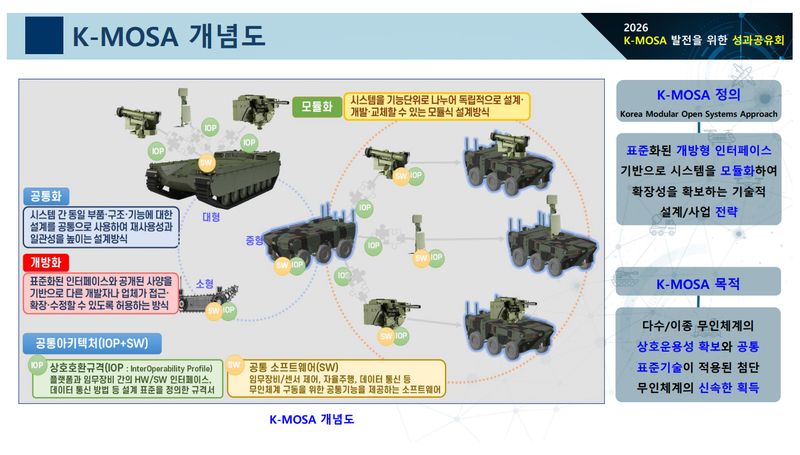
K-MOSA is both a technical design and a program strategy that modularizes weapon systems by function and applies standardized open interfaces to rapidly integrate new technologies. The event also comprehensively unveiled results from the development of common architectures across operational domains and in AI and autonomy, areas that will be central to future battlefields, alongside the policy direction for advancing K-MOSA.
The full-scale implementation of K-MOSA in operational settings is not simply a matter of following overseas technology trends. It is a proactive strategy to maintain the South Korean military’s readiness without gaps amid grave security threats while making the country’s defense ecosystem healthier and more resilient.
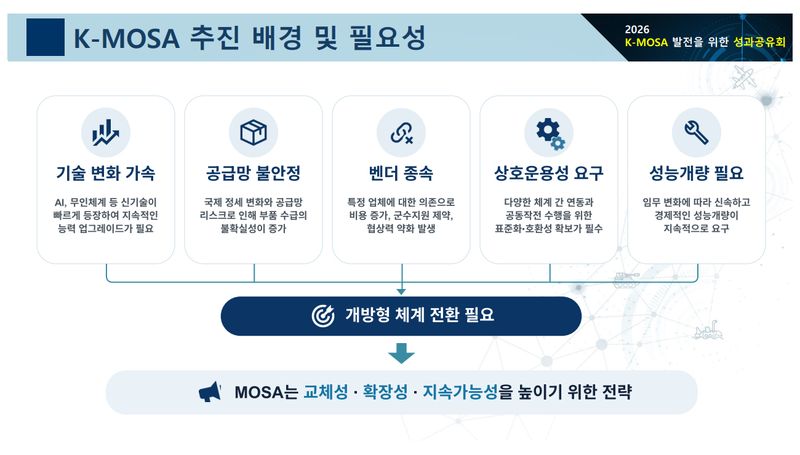
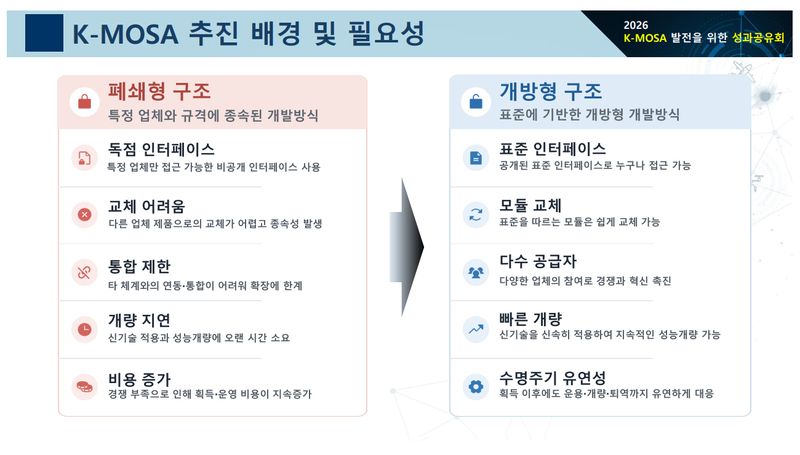
Until now, South Korea’s defense R&D has faced chronic constraints under a “closed structure” dependent on specific companies and specifications: replacing modules with products from other companies has been difficult, and the use of proprietary interfaces has driven up acquisition and operating costs. But with the full-scale adoption of K-MOSA, complete interoperability among different types of unmanned systems—large, medium and small—will be ensured on the basis of interoperability standards (IOP) and common software. This is expected to encourage participation by multiple suppliers and healthy competition, enabling the rapid fielding of unmanned weapon systems.
In particular, the event is serving as an opportunity to shine a light again on the efforts of South Korean defense companies that have worked on the ground as the country rose to become a global defense powerhouse. In the past, when the country had limited technological self-reliance, defense industry workers overcame the frustration of facing barriers to classified foreign technologies with their characteristic perseverance and world-class precision manufacturing capabilities. Thanks to the sacrifices of researchers who worked day and night and bold investment, South Korea’s defense industry has developed distinctive strengths that are now recognized in global markets: an unbeatable price-performance ratio, rapid delivery and outstanding reliability.
Building on the achievements of South Korean defense companies, the military and government plan to provide institutional infrastructure through K-MOSA to help companies spread their wings. As uncertainty in global supply chains deepens, the commonization and standardization of domestic defense technologies are expected to help eliminate risks to parts supply and serve as a bulwark that further strengthens the global technological competitiveness of South Korean companies.
Assistant Minister Won Jong-dae of the Ministry of National Defense said, “This event is an opportunity to review the progress made on K-MOSA and discuss together the next steps for connecting it to actual acquisition and R&D.” He added, “Building on cooperation among industry, academia, research institutes and the military, we will continue to develop the foundations that will allow new technologies to be applied in the defense sector more quickly and flexibly.”
The government and military plan to use the event as a starting point for establishing K-MOSA standard guidelines throughout the entire life cycle of advanced unmanned weapon systems and pursuing legislation. Even in the face of security threats, South Korean military and defense companies remain vigilant, and their relentless innovation to more fully uphold the country’s globally recognized reputation as the “arsenal of democracy” continues to this day.
[email protected] Lee Jong-yoon Reporter