A Poor Kid Who Moved 10 Times Because of Financial Hardship Shakes a U.S. Conservative Stronghold ... Korean American Munson’s Challenge [Hong Chae-wan’s Global Profile]
- Input
- 2026-11-14 05:00:00
- Updated
- 2026-11-14 05:00:04
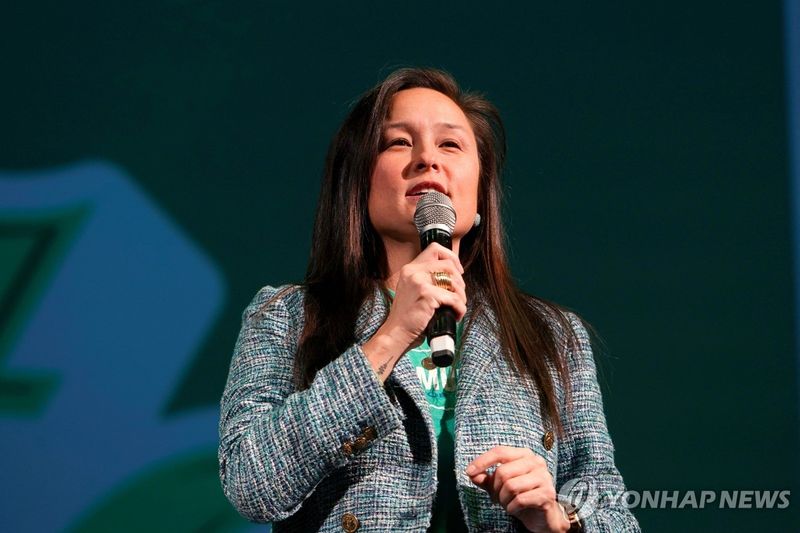
[Financial News] She had moved 10 times by the time she graduated from high school, all within the same city of Lawton, Oklahoma. Her father, a serviceman, raised his two daughters alone and held several jobs, but the family had to keep moving in search of cheaper housing. A state program that provided tuition assistance to low-income students opened the door to college.
The girl became the first college graduate in her family and went on to become a politician after working to help children in circumstances like her own. This is the story of Democrat Cindy Munson, who sought to become the first Korean American governor of the United States in Oklahoma’s gubernatorial election on the 3rd (local time). She lost to Republican Mike Mazzei, but made her presence felt in a Republican stronghold by keeping the gap to about 6 percentage points.
From a student receiving tuition aid to a politician defending public education
Munson was born to a U.S. military veteran of the Vietnam War and an immigrant mother from Korea. Her father raised Munson and her younger sister, and the family moved repeatedly to cut housing costs because money was tight.
After graduating from Eisenhower High School in Lawton, she attended the University of Central Oklahoma through Oklahoma’s Promise, a program that covers in-state college tuition for low-income students. She earned a bachelor’s degree in political science there, then went on to receive a master’s degree in educational leadership from the University of Nebraska–Lincoln.
In an interview with local outlet Oklahoma Voice last June, Munson said the tuition assistance program “gave me hope.” She had firsthand experience of how public policy can open up opportunities for an individual. This background may also help explain why she made public education and access to health care key political issues.
She ran again after losing her first election—and flipped a Republican seat
The path to elected office was not smooth. Munson ran for Oklahoma House District 85 in 2014 but lost to incumbent Republican David Dank. When a special election was held the following year after Dank’s death, she ran again.
The result was reversed. In September 2015, Munson won 53.79% of the vote, defeating Republican Chip Carter. Local public radio station KGOU described her at the time as the first Democrat elected in the district. She was also the first Asian American woman elected to the Oklahoma Legislature.
After rising to become a Democratic leader in the state House, Munson focused on children and women, working families, and public education reform. In an official statement issued this May for Asian American and Pacific Islander Heritage Month, she said that as a child, she too needed leaders who looked like her. She said she never forgets what it means to serve in the legislature representing Asian women and girls.
Cost of living and public education front and center... progressive agenda maintained in a conservative state
As she ran for governor, Munson put residents’ day-to-day finances at the forefront. Her pledges included easing the burden of homeowners’ insurance premiums and prescription drug and health insurance costs, expanding funding for public schools, and improving conditions for teachers and support staff. She also said tax revenue should go first to programs that help residents rather than to tax cuts for big businesses.
On education, she clashed with Republicans over how public funds should be spent. She favored ending tuition tax credits for families who send their children to private schools and increasing support for public schools. She also drew attention by saying she would restore diversity, equity, and inclusion (DEI) programs.
She also had to contend with criticism unrelated to policy. In an interview with Oklahoma Voice, Munson said she had been criticized for being unmarried, having no children, and her age. Even so, she said her sincerity in understanding voters’ lives and trying to solve their problems could be a strength.
Defeated by about 6 percentage points... political realities she could not overcome
Her opponent in this election was Mazzei, who had the support of U.S. President Donald Trump. A former state senator and state budget director, Mazzei spent $13 million (about 17.3 billion won) on the campaign. Munson was up against not just an individual candidate but also the deeply entrenched Republican base in Oklahoma.
Munson received about 45.9% of the vote, compared with about 51.9% for Mazzei. Munson won Oklahoma County, the state’s most populous county, and Tulsa County, among others, but trailed in other areas. Local public radio station KOSU reported that “the margin of victory for this year’s Republican candidate was about half the size of those in the 2018 and 2022 gubernatorial elections.”
She did not achieve her dream of becoming the first Korean American governor of the United States. But there is a consistency to Munson’s path that is difficult to explain through election results alone. The young person who went to college with tuition assistance became an advocate for vulnerable young people, and in the legislature made public education and residents’ living conditions key issues.
Munson said, “Even though I lost the election, I haven’t lost the power to change Oklahoma.” Having once moved repeatedly in search of cheaper housing, she now hopes to open up for others the opportunities she was given. That is why her continued efforts, undeterred by her election defeat, are drawing attention.
[email protected] Hong Chae-wan Reporter