North Korea fires new air-defense missile resembling Russia’s S-400; test-launches Hwasal-1 carrying cluster munitions and targeting Riwon Airfield
- Input
- 2026-11-05 17:26:09
- Updated
- 2026-11-05 17:26:09
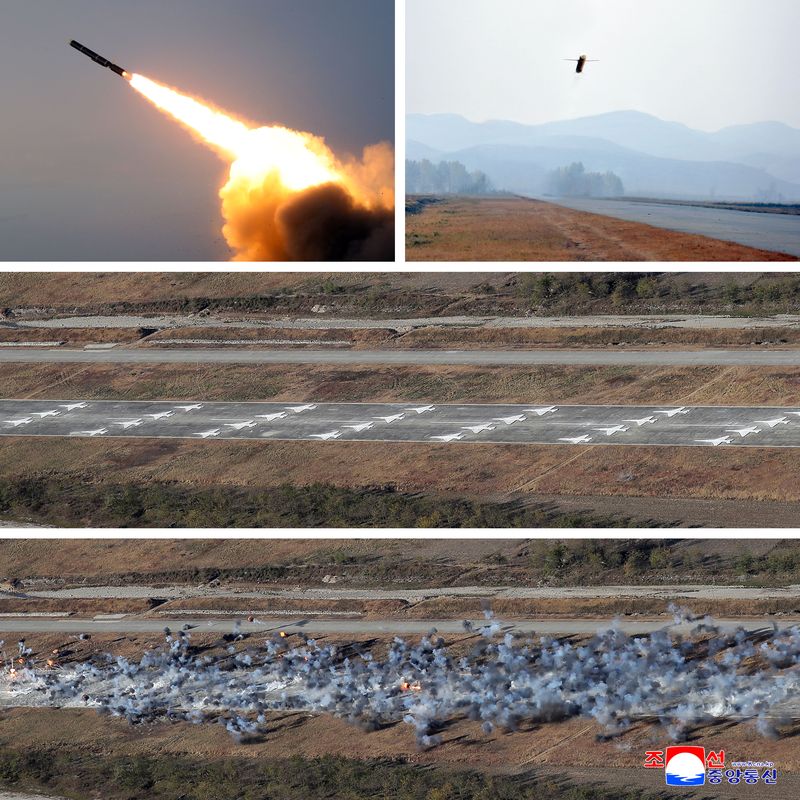
On the 5th, North Korea’s external news outlet KCNA reported that the DPRK Missile Administration had conducted a test launch on the 4th to verify the design and technical characteristics of a new antiaircraft (surface-to-air) missile system. North Korea said that the test, led by Kim Jong-sik, first vice department director of the Party Central Committee, instead of State Affairs Commission President Kim Jong Un, verified the reliability of new airframe materials, an intelligent, multi-complex guidance method, and a target identification and detection-information processing system. Earlier, the Joint Chiefs of Staff said it had detected several missiles launched toward the East Sea from the area around Sŏndŏk in South Hamgyong Province the previous morning, which flew less than 300 km, and was analyzing their detailed specifications.
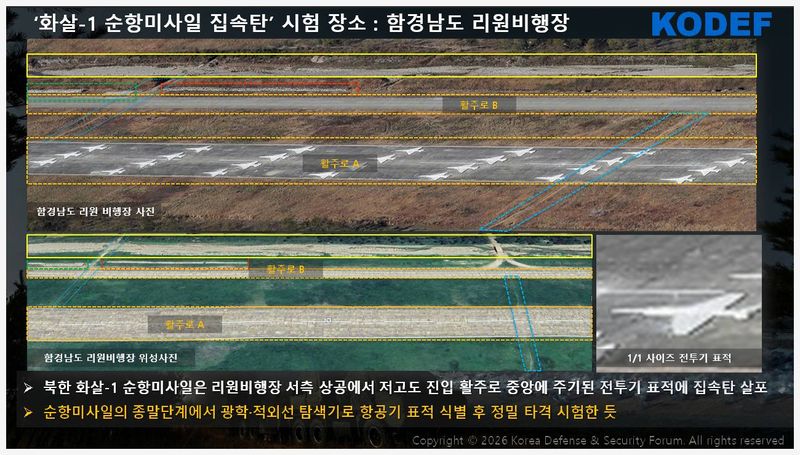
On the same day, a demonstration firing drill was also conducted by a firing subunit under the North Korean military’s Eastern District long-range strategic cruise missile unit. A detailed analysis of North Korean publicly released materials by the Korea Defense & Security Forum (KODEF), a military and security think tank, identified Riwon Airfield in South Hamgyong Province as the site of the Hwasal-1-type long-range strategic cruise missile’s live-fire strike test.
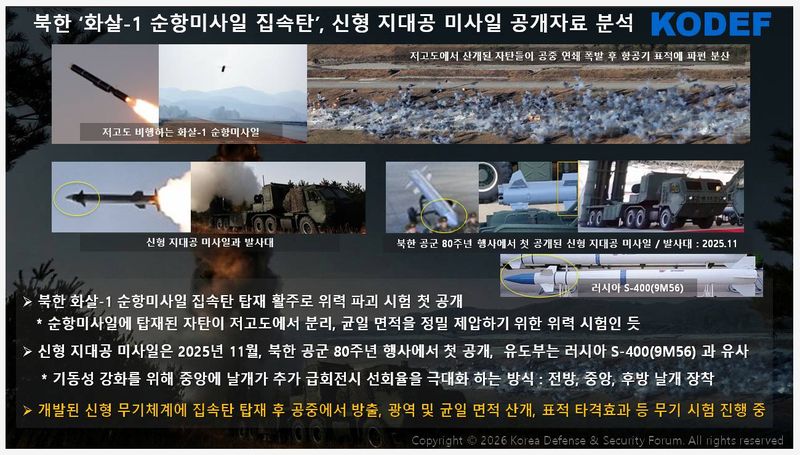
North Korea’s Hwasal-1 cruise missile is believed to have entered at low altitude from the airspace west of Riwon Airfield, identified a real, full-scale fighter-shaped target parked in the center of the runway, and carried out a “dispersed-warhead effectiveness evaluation test,” scattering the submunitions carried in its warhead in midair. The tactic involves using optical and infrared seekers during the cruise missile’s terminal phase to identify the aircraft target autonomously, then detonating submunitions over a wide area to destroy aircraft assets with fragments. This is interpreted as a blatant attempt to neutralize key airfield assets of the ROK-U.S. air forces, countering the South Korean military’s moves to greatly extend the Cheonghae Unit’s operating area as far south as the waters off Oman and strengthen advanced capabilities such as maritime patrol aircraft, in response to worsening conditions including a sharp rise in piracy near Somalia, as well as its strategy to ensure the continuity of maritime supply routes.
The technical advances in the newly unveiled surface-to-air missile were also noted. Shin Jong-woo, secretary-general of KODEF, said the missile’s guidance section is very similar in shape to Russia’s cutting-edge interception system, the S-400 (9M56). He said the missile had adopted a design that adds wings to its front, center and rear to enhance high-altitude maneuverability and maximize its turning rate during sharp turns. He explained that this suggests the tactical sophistication of North Korea’s independent air-defense network, intended to counter the precision-strike assets of the ROK-U.S. combined air forces, has reached a dangerous level.
This series of demonstrations of force is being carried out as part of North Korea’s meticulous political calculations. In a statement issued the previous day in the name of Kim Yo Jong, director of the Workers’ Party’s General Affairs Department, North Korea said, “The abandonment of the United States’ hostile policy toward North Korea is the fundamental prerequisite for resolving all problems,” and strongly pressed for a change in U.S. policy toward the North. Military experts assess that North Korea, seeking to shift the balance after the U.S. midterm elections, is highly likely to use these surface-to-air and cruise missile tests as a springboard for further high-intensity provocations, including surprise test launches of new intercontinental ballistic missiles (ICBMs) such as the Hwasong-20, which could directly strike the U.S. mainland.
[email protected] Lee Jong-yoon Reporter