[On the ground] Hong Kong’s ‘Cyberport’ draws tech and capital... ‘AI’ is the buzzword
- Input
- 2026-11-05 13:56:09
- Updated
- 2026-11-05 13:56:09
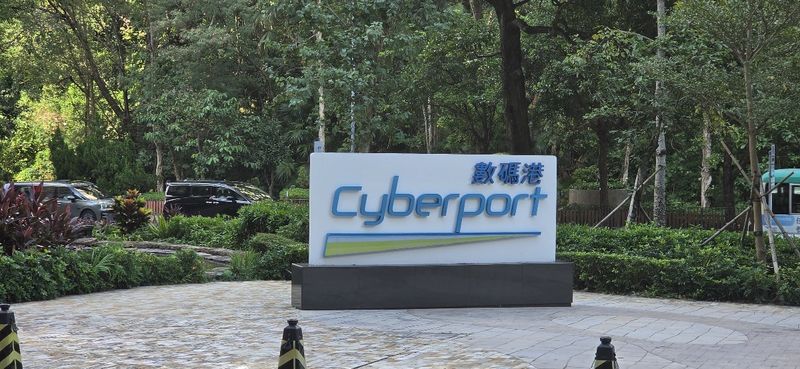
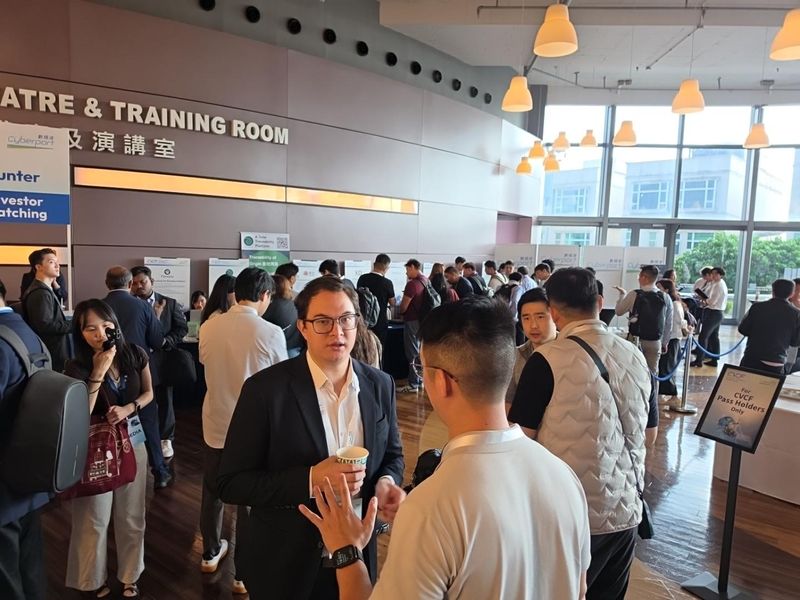
At the CVCF that day, companies touting a range of technologies—from electric heavy-duty trucks to artificial intelligence (AI) cameras that analyze customer behavior in stores—sought investors. Cyberport is where companies looking to showcase their technology and capital seeking investment opportunities are brought together.
A digital technology hub connecting companies with capital
Cyberport, known as Hong Kong’s digital technology hub, supports startups with funding and workspace and helps them turn technology into businesses. Through its network of companies, investors, technology firms and experts, it helps them find customers and partners and provides opportunities to enter overseas markets. The forum that day also featured company presentations, investor matchmaking and technology exhibits.According to Cyberport, more than 2,400 companies participate in the community. Startups have raised a cumulative total of more than HK$74.5 billion. The community includes 30 listed companies and 10 unicorns, as well as more than 500 startups in AI and data science.
Since its launch, the Cyberport Investor Network (CIN) has facilitated more than HK$6 billion in fundraising. As of last September, the Cyberport Macro Fund (CMF) had invested in 30 projects, with total investments, including co-investments, exceeding HK$2.7 billion.
Examples of how the technology is being used could also be seen at the Low-Altitude Economy Applications Exhibition Hall. Exhibits included hydrogen fuel-cell drones and inspection drones that photograph building exteriors to find defects. A drone that delivers food to the balconies of homes was presented as a research project.
At the Digital Tech Center, which we visited next, a device that transmits sound through bone conduction was introduced. It converts sound signals into vibrations and sends them through the bones to the inner ear. Rather than inserting earphones into the ears, users wear the device in contact with their bodies.
Local companies showcase AI validation and security
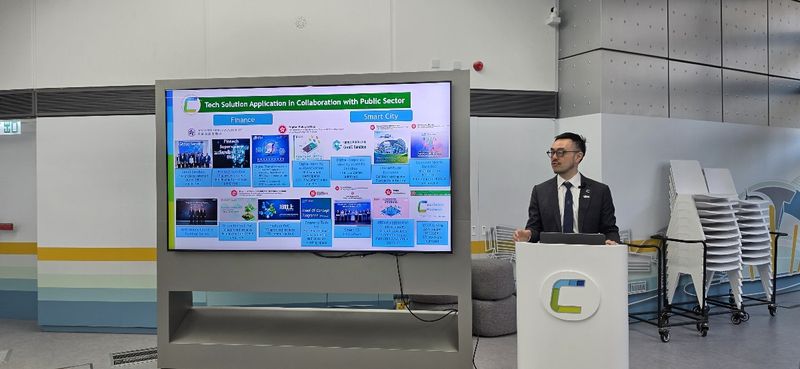
AI was also a major topic at Cyberport, which is driving Hong Kong’s digital industry. Both local companies we met that day introduced AI-related technologies. The key was technology that enables AI to perform tasks while also verifying and controlling its actions and results.AIFT, an AI security company, drew particular attention with its proposal for controlling the execution permissions of AI agents. Michelle Yip, AIFT’s group managing director and an alumna of Cyberport’s incubation program, pointed to the risks of granting AI broad permissions.
“You wouldn’t give a newly hired employee at a company a key that opens every door, because you can’t watch what they’re doing every moment,” said Yip, AIFT’s group managing director. “AI agents can act thousands of times a day in the blink of an eye, and tasks can be carried out without anyone knowing,” she stressed. She added, “Before launching an AI application, you need to make sure you can control it.”
AIFT introduced red teaming, which identifies AI vulnerabilities from an attacker’s perspective before deployment, as well as technology that monitors inputs, outputs and actions during operation. The system allows or blocks actions an agent is about to take according to policy, and requires human approval when necessary.
A string of hacking incidents at major banks in South Korea has made strengthening security across the financial sector an urgent priority. The challenge is to shore up gaps in existing security while also managing the expanded access and execution permissions that come with adopting AI.
Asimov introduced a platform for validating and testing financial companies’ models and AI systems. It automates document review, data analysis and report writing while retaining the rationale behind decisions and records of approvals. The platform was developed with the recognition that financial companies also need to secure the evidence required for supervision and audits when applying AI to their operations.
Cyberport was also laying the groundwork for testing these technologies in real-world financial settings.
“Financial services companies need computing resources to use AI,” said Victor Lam, head of AI and data science at Cyberport. “We have been working with the Hong Kong Monetary Authority to advance a generative AI sandbox.”
[email protected] Ye Byung-jung Reporter