Kansas, the Republican Party’s “sacred ground,” falls for the first time in 94 years [Then and There with Park Jong-won]
- Input
- 2026-11-07 06:00:00
- Updated
- 2026-11-07 06:00:00

[Financial News] In the midterm elections held in Kansas on the 3rd (local time), an upset occurred for the first time in 94 years. A Democratic candidate won a Senate race for the first time since 1932. Kansans, who had supported Republicans for generations, finally had enough of rising prices and cast their votes for a pastor who was at least relatively distant from left-wing ideology.
Kansas covers about 213,100 km2 and is home to about 2.97 million people. To put that in perspective, it is as if the population of Incheon Metropolitan City lived within the area of the entire Korean Peninsula. The land was originally inhabited by Native Americans, but became French territory after a claim of sovereignty in 1682. In 1803, France sold its central North American territories to the newly formed United States, along with what is now Kansas. Kansas was part of the Missouri Territory, a provisional self-governing territory, until 1821. When Missouri became a state, Kansas was separated from it and became unassigned land. It was used as a Native American settlement area until 1854.
In 1854, the U.S. federal government in the East sought to establish administrative bodies in the unsettled central lands, including Kansas, as a first step toward building a transcontinental railroad to the West. Kansas and Nebraska were each organized as territories under the Kansas-Nebraska Act, enacted on May 30 that year. The act included a provision allowing local residents to vote on whether to abolish slavery.
The act in question brought bloodshed to Kansas. In 1820, the U.S. Congress agreed under the Missouri Compromise to prohibit slavery in any new states established north of the 36°30′ parallel. This measure left the United States with 12 slave states and 12 free states. Both territories established in 1854 lay north of 36°30′. Anti-slavery forces in U.S. politics at the time organized the Republican Party to oppose the Kansas-Nebraska Act, arguing that it had destroyed the Missouri Compromise.
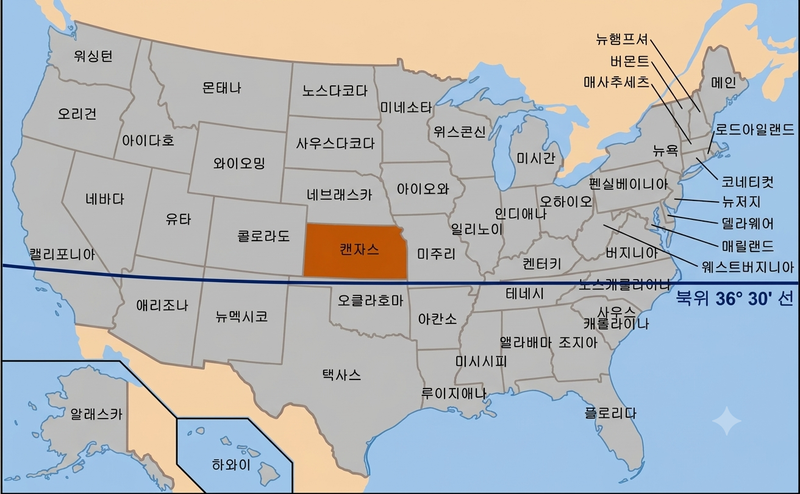
Nebraska, farther north, banned slavery in 1861 without major conflict, as many of its neighboring states opposed it. Kansas, by contrast, shared its eastern border with Missouri, a staunch supporter of slavery. As a result, large numbers of pro-slavery outsiders from Missouri and the South moved into Kansas and tried to bring it into the pro-slavery camp. From 1854 to 1859, clashes over slavery in Kansas led to assassinations, kidnappings and skirmishes, in a bloody episode known as “Bleeding Kansas.” Estimates put the death toll at around 50 to 200. The conflict is described in U.S. history as a prelude to the Civil War. Ultimately, Kansas voted to become a free state.
After driving out pro-slavery forces from elsewhere, Kansans threw their support behind the fledgling Republican Party. The party, led by Abraham Lincoln, admitted Kansas as a state in 1861. In 1862, the Republican government’s free land grants brought large numbers of Republican supporters from the North to Kansas. Local residents also came to reject outsiders who had wreaked havoc in their homeland, as well as the Democratic Party, which had supported slavery. In 1903, Kansas adopted the sunflower as its official state symbol to honor settlers who won their freedom through Bleeding Kansas and the Civil War.
Kansas’s Republican leanings held through this year. Democrats occasionally won House or gubernatorial elections, but Republicans consistently won the Senate seat. But the policies of Trump’s second administration shook local sentiment. Rising diesel and fertilizer prices due to the Iran war made farming difficult for those in agriculture, who account for about 9% of the total workforce. People working in distribution and logistics, who make up 17.5% of the workforce, also found it harder to make ends meet because of the second Trump administration’s tariff policies and inflation. In addition, since the 2000s, IT, biotechnology and battery-related companies have set up in Kansas’s suburbs, bringing in a young urban population that supports the Democrats.
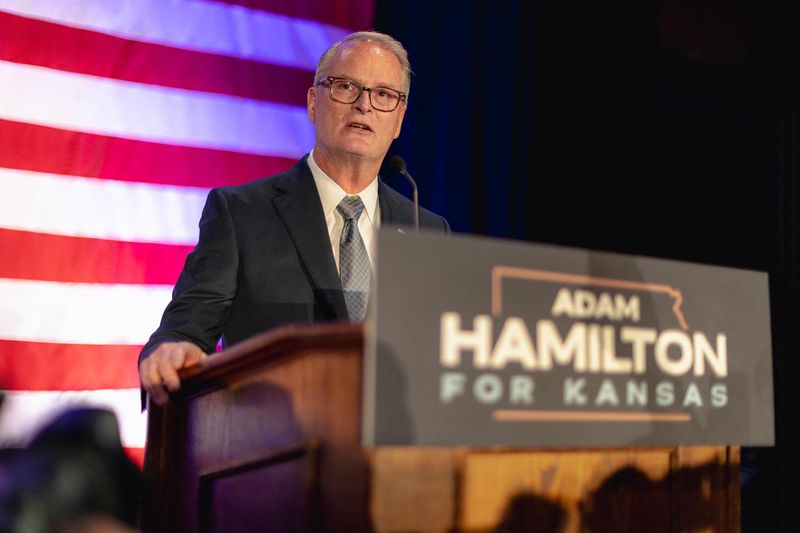
Adam Hamilton, the Democratic candidate elected to the Senate this time, is a former Methodist pastor whose views are distant from the party’s hard-left ideology. He received $5 million (about 6.7 billion won) in this election from political fundraising groups supporting Senate Democratic Leader Chuck Schumer of the State of New York, but said he would not support Schumer. Hamilton had initially planned to run as an independent, but campaigned on putting Kansas first rather than on Democratic ideology, winning over many centrist voters.
[email protected] Park Jong-won Reporter