Vocational high school employment rate reaches 55.8%; large-company employment rises for fifth straight year
- Input
- 2026-11-05 12:00:00
- Updated
- 2026-11-05 12:00:00
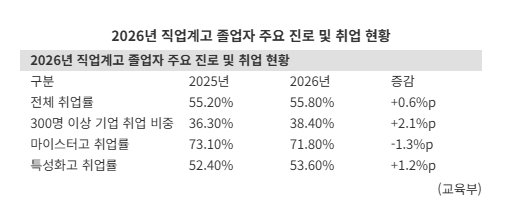
[Financial News] This year, the employment rate among vocational high school graduates was 55.8%, up 0.6 percentage points from last year. The share employed at companies with 300 or more employees also rose to 38.4%, marking a fifth consecutive annual increase, in a sign that the quality of employment continues to improve.
According to the results of the 2026 Employment Statistics Survey of Vocational High School Graduates, released on the 5th by the Ministry of Education and the Korean Educational Development Institute (KEDI), 16,209 of the 63,038 vocational high school graduates from January and February this year were employed. The employment rate is calculated after excluding those who continued their education, enlisted in the military, or were recognized as unable to participate in economic activity. The total number of graduates increased by 3,377 from the previous year, while the number of employed graduates rose by 913.
By workplace size, among the 16,007 graduates covered by workplace-based National Health Insurance or Employment Insurance, 38.4% were employed at companies with 300 or more employees, up 2.1 percentage points from the previous year and marking a fifth consecutive year of growth. The share employed at companies with fewer than 30 employees was 29.7%, down 0.2 percentage points from the previous year.
Results varied by school type. The employment rate at specialized high schools rose 1.2 percentage points from the previous year to 53.6%, while the rate at Meister high schools fell 1.3 percentage points to 71.8%. The employment rate for vocational programs at general high schools also declined 0.4 percentage points to 37.8%. The overall rate of enrollment in further education was unchanged from the previous year at 49.2%.
By gender and region, the employment rate for female graduates was 57.8%, higher than the 54.7% rate for male graduates. By school location, the rate at schools outside the capital region was 58.7%, exceeding the 51.4% rate at schools in the capital region. By province and major city, Daegu had the highest rate at 68.7%, followed by Gyeongsangbuk-do at 67.7% and Daejeon at 59.9%.
Employment retention rates, which show whether graduates remain employed, tended to decline over time. Among the 15,121 graduates of 2025 who were covered by workplace-based National Health Insurance or Employment Insurance as of April 1 last year, the reference date for the main survey, the first employment retention rate—the share whose coverage was confirmed six months later—was 82.2%. The second rate, measured after 12 months, fell to 68.9%. Compared with the previous year's graduates, the first rate decreased by 0.9 percentage points, while the second rose by 0.7 percentage points. For 2024 graduates, the first and second rates were 83.1% and 68.2%, respectively, while the third rate, measured after 18 months, fell to 62.2%.
Deputy Education Minister Choi Eun-ok said, “The rebound in employment among vocational high school graduates with technical skills—key talent for balanced regional development—is a meaningful outcome achieved amid challenging conditions for youth employment.” She added, “Above all, it is encouraging that the quality of employment continues to improve, with the rate of employment at companies with 300 or more employees rising for five consecutive years.”
The Ministry of Education plans to expand Meister high schools and contract-based specialized high schools and work with relevant ministries and provincial and metropolitan offices of education to support the development of vocational high school graduates with technical skills.
[email protected] Kim Man-gi Reporter