Defense Ministry submits motion to double Cheonghae Unit’s operational area; major boost to advanced capabilities
- Input
- 2026-11-05 11:27:44
- Updated
- 2026-11-05 11:27:44
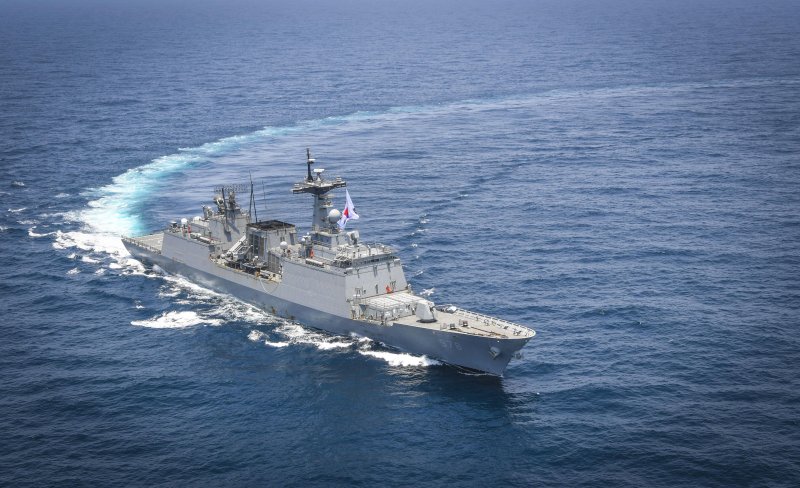
According to Defense Ministry and National Assembly officials on the 5th, the ministry has drafted a revision to the motion to extend the Cheonghae Unit’s deployment and plans to complete the necessary administrative and political procedures next week, with a view to tabling and passing it at a plenary session as early as the 16th of this month. Given that the unit’s current deployment authorization expires at the end of this year, the government’s strategy is to secure National Assembly approval after deliberation by the State Council of South Korea and the president’s approval. If the revision passes, the Cheonghae Unit’s deployment will be extended through the end of next year (December 31, 2027).
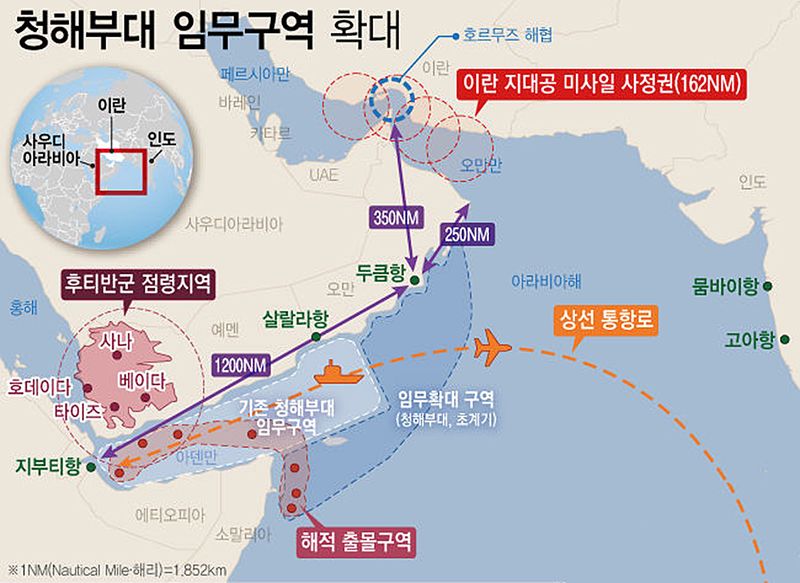
The key feature of the revised motion is its pragmatic approach: avoiding the political burden of deploying a separate new unit while roughly doubling the Cheonghae Unit’s existing area of operations to include waters south of Oman, near the southern entrance to the Strait of Hormuz. As a result, the operational radius, previously confined to the Gulf of Aden area (about 600 nautical miles, or 1,111 km), will be substantially expanded to waters south of Oman (about 1,200 nautical miles, or 2,222 km).
The decision comes amid a deteriorating security situation, including a recent surge in pirate activity near Somalia from 11 incidents in 2025 to 36. In addition, with global multinational forces concentrated in the Red Sea and the Strait of Hormuz, the plan is to fill the operational gap in waters south of Oman, ensure the uninterrupted continuity of maritime supply routes, and protect Korean-flagged vessels. Accordingly, the unit’s mission statement in the motion now explicitly includes “safeguarding freedom of navigation on international sea lanes,” in addition to its existing mission to “protect Korean citizens and vessels.”
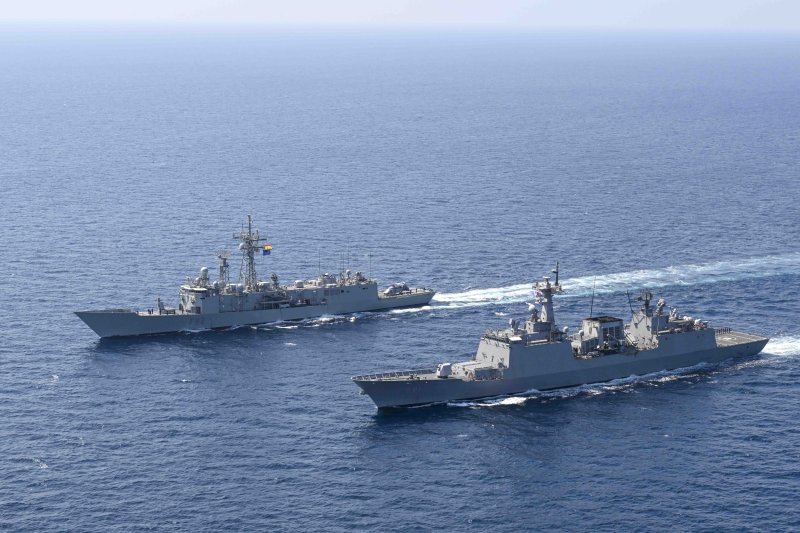
The forces and personnel allocated to strengthen military capabilities will also be substantially increased. The deployment will grow by 75 personnel, to a maximum of 395. In addition to the 4,400-ton Korean destroyer (DDH-II) currently in service, one maritime patrol aircraft, an explosive ordnance disposal (EOD) team, and advanced unmanned mine-countermeasure equipment, including unmanned surface and underwater vehicles, will be deployed for the first time. The maritime patrol aircraft is expected to use a base in Djibouti, Africa, to detect hostile forces’ movements around the outer edge of the operational area in advance; reaching the area is expected to take about three days. The EOD team will share intelligence with multinational forces and hone its tactics in preparation for underwater mine threats and other dangers.
The Defense Ministry made clear, however, that the expansion of the operational area and reinforcement of capabilities are not intended to involve South Korea in any particular conflict in the Middle East. A ministry official said, “This decision was made to protect our citizens and vessels and safeguard our economic interests, not to become involved in or intervene in a war with Iran,” adding, “The operational area is confined to waters south of Oman, limiting direct surveillance of Iranian territory or the Strait of Hormuz.” The ministry’s position is that sending the maritime patrol aircraft and EOD team is also not a “backdoor deployment” linked to the situation in the Strait of Hormuz.
At the same time, military authorities said, “We do not rule out preparing in advance for the possibility of deploying to the Strait of Hormuz and elsewhere, following an additional approval process at a plenary session of the National Assembly, if a ‘permissive environment’—such as an end to hostilities or an agreement between the parties—emerges and the international community makes a request.” The remarks suggested a multipurpose move to prepare for a possible intensification of calls for South Korea to contribute to the South Korea–U.S. military partnership.
The prevailing view among military experts is that passage of the motion is directly tied to the combined defense capabilities and cohesion of the South Korea–U.S. alliance, a central pillar of South Korea’s foreign and security policy. Given that the essence of an alliance lies in practical military cooperation and mutual trust, experts warn that if South Korea turns away from contributing to the stability of a key sea lane through which at least 70% of the country’s crude oil imports pass, its bargaining power could weaken in areas such as the credibility of U.S. security commitments in the event of a contingency on the Korean Peninsula and negotiations over defense cost-sharing.
Analyses by global security think tanks, including those in Europe, suggest that for major manufacturing nations such as South Korea, which depend heavily on foreign trade and oil shipping routes, a pragmatic alternative is to retain independent command within the framework of a multinational partnership and flexibly expand military contributions, rather than becoming directly subordinate to a coalition operation led by a particular major power.
Defense and security experts broadly agree that adjusting the operational area of existing deployed assets and reinforcing advanced capabilities—while avoiding the political friction of a new deployment in order to protect key sea lanes linking the Strait of Hormuz and the Gulf of Aden—is a “low-cost, high-efficiency military-diplomatic alternative” that minimizes diplomatic risks while serving national interests and energy security.
Whether the National Assembly passes the motion to extend and reorganize the Cheonghae Unit’s deployment is expected not only to demonstrate the Republic of Korea Navy’s long-range operational capabilities but also to help strengthen the South Korea–U.S. alliance’s tactical cohesion. Concerns have also been raised that failure to pass the motion by the deadline would inevitably bring renewed scrutiny of South Korea’s maritime security responsibilities in the international community and accelerate cracks in traditional military partnerships. With December 31, when the National Assembly’s operations for the year end, approaching, security watchers at home and abroad are closely following the Defense Ministry’s moves and the Assembly’s final decision.
[email protected] Lee Jong-yoon Reporter