Cheonghae Unit’s ‘Hormuz intervention’ enters parliamentary approval process; major deployment of military assets, including maritime patrol aircraft
- Input
- 2026-11-05 10:06:18
- Updated
- 2026-11-05 10:06:18
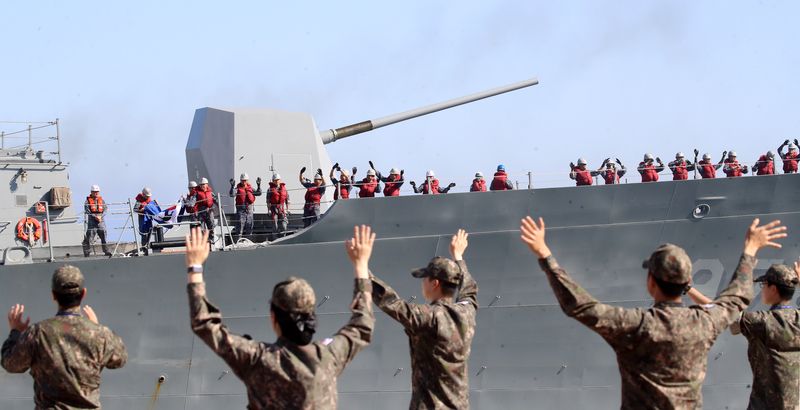
According to the Ministry of National Defense on the 5th, a revised motion to extend the deployment, covering an expansion of the Cheonghae Unit’s mission area and the dispatch of additional assets, is expected to be submitted to the National Assembly. The motion passed a vice-ministerial meeting that day and is expected to be submitted to the Assembly for approval after next week’s State Council meeting and presidential sign-off. The existing authorization to extend the deployment, which remains in effect until the end of this year, specifies the Cheonghae Unit’s deployment area as “the Gulf of Aden and surrounding waters, as well as waters designated for operations to protect Korean nationals in an emergency.” The area will be expanded to the open waters south of Oman. If the National Assembly approves the measure, the patrol aircraft could be deployed within days at the earliest.
The Ministry of National Defense has decided to expand the Cheonghae Unit’s mission area from the Gulf of Aden off Somalia, where it protects merchant ships, southward toward Oman, closer to the Strait of Hormuz, and to send additional assets, including a maritime patrol aircraft, an Explosive Ordnance Disposal (EOD) team and unmanned minesweeping equipment. The dispatch of the EOD team and unmanned minesweeping equipment is also intended to prepare for the possibility of joining international mine-clearance operations in the Strait of Hormuz, which could begin after the U.S.-Iran war ends.
The Blue House has been weighing whether to deploy the Cheonghae Unit to the Strait of Hormuz. On the 30th of last month, National Security Office chief Wi Sung-lac said the government was considering ways to strengthen and expand the unit’s activities in the Strait of Hormuz. However, it had proceeded cautiously amid threats from Iran that it would attack any form of intervention in the strait.
The Cheonghae Unit is a South Korean military unit deployed overseas. It has been stationed in the Gulf of Aden since 2009, conducting counterpiracy operations and supporting the safe escort and passage of ships.
The Cheonghae Unit’s mission area is expected to double from its existing roughly 1,100 km, according to reports. It will extend as far as the southern end of Oman’s Port of Duqm, which is 350 nautical miles (about 650 km) in a straight line from the Strait of Hormuz. However, the Gulf of Oman, which directly adjoins the Strait of Hormuz, will not be included in the expanded mission area.
The Cheonghae Unit’s existing assets consist of one 4,400-ton destroyer (DDH-II) carrying one naval operations helicopter and up to three high-speed boats, along with up to 320 personnel. The destroyer Chungmugong Yi Sun-sin (DDH-975), part of the unit’s 49th rotation, departed on the 2nd of last month to relieve the current deployment.
The plan is to additionally deploy one of the Navy’s newest P-8A Poseidon maritime patrol aircraft, unmanned minesweeping assets including unmanned underwater vehicles (UUVs), unmanned surface vehicles (USVs) and remotely operated vehicles (ROVs), and an EOD team to operate them.
The deployed personnel will also increase by 75, including command staff, 30 EOD personnel and 45 patrol-aircraft operators, including pilots, bringing the total to around 395.
The newly deployed P-8A patrol aircraft and unmanned minesweeping assets are planned to be based in Djibouti, in East Africa. Djibouti is home to the U.S. Air Force’s Camp Lemonnier, among other facilities, and the United States, Japan, Spain and France have deployed patrol aircraft there.
The government cites clashes in the Red Sea area between Saudi Arabia and the Iran-backed Houthi rebels in Yemen as a key reason for expanding the Cheonghae Unit’s mission and assets.
The deployment period specified in the extension proposal runs from its passage by the National Assembly through December 31 of next year. The government believes, however, that the additional assets could be withdrawn before the deadline if the situation on the ground stabilizes.
Meanwhile, after the government signaled it would send military assets to the Strait of Hormuz, the People Power Party has criticized the Blue House for pursuing “Hong Gildong-style fence-sitting diplomacy.”
The criticism is that, while unable even to give a clear answer to the U.S. demand to deploy warships, it is quietly toying with expanding the Cheonghae Unit’s operations.
The People Power Party said, “They say they will never get involved in a war, yet are considering sending our troops near a conflict zone,” and called it “nothing short of a modern-day Hong Gildong who cannot call a troop deployment a troop deployment,” accusing the government of playing both sides diplomatically.
The People Power Party said, “If the ROK-U.S. Alliance is important, negotiate confidently; if protecting our ships is urgent, plainly explain the need for and risks of the operation to the public.” It urged the Lee Jae Myung government to stop hiding behind the bizarre sophistry of “a non-deployment that is like a troop deployment.” [email protected] Kim Kyung-soo, reporter
[email protected] Kim Kyung-soo Reporter