“Share appraisal rights granted in spin-offs are excessive regulation, hindering business restructuring”
- Input
- 2026-11-05 10:13:27
- Updated
- 2026-11-05 10:13:27
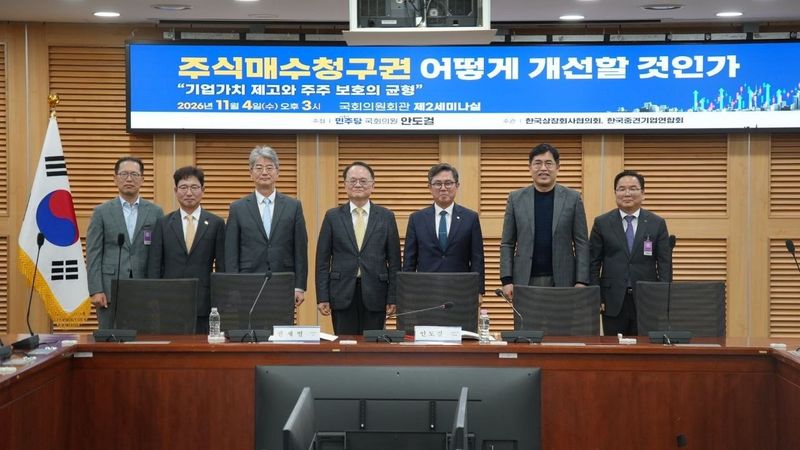
[Financial News] Critics said that the share appraisal rights granted to shareholders during corporate spin-offs amount to excessive regulation. The argument is that the system should retain its aim of protecting minority shareholders while being reformed to focus on dual listings, rather than spin-offs themselves.
According to industry sources on the 5th, the National Assembly Forum on Share Appraisal Rights, hosted by Ahn Do-geol, a lawmaker from the Democratic Party of Korea, and co-organized by the Korea Listed Companies Association and the Korea Federation of Mid-sized Enterprises, was held at the National Assembly the previous day.
In a presentation at the forum, Shin Hyun-han, a professor at Yonsei University and former president of the Korean Securities Association, said the current system was introduced after the LG Chem spin-off controversy and has effectively become a framework that blocks all spin-offs. He said that regulation introduced to address the issue of dual listings is now also preventing companies from restructuring their businesses.
Shin said the system was like “burning down the house to kill a bedbug” and stressed that the practice of granting share appraisal rights across the board at the time of a spin-off should be reconsidered. He cited as problems cases in which even shareholders who support a spin-off express opposition in order to exercise their appraisal rights, and the lack of exceptions for small-scale spin-offs.
As an alternative, Shin proposed granting appraisal rights to parent-company shareholders when a subsidiary seeks to go public. If it is difficult to overhaul the system immediately, he said, a phased reform is needed, starting by exempting small-scale spin-offs from the appraisal-rights requirement.
There were also repeated calls from industry for changes to what they viewed as excessive regulation. Kwon Jae-yeol, a professor at Kyung Hee University, voiced concern, saying, “There are problems with regulating share appraisal rights through an enforcement decree despite the absence of a delegation provision under the current Capital Markets Act, and with the current rights serving as a means of withdrawing money ahead of creditors.”
Ahn Tae-jun, a professor at Hanyang University, said, “Regulations should address the underlying cause, but the problem is dual listings, not spin-offs,” adding, “We cannot say that a spin-off will necessarily lead to a dual listing, yet the current system gets both the cause and the remedy wrong.”
He also stressed, “Although a simple corporate division has a limited impact on existing shareholders, appraisal rights are being allowed excessively,” adding, “The current share appraisal-rights system, which suppresses spin-offs alone in a way that runs counter to the original purpose of regulation, needs to be abolished or reconsidered.”
There were also calls to ease regulations to enable companies to restructure their businesses quickly. Park Yang-kyun, policy chief at the Korea Federation of Mid-sized Enterprises, stressed that business restructuring had become crucial to corporate survival amid competition for hegemony between the United States and China and China’s technological catch-up. “Blocking spin-offs themselves is excessive ex ante regulation,” Park said, calling for conditions that would allow companies to restructure their businesses swiftly.
However, there were also calls to strengthen corporate communication with shareholders alongside institutional reform. Shin stressed, “We need to change the reality in which shareholder meetings remain mere formalities, and ensure that companies communicate meaningfully with their shareholders.”
[email protected] Park Ji-yeon Reporter