“If you have 200 million or 300 million won in cash, go for a Seoul apartment”—The neighborhood an expert picked as “undervalued”
- Input
- 2026-11-05 10:01:52
- Updated
- 2026-11-05 10:01:52

[Financial News] Amid rising home prices in Seoul, an expert has advised buyers to look for relatively undervalued apartments and pursue homeownership. Rather than buying beyond their means based solely on hopes for reconstruction, they should assess location, price and potential additional contributions to find apartments that offer good value.
In a video titled “An Opportunity Is Coming, So Seize It No Matter What,” posted on his YouTube channel “Pyoyoungho TV” on the 4th, Good Mic CEO Pyo Young-ho said he had recently received many inquiries asking, “Can I buy an apartment in Seoul with 200 million, 300 million or 400 million won in cash?” He outlined strategies for buying a home in Seoul and the Seoul metropolitan area. In particular, he advised that in 2027, buyers should avoid chasing prices after they have risen and instead look for undervalued unit types or nearby complexes.
For reconstruction projects, assess land share and additional contributions first
Pyo stressed, “If you don’t own a home, rather than watching the market and waiting indefinitely, you should make a plan to buy a home when you’re ready within the limits of your available assets and home prices see a slight correction sometime between next year and the following year.”
He continued, “If you buy into a reconstruction apartment, will it automatically make money? It won’t,” stressing that reconstruction apartments are not necessarily valuable investments. Additional contributions may arise during the project, and funds may be tied up if the project is delayed for a long time.
The first criterion he presented was the land share. Pyo explained, “A good land share averages around 15 pyeong. Don’t fixate on expensive large units; stay within your budget and target mid-sized complexes where the average land share per household is around 15 pyeong. That’s a much wiser choice.” He said the burden of additional contributions could grow if the average land share falls to 12 or 13 pyeong or less.
The second criterion is the proportion of elderly residents. If many residents oppose a reconstruction project, it could proceed more slowly. The third is the price premium on older apartments: he cautioned that if their prices are excessively high compared with nearby new apartments, expectations for reconstruction may already be reflected in the price.
Finally, Pyo stressed that buyers must make sure they can afford the additional contributions. “If you just buy first and jump in blindly, thinking that once you become a member of the association everything will work out somehow, you could be badly hurt by a massive contribution bill,” he said, adding, “It would be hard to afford an additional payment of around 700 million to 800 million won just to increase the unit size by a mere 5 pyeong.”
“Use loans wisely, and you can buy a Seoul apartment with cash in the 200-million-won range”
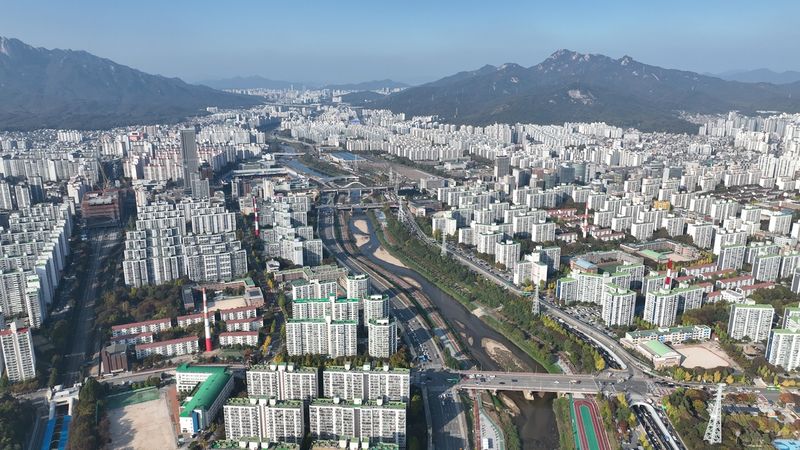
Pyo said it was possible to buy an apartment in Seoul with 200 million to 300 million won in cash by using loans, citing Suraksan Parkville in Sanggye-dong, Nowon District, Seoul, as an example. He said a unit with 31 pyeong of exclusive floor area there was priced in the 800-million-won range, while a 43-pyeong unit had recently sold for 570 million won, and recommended looking for complexes with a relatively lower price burden.
He also cited Geukdong Neulpureun Apartment in Sanggye-dong and Poonglim I’WANT in Jeongneung, Seongbuk District, arguing that relatively undervalued apartments could still be found in Seoul. “Because demand for small and mid-sized units is high, there are many areas where large units are significantly undervalued by comparison,” Pyo said. “It’s just that we’re all focused on expensive or newly built apartments; there are still quite a lot of apartments that offer good value.”
However, he cautioned against taking out as much debt as possible. Referring to the debt service ratio (DSR), Pyo added, “When people take out mortgage loans, the DSR banks currently apply is usually 40% of annual income. But that is only a theoretical maximum. In terms of how households actually feel the economy, it’s enough to leave you gasping for breath, so I recommend keeping your DSR at or below 30%.”
“Don’t chase homes that have risen; look for ones that have risen less”
Pyo advised avoiding chase buying as part of a home-buying strategy for 2027. Rather than anxiously following apartments whose prices have recently surged, buyers should look for complexes in the same area that have not risen as much.
Pyo stressed, “You shouldn’t see an apartment rise by at least 5% in just a month or two, get anxious and think you won’t be able to buy if you don’t act now, then impulsively buy it.” He added, “It’s better to use what’s called a ‘sideways-upgrade’ strategy: look for a nearby complex that has risen less, or an undervalued unit type next to a complex you have your eye on.”
He also stressed the need to manage loans carefully in preparation for interest-rate fluctuations and to view real estate from a long-term perspective centered on owner-occupancy. He added that reconstruction and redevelopment should not be pursued based on expectations alone. Projects in their early stages could take 10 to 20 years before residents can actually move in, leaving funds tied up for a long time.
His conclusion was that buyers should decide on a location first and then choose an apartment there that is competitively priced. Pyo reiterated, “Deciding first where you want to live and buying the best-value apartment in that area is the shortcut to housing stability.”
[email protected] Kim Hee-sun Reporter