A Hydrogen City Takes Shape at Hyundai Motor Group’s Pavilion... WHE 2026 to Showcase Saemangeum, Urban, Port and Manufacturing Scenarios
- Input
- 2026-11-05 09:34:43
- Updated
- 2026-11-05 09:34:43
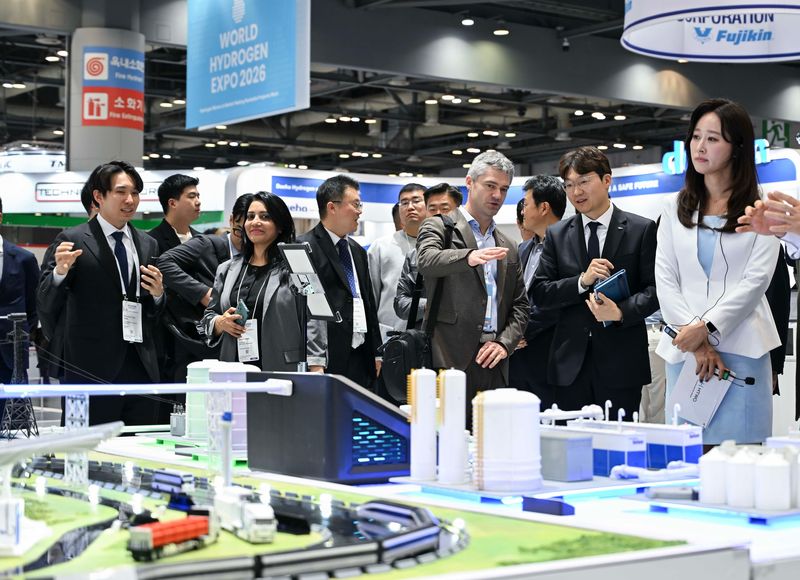
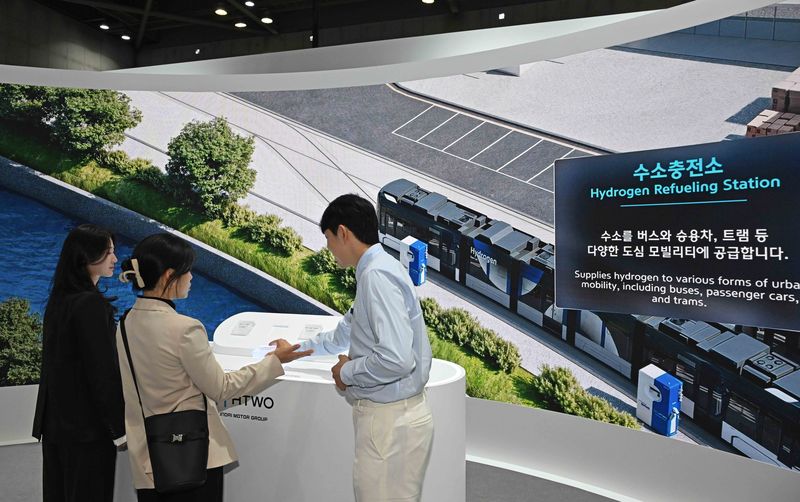
■ Hydrogen City Diorama and Four Scenarios
The hydrogen city diorama shows how the entire value chain—from hydrogen production infrastructure and storage and supply facilities to hydrogen fuel cell vehicles and railcars—is connected within a single city. Renewable energy, an AI data center, a robot manufacturing plant and a water electrolysis plant bring to life Hyundai Motor Group’s vision of a future city powered by hydrogen.The video exhibit features four scenarios: Saemangeum AI Valley, urban living, port logistics and manufacturing. Saemangeum AI Valley is an ecosystem based on local production and local consumption, in which energy generated in the region is used there. Renewable energy is used to produce hydrogen, which then powers the city, provides heat and fuels mobility.
The urban living scenario presents a circular resource system that uses hydrogen produced from organic waste, such as food scraps, to provide electricity and heat to residential complexes and to power buses, passenger cars and trams. In the port logistics scenario, renewable hydrogen is supplied to port equipment such as automated guided vehicles (AGVs) and integrated with hydrogen fuel cell trucks and locomotives, connecting movement within the port with road and rail transport. The manufacturing scenario shows hydrogen used as a reducing agent for iron ore and as a heat source, steel sheets transported by hydrogen fuel cell trucks, and hydrogen-powered forklifts and burners used for energy at finished-vehicle plants.
■ Hyundai Motor Group: “Competition Is Shifting Toward Ecosystems”
Hyundai Motor Group said hydrogen cannot fully realize its industrial value through the efforts of individual companies or a single technology alone. The entire value chain—from production to storage and transportation, supply infrastructure, and mobility and industrial demand—needs to be interconnected, the group said. It also sees global competition shifting from individual products and technologies toward ecosystems.Hyundai Motor Group cited China, Japan and the European Union (EU) as examples of hydrogen policies in major economies. China’s 15th Five-Year Plan for Economic and Social Development of the People’s Republic of China, finalized last March, sets out a goal of developing hydrogen as a new growth engine and links the full life-cycle value chain for clean, low-carbon hydrogen, from production through storage, transportation and use.
Japan is pursuing large-scale clean hydrogen supply chains, creating demand in industry and power generation, and developing hydrogen hubs following its 2023 revision of the Basic Hydrogen Strategy and the 2024 enactment of the Hydrogen Society Promotion Act. The EU is using the European Hydrogen Bank, introduced in 2023, to cover the gap between clean hydrogen production costs and market prices, reducing the burden of initial costs. Hyundai Motor Group said the program is expected to spur the introduction of about 3 GW of electrolysis capacity and production of about 3.44 million tonnes of hydrogen over the next 10 years.
■ 2,932 South Korean Hydrogen Companies, 85% Small or Mid-Sized
The group also presented data on the state of South Korea’s hydrogen industry. According to the Korea Hydrogen Alliance’s 2025 Survey of the Hydrogen Industry, as of 2024 there were 2,932 companies in the country’s hydrogen industry, employing 36,264 people. By sector, there were 412 hydrogen production companies (6,809 employees), 833 hydrogen distribution companies (4,491 employees), 1,261 hydrogen utilization companies (21,827 employees) and 426 hydrogen-related service companies (3,137 employees).Small and medium-sized enterprises and mid-sized companies account for 85% of South Korea’s hydrogen businesses. As many as 82.7% of companies had no dedicated research and development (R&D) department. Investment in the hydrogen industry rose only 4.6%, from 4.1469 trillion won in 2022 to 4.3373 trillion won in 2024.
Hyundai Motor Group said a stronger ecosystem would speed up companies’ commercialization of technology and recovery of investment, while also helping related industries expand investment and employment and enter overseas markets. The group added that experts say institutional support is needed, including measures to expand demand, build out supply infrastructure and support early-stage commercialization.
A hydrogen industry official said, “As the axis of competition in the hydrogen industry shifts from individual technologies and products to ecosystems, the competitiveness of ecosystems will determine who leads the global hydrogen industry.” The official added, “South Korea, too, needs policy support to expand demand and infrastructure, as well as efforts by large, medium-sized and small companies to build up the industry together.”
[email protected] Kim Dong-chan Reporter