“10-year survival similar with stents and surgery” ... Korea-led study across five countries published in The Lancet [Health Check]
- Input
- 2026-11-05 10:23:18
- Updated
- 2026-11-05 10:23:18
[Financial News] Patients diagnosed with left main coronary artery disease are often faced with the choice of “a stent or surgery.” A large-scale, long-term follow-up found no difference in 10-year survival outcomes between the two treatments. However, myocardial infarctions and repeat procedures were more common with stenting, while strokes were more common with surgery, confirming the importance of choosing a treatment suited to each patient’s condition.
On the 5th, a team of professors from the cardiology department at Asan Medical Center—Park Duk-Woo, Park Seung-Jung, Kang Do-yoon and Wi Seong-bong—said that a long-term follow-up of 5,379 patients treated for left main coronary artery disease at 46 medical institutions in five Asian countries found similar 10-year mortality rates: 24.0% in the stent group and 22.9% in the coronary artery bypass surgery group. The findings differ from some Western studies that reported an advantage for bypass surgery in long-term survival.
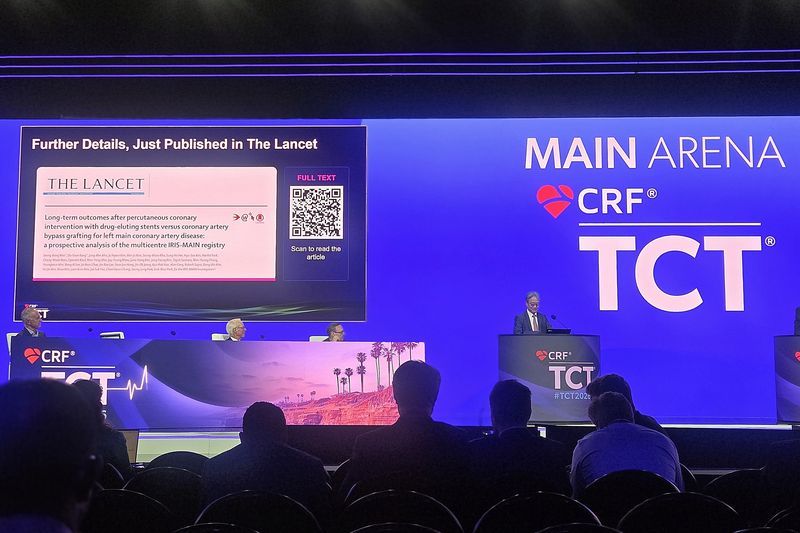
The results were presented on the 3rd (local time) in the “Late-Breaking Clinical Trials” session at TCT (Transcatheter Cardiovascular Therapeutics) 2026, an international conference on cardiovascular interventions held in San Diego, United States. They were also published at the same time in the prestigious medical journal The Lancet. Founded in 1823, The Lancet ranks first worldwide among journals in general medicine, with an impact factor (IF) of 109.0.
The research team analyzed data from 3,836 patients who underwent drug-eluting stent procedures and 1,543 who underwent coronary artery bypass surgery at 46 institutions in South Korea, India, Japan, Indonesia and Malaysia between January 2003 and December 2024.
Mortality rates were also similar between the two treatments across the different follow-up periods. Within one year of treatment, the mortality rate was 3.2% in the stent group and 3.4% in the bypass surgery group; between one and five years, the rates were 9.2% and 8.4%, respectively, and between five and 10 years, 14.3% and 12.5%. There was also no statistically significant difference in cumulative 10-year mortality between the two groups.
Complication rates differed by treatment. Procedure-related myocardial infarction occurring shortly after treatment affected 1.8% of the stent group and 0.4% of the bypass surgery group, while later spontaneous myocardial infarction affected 4.6% and 1.9%, respectively. The rate of undergoing another procedure or surgery on the same vessel was also higher in the stent group, at 11.8%, than in the bypass group (4.6%). By contrast, the stroke rate in the stent group was 3.0%, about half that in the bypass group (6.2%).
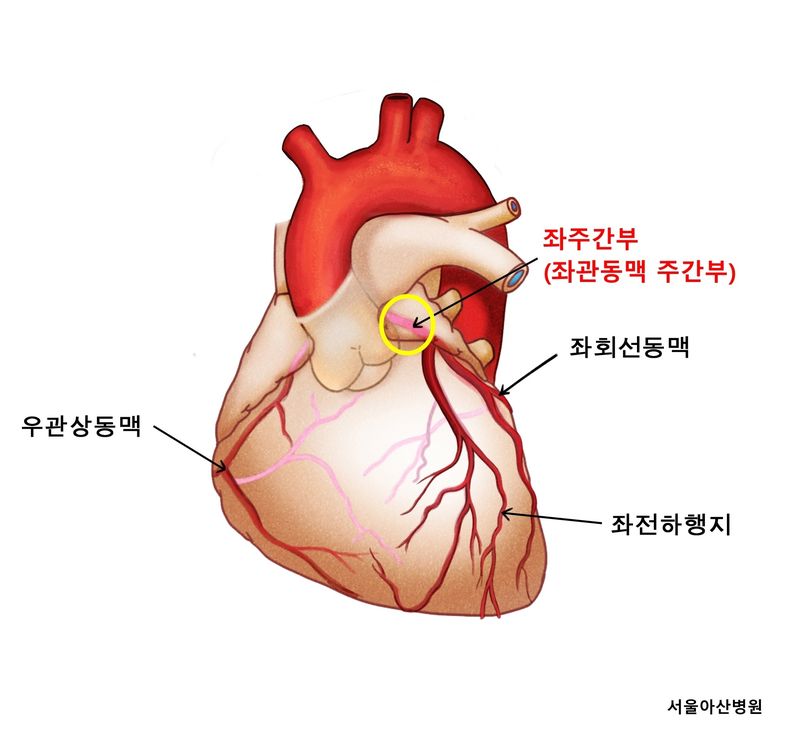
The left main coronary artery is where the left coronary artery begins. It is the most important part of the coronary arteries, which divide into two major vessels and supply blood to a large area of the heart muscle. If it becomes narrowed or blocked, it can lead to serious complications such as myocardial infarction or a heart attack, making the choice of treatment important.
The main treatments are coronary artery bypass surgery and stent procedures. Coronary artery bypass surgery, which has been the standard treatment for more than 30 years, is open-chest surgery that uses blood vessels taken from areas such as the patient’s chest or leg to create a new route for blood to flow around a blocked coronary artery. It is generally performed when blood vessels are complexly narrowed or disease affects multiple coronary arteries.
In a stent procedure, a thin tube is inserted through a blood vessel in the thigh, and a mesh-like metal stent is placed in the narrowed coronary artery to widen it. Because the chest is not opened, the procedure involves less of the burden associated with general anesthesia or an incision, and recovery is faster. Asan Medical Center professor Park Seung-Jung has led the field since successfully performing the world’s first left main coronary artery stent procedure in 1998.
As stenting technology has advanced, the procedure has become widely used for left main coronary artery disease as well. However, studies comparing long-term treatment outcomes have mainly involved Western patients. This has prompted calls to examine long-term outcomes in Asian patients, whose characteristics and treatment settings differ.
Professor Park Seung-Jung said, “South Korea has been a global leader in left main coronary artery stenting for the past 30 years. This study is an important achievement that once again demonstrates, drawing on the clinical experience and research capabilities we have built up, that South Korea is leading advances in the treatment of left main coronary artery disease.”
Professor Park Duk-Woo said, “There has been ongoing debate around the world about which treatment is more effective over the long term for left main coronary artery disease, but this large-scale international collaborative study confirmed that there is no difference in 10-year mortality between the two treatments. We will continue to build evidence to provide better treatment for patients and contribute to improving the standard of care for left main coronary artery disease.”
[email protected] Jung Myung-jin, Medical Correspondent Reporter