“Choice 4 Has Been the Answer to CSAT English Question 25 for Five Consecutive Years”
- Input
- 2026-11-05 08:57:48
- Updated
- 2026-11-05 08:57:48
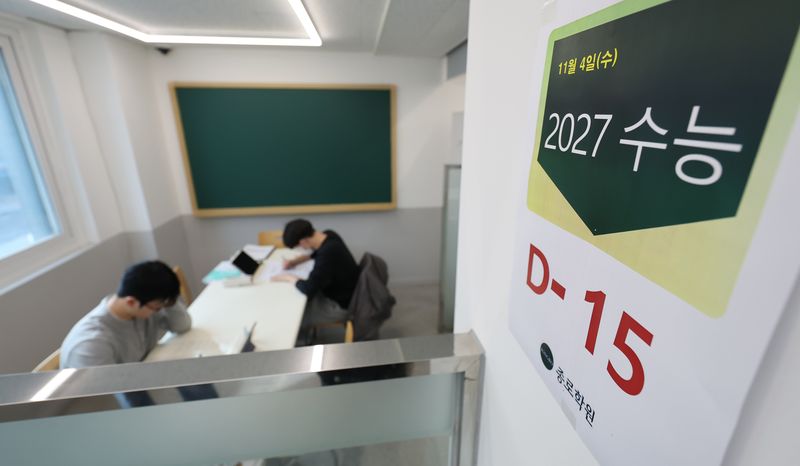
[Financial News] Over the past five years, the correct answer to Question 25, a chart question in the CSAT English section, was choice 4 for five consecutive years. Also, in math constructed-response Questions 16–19, there was not a single instance of a three-digit answer of 100 or more.
On the 5th, 14 days before the 2027 CSAT, the Etoos Educational Evaluation Research Institute said its analysis of the answer distributions for the past five years had revealed some unusual patterns.
Over the past five years, the 20 instances of constructed-response Questions 16 through 19 in the common section of the math test all had answers of two digits or fewer. By contrast, among the high-difficulty constructed-response questions after Question 20 and Questions 29 and 30 in the elective subjects, the share with three-digit answers of 100 or more was at least 40%.
In the English section, too, the answer to the chart question, Question 25, was choice 4 for five consecutive years. Meanwhile, Questions 36 and 37, which ask about the order of a passage, never had choice 1 as the correct answer over the past five years.
Kim Byung-jin, head of the Etoos Educational Evaluation Research Institute, advised, “Past answer data are for reference only, and there is no guarantee the same pattern will recur on the next CSAT. Rather than relying on statistics, test takers should find the answer based on the conditions and evidence in the question.”
When the answer is not readily apparent during the actual exam, it is useful to make use of subject-specific conditions and answer choices.
In the Korean language section, questions with categorical words in the answer choices—such as “always,” “must” or “all”—should be carefully checked against the conditions in the passage. If you get stuck interpreting a literary work, referring to the material provided with the question can make it easier to identify the criteria for appreciating it.
In the math section, if you get stuck on a multiple-choice calculation, you can try plugging the numbers in the answer choices back into the problem’s conditions. For constructed-response questions, it is helpful to first narrow down the range by determining whether the value you are looking for is a natural number or a multiple of a particular number.
In the English section, when a sentence is difficult to interpret, use connectors such as “but” and “however” to signal contrast, or “for example” to introduce an example, along with reference words to understand the context.
Director Kim said, “If you eliminate two answers you know are wrong from the five choices, your chance of getting the right answer rises sharply from 20% to 33.3%.” He emphasized, “Rather than spending too much time on a single question you are stuck on, managing your time so you secure the questions you can solve first will make the difference between success and failure.”
[email protected] Kim Man-gi Reporter