Hyundai Motor Company and Kia Corporation earn international certification for in-house automotive semiconductor development process under ISO functional safety standards... to establish SoC standards from 2025
- Input
- 2026-11-05 09:04:20
- Updated
- 2026-11-05 09:04:20
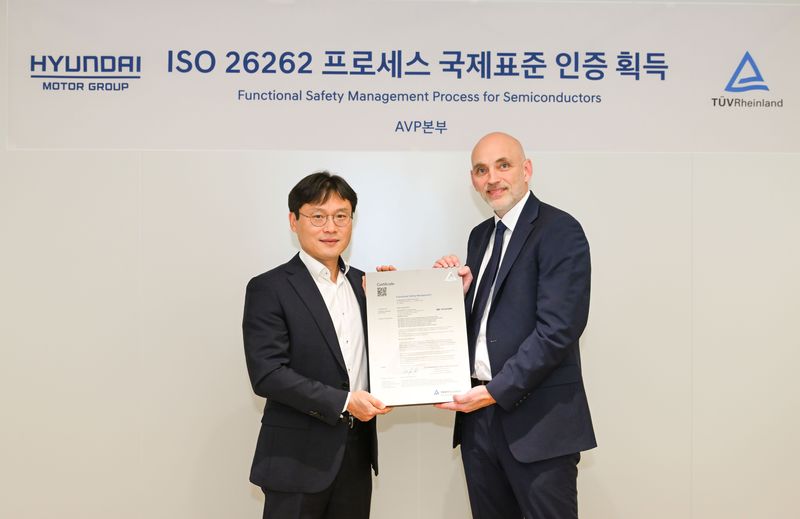
On the 5th, Hyundai Motor Company and Kia Corporation said they had held a ceremony on the 4th at Pangyo Tech One in Seongnam, Gyeonggi Province, to receive certification from international certification body TÜV Rheinland for the “ISO-Based International Standard for Functional Safety Processes.” The certification covers the development process and functional safety management system, not the semiconductors themselves.
The ceremony was attended by company executives and employees, including Yoo Ji-han, vice president in charge of the SDV Platform at Hyundai Motor Company and Kia Corporation, as well as representatives of TÜV Rheinland. Since 2025, Hyundai Motor Company and Kia Corporation have developed and operated their own standard process tailored to automotive SoC (system-on-chip) development. A SoC is a semiconductor that implements a system with multiple functions on a single chip.
TÜV Rheinland reviewed the development framework as a whole, including the functional safety management system, definitions of the development process, organizational roles and responsibilities, standard deliverables, templates, guidelines and checklists. In particular, it focused on whether consistency across all stages—from development goals through design, implementation and verification—and the configuration and change-management system met international standard requirements.
According to Hyundai Motor Company and Kia Corporation, TÜV Rheinland found that system, hardware and software development were organically linked throughout, with criteria and deliverables clearly defined for each stage. It also found that the framework could identify potential errors early in development and ensure safety requirements were consistently reflected through to the final product.
Having secured a foundation to develop automotive semiconductors under a global-level functional safety framework through this certification, Hyundai Motor Company and Kia Corporation plan to extend their standardized development process across semiconductor development as a whole, strengthening safety and reliability.
Vice President Yoo Ji-han said, “I am pleased that we have received objective certification that Hyundai Motor Company and Kia Corporation’s semiconductor development process is aligned with global standards,” adding, “We will focus all our capabilities on developing automotive semiconductors that can lead the future mobility market.”
[email protected] Kim Dong-chan Reporter