Kim Min-seok: “Backlash might have been greater if allegations concerning the Shincheonji Church of Jesus, the Temple of the Tabernacle of the Testimony (Shincheonji) had been fully disclosed”
- Input
- 2026-11-05 08:36:37
- Updated
- 2026-11-05 08:36:37
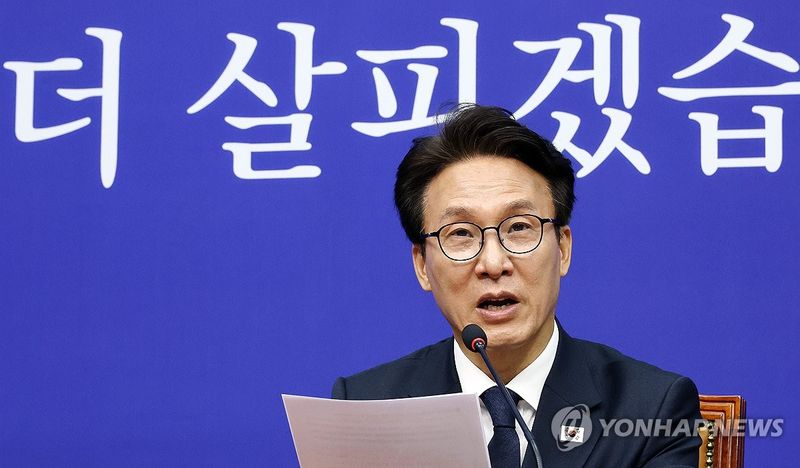
[Financial News] On the 5th, Democratic Party of Korea (DPK) leader Kim Min-seok reaffirmed his position that the party would address the conflict surrounding allegations of Shincheonji’s political intervention in party affairs through internal access to the membership list and institutional reforms, rather than by disclosing the entire list. “Honestly, I feel very uncomfortable,” he said, adding that he believed full disclosure could have prompted even greater backlash within the party.
Asked about his feelings over the recent internal party conflict when he appeared on the DPK’s official YouTube program Minty07 that morning, Kim said, “I feel both sorry to and grateful for our party members,” adding, “The issue of religious intervention in politics, and the issue of political intervention within the party itself, are both really difficult to resolve.”
Kim explained, “We have entered a process of checking the problems or concerns through internal access in a relatively less shocking and orderly way, and of overcoming them through the party’s own capabilities by determining how to address them institutionally.”
On the continuing backlash within the party, he said, “Even if we had opted for full disclosure, there would have been a range of objections raised internally, similar to those being raised now or even greater,” adding, “I think they might have been greater.”
He continued, “The question of responsibility for raising claims with absolutely no substance or basis is a separate matter that can be resolved in due course,” adding, “I’m not particularly concerned about that.” He was indicating that he would deal separately with the issue of responsibility for how the allegations were raised and the issue of addressing concerns about religious intervention in politics.
Kim stressed, “Ultimately, what remains is how to resolve the substantive issue. It will take a little time, but I’ll go through the remaining steps according to the approach the lawmakers agreed to for now at the party caucus meeting.” He explained that the current approach was relatively better for strengthening the party internally and focusing on people’s livelihoods during the regular session of the National Assembly.
Meanwhile, Kim said the party had settled its position on deferring taxation of virtual-asset income. “It would be problematic in various respects to begin taxation when the law establishing the basic framework, the General Act on Digital Assets, has not yet been enacted,” he said. “We ultimately agreed that the right approach would be to enact the law first, then begin after a period of getting accustomed to it under that law.” He added that the party had conveyed its position to the government.
Kim also shared his position on restructuring the operating model for highway rest areas. He pointed out that intermediary operating companies stand between the Korea Expressway Corporation and the businesses at the rest areas, taking a share of revenue ranging from the 30-percent range to as high as the low 50-percent range. He said that switching to direct contracts was expected to bring commission rates down to roughly 8% to the low 10% range, and that the party would pursue pilot improvements at some rest areas. He said he expected this to lower food prices and improve service quality.
[email protected] Kim Kyung-min Reporter