“Three years and six months of treatment without working”... KEF releases findings on long-term treatment of workers injured in industrial accidents
- Input
- 2026-11-05 11:00:00
- Updated
- 2026-11-05 11:00:00
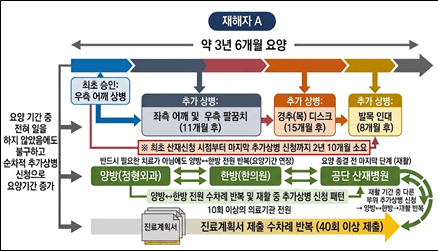
The Korea Employers Federation (KEF) released a report titled “Long-Term Treatment of Workers Injured in Industrial Accidents: Current Status and Directions for Improvement” on the 5th. KEF says that while the average number of treatment days is falling overall, the share of workers receiving long-term treatment for a year or more remains high, making changes to treatment management necessary.
A KEF survey of workers with approved workers’ compensation claims in major manufacturing industries, including shipbuilding, automotive and tire manufacturing, found that as of the first half of this year, 29.7% of injured workers in the tire industry and 27.7% in shipbuilding received long-term treatment for a year or more, approaching 30%. The share in automotive manufacturing was lower than in other industries, at 14.9%, but showed an upward trend, rising from 12.7% in 2024 to 14.9% in the first half of this year.
KEF said its analysis of cases involving particularly long treatment found many instances in which workers prolonged care for years by repeatedly claiming additional conditions affecting other parts of the body after their workers’ compensation claims were approved, transferring between hospitals several times and seeking extensions of treatment.
One injured worker first received workers’ compensation approval for a shoulder condition, then continued filing additional claims for conditions affecting the neck, elbow and ankle. In the process, the worker changed hospitals more than 10 times and submitted treatment plans more than 40 times, extending the treatment period to three years and six months. The worker was not actually working, making it difficult to establish a work-related connection for the additional injuries. Nevertheless, the worker repeatedly extended treatment by filing claims for conditions affecting new body parts or submitting treatment plans whenever the end of treatment approached.
Another injured worker began treatment for a knee injury covered by workers’ compensation and, after receiving approval for additional conditions on three occasions, made repeated trips to a hospital more than 200 km from home. The worker also submitted treatment plans several times, bringing the treatment period to five years and two months. KEF said treatment at a distant hospital was approved without any particular reason, and extensions continued to be approved based on treatment plans submitted by the attending physician, even though a medical consultant for the Korea Workers’ Compensation and Welfare Service had said that the end of treatment should be considered.
It was also found that some workers whose elbow injuries had been approved for workers’ compensation frequently took part in leisure activities such as golf and fishing while receiving self-treatment (outpatient care), prompting criticism that oversight of people receiving such care is effectively lax.
To prevent unnecessary long-term treatment, KEF proposed drawing up standard treatment-duration guidelines for each condition; strengthening the application and review process for additional conditions; limiting transfers between medical institutions and the number of treatment-plan applications; and strengthening targeted monitoring of people receiving self-treatment.
On standard treatment durations, KEF cited the Korea Workers’ Compensation and Welfare Service’s practice of limiting treatment for accident-related sprains to a maximum of six weeks, and proposed establishing medically based standard guidelines for other common conditions as well. For claims involving additional conditions, KEF said verification of their connection to the initially approved condition should be strengthened and a time limit should be placed on when applications may be filed.
KEF also proposed limiting the number of transfers between medical institutions and treatment-plan submissions to a set level, and requiring several experts to jointly review a worker’s treatment progress if that level is exceeded. It also recommended that when the attending physician and the Service’s medical consultant disagree over an extension of treatment, the consultant’s opinion should take precedence.
Im Woo-taek, head of KEF’s Occupational Safety and Health Division, said, “Recent improvements in the management of workers’ compensation treatment are evident, partly as a result of KEF’s release last year of a report on long-term treatment for workers injured in industrial accidents.” He added, “Cases of excessive long-term treatment are still recurring, negatively affecting fellow workers and businesses, so the Korea Workers’ Compensation and Welfare Service needs to make active efforts to improve the system.”
[email protected] Kim Dong-chan Reporter