Congressional checks may grow after the midterms, but Trump’s approach won’t change... “Tariff risks must be factored into contracts”
- Input
- 2026-11-05 15:00:00
- Updated
- 2026-11-05 15:00:00
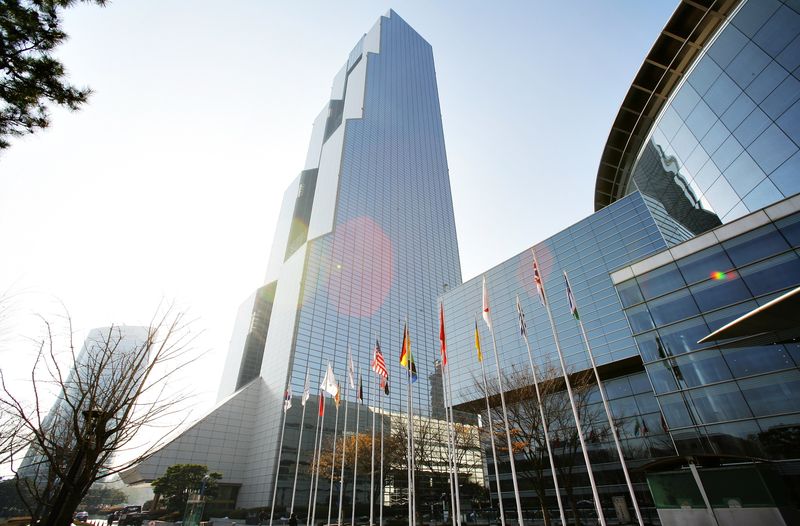
On the 5th, the Korea International Trade Association and Lee & Ko held a seminar at COEX in Seoul’s Gangnam District titled “U.S. Midterm Election Results and Prospects for Korea-U.S. Trade Relations.” The seminar took place amid expectations that a divided government would emerge in the latter half of the Trump administration’s term, as the Democrats were considered highly likely to win majorities in both the Senate and the House in the U.S. midterm elections held on the 3rd, local time. About 100 people from the trade industry and related organizations attended.
The seminar consisted of two sessions: the midterm election results and the global trade order, and Korea-U.S. trade issues and challenges.
In his opening remarks, Korea International Trade Association Executive Director Jang Seok-min said, “As the United States has become a major production and investment hub for our companies, changes in U.S. policy are having an increasingly significant impact on their business there.” He emphasized that “we need to assess how the midterm election results will affect U.S. trade policy and revisit our business strategies.”
In the first session, Sogang University Professor Ha Sang-eung said he expected the election results to bring no major change in policy direction, “given that the Trump administration’s second term has pursued its policies by bypassing Congress and accepting the risk of clashes with the judiciary.”
Sogang University Professor Yoon Heo expected trade pressure to continue even if conflicts between Congress and the executive branch intensify over budget bills and other matters. “Investment pressure on South Korea, Japan and Taiwan, which rely on the United States for security, will intensify further,” he predicted.
Lee & Ko adviser Lee Tae-ho said, “The Trump administration’s tariff policy has maintained its basic structure even when its legal basis has changed.” He added, “Even if congressional checks grow stronger in the next session, the ‘Turnberry system,’ centered on high tariffs and bilateral agreements, will continue.”
The second session covered implementation of investment agreements with the United States, tariff measures and economic security regulations. CHANG Sang Sik, head of the Korea International Trade Association’s Institute for International Trade and Commerce, reviewed the status of investment agreement implementation and proposed that “if conflict between Congress and the executive branch drags on under a divided government, it could also affect administrative procedures related to investment in the United States.” He added, “We need to check that safeguards such as payment caps and umbrella-style profit sharing are working properly.”
Practical advice for businesses followed. Korea University Professor Cho Su-jeong said tariff measures and trade pressure using Section 232 of the Trade Expansion Act of 1962 and Section 301 of the Trade Act are expected to continue in the latter half of Trump’s term. “Companies should manage risks, including by factoring tariff risks into their contracts,” she emphasized.
Lee & Ko attorney Park Jeong-hyeon advised, “The fact that goods are made in South Korea does not by itself eliminate all risks from U.S. economic security regulations when exporting to the United States.” He added, “Companies should have documentation to verify not only origin, but also component and process histories, the ownership structure of their business partners, and whether their technology is subject to export controls.”
While this seminar focused on U.S. trade policy, the focus will broaden to major economies as a whole at the end of this month. On the 30th, KITA will hold the “2026 KITA International Conference,” bringing together experts from South Korea and abroad to discuss changes in major economies’ trade policies, supply chain realignment, new growth engines for South Korean exports and response strategies.
[email protected] Kim Dong-chan Reporter