“Buy in November”—will that saying hold true this year? Optimism about a rebound grows among brokerages
- Input
- 2026-11-05 07:58:42
- Updated
- 2026-11-05 07:58:42
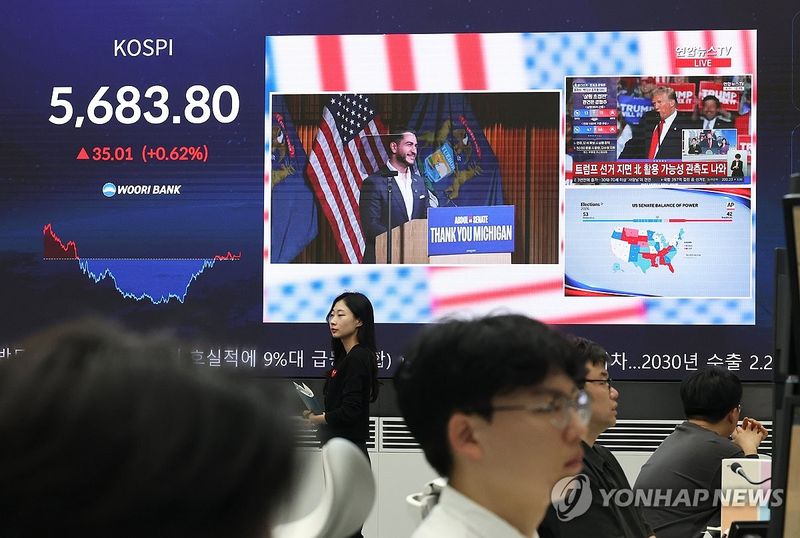
[Financial News] “Sell stocks in May and buy them back in November” is a well-known Wall Street saying. It reflects seasonality in the U.S. stock market, where November has traditionally been considered a strong month. In South Korea, too, November ranks as the month with the second-highest stock market returns. With the KOSPI recently showing high volatility amid domestic and international headwinds, attention is focused on whether a seasonal uptrend will emerge again this year.
November’s average return has been 2.48% since 1980, second only to January
According to Newsis on the 5th, South Korea’s stock market has recently continued to show high volatility amid domestic and international headwinds, including concerns about the profitability of artificial intelligence (AI), a peak-out in semiconductors, and continued foreign investor outflows. In particular, after moving around the 7,000 level in September, the KOSPI plunged last month, at one point falling as low as the 5,300 level.
Since the start of this month, the market has been seesawing, rising one day and falling the next, without establishing a clear direction. Against this backdrop, the market is watching to see whether South Korea’s stock market can repeat this year the seasonal pattern of gains it typically shows in November.
Historical statistics show that November has been a favorable month for South Korea’s stock market. A look at monthly KOSPI returns from 1980 through last year shows that November’s average gain was 2.48%, the second-highest after January.
However, concerns have emerged that domestic and international factors different from those of previous years could weigh on the stock market this year. Some policy uncertainty surrounding the U.S. midterm election results may ease, providing a catalyst for a rebound, but geopolitical tensions between the United States and Iran, along with the burden of high oil prices and interest rates, remain sources of market unease. Some observers expect high volatility to persist for the time being.
Medium- to long-term rebound seen as more likely as uncertainty over U.S. midterms eases
Brokerages, however, appear to be leaning toward a medium- to long-term rebound in South Korea’s stock market, with the easing of valuation pressures following the recent plunge and the resolution of uncertainty over the U.S. midterm elections serving as potential catalysts. Analysts say that if concerns about the sustainability of AI investment ease, a recovery could take hold, led by large-cap semiconductor stocks.
Seo Sang-young, a researcher at Mirae Asset Securities, noted, “In the short term, the likelihood has increased that a Democratic victory will curb the AI industry and lead to a slower pace of development. But we should bear in mind that this was already anticipated, that data center construction will continue, and that new projects are likely to be the main point of contention.”
Seo said, “If it becomes clear that the scope of regulations actually passed going forward is limited and that Big Tech’s AI investment plans have not changed significantly, a rebound is expected, particularly in the semiconductor sector, which has recently plunged,” forecasting a recovery.
Lee Jae-won, a researcher at Yuanta Securities Korea Co., Ltd., also said, “The results of these midterm elections could bring a change to the vicious cycle of widening fiscal deficits, geopolitical conflict, high oil prices and rising inflation.” He added, “Apart from the Democrats’ efforts to rein in further fiscal expansion, if progress in U.S.-Iran negotiations leads to stable oil prices, we could also expect relief from inflation and the pressure of interest-rate hikes.”
Lee said, “Stability in long-term interest rates lowers AI companies’ financing costs and could ease concerns currently being raised about the sustainability of investment.” He explained, “Regulatory concerns currently priced into the market cannot be ignored, but a Blue Wave would not be a surprise, so there is little room for further pricing-in at current levels.”
With negative factors already priced in, some see scope for a rebound in the semiconductor sector. Lee forecast, “If, after uncertainty over the election has cleared, we see long-term interest rates and credit risk stabilize and foreign investors turn to net buying, expectations for a recovery led by large-cap semiconductor stocks will remain valid.”
[email protected] Kim Hee-sun Reporter