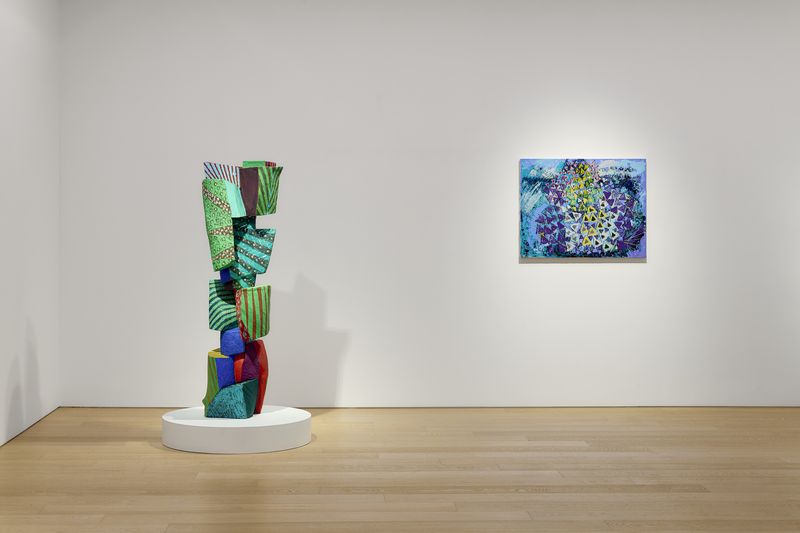
First-floor view of Kim Yun Shin’s solo exhibition ‘In the Continuum’ at Lehmann Maupin Seoul in Seoul’s Yongsan District. On the left is ‘Tree Full of Songs 1984-11U1,’ cast in aluminum based on an existing wood sculpture. Photo by Lee Seung-heon, courtesy of Lehmann Maupin Lines resembling green leaf veins, red stripes and densely packed dots come together in a single sculptural form. The view changes with each step. It is Kim Yun Shin’s ‘painting-sculpture,’ with each face of the sculpture serving as a canvas.Kim Yun Shin, one of Korea’s first-generation women sculptors, is holding a solo exhibition, ‘In the Continuum,’ at Lehmann Maupin Seoul in Seoul’s Yongsan District from the 5th through December 24. It is the artist’s first solo exhibition at the gallery since returning to Korea after working for about 40 years in Argentina, Mexico and elsewhere. The exhibition presents 35 paintings and sculptures across two floors.
■ ‘Painting-sculpture’ born from wood sculptureStanding on the first floor, the 154-centimeter-tall ‘Tree Full of Songs 1984-11U1’ was cast in aluminum in 2025 based on an existing wood sculpture. Even beneath its acrylic paint, the surface reveals the grain of the wood and traces of carving. Other works in the same series, with color applied to bronze, are also on display.
Kim Yun Shin began making painting-sculptures around the time of the COVID-19 pandemic. At a press conference on the 4th, Kim cited the difficulty of keeping wood sculptures outdoors for long as the impetus for casting them in metal. She said she had experimented by painting patterns on metal surfaces to see how the same motif looked different depending on the sculpture’s form, and said, “I want to leave the term ‘painting-sculpture’ to the world.”
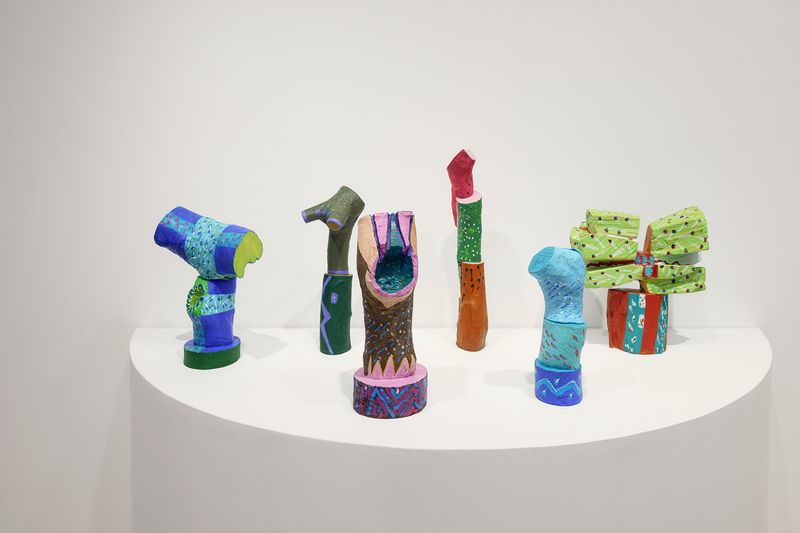
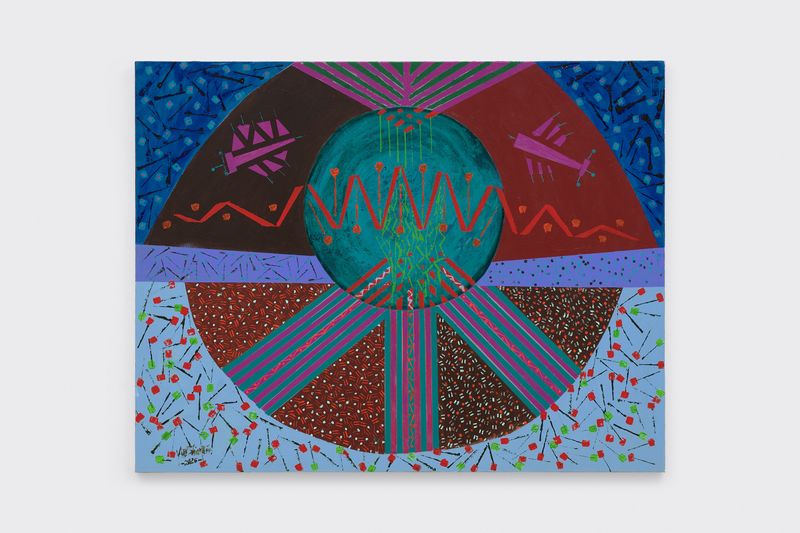
Six works from Kim Yun Shin’s ‘Tree Full of Songs’ series, with acrylic paint applied to bronze, are displayed on the first floor. Photo by Lee Seung-heon, courtesy of Lehmann Maupin Kim Yun Shin’s painting ‘Grace in the Glow 2026-35,’ being shown for the first time in this exhibition. Forms resembling seeds, flowers and waves come together across a geometrically divided surface. Photo by Lee Seung-heon, courtesy of Lehmann Maupin After she returned to Korea, the kind of wood she worked with changed, and so did her approach to it. According to Kim, the wood she used in South America was so hard it could make a chainsaw bounce back, but once cut, its cross-section was smooth. The wood she works with in Korea is relatively soft, but leaves saw marks, requiring more work to sand the surface.
‘Grace in the Glow 2026-35,’ being shown for the first time in this exhibition, is also displayed on the first floor. Forms resembling seeds, flowers and waves come together across a geometrically divided surface. Kim builds up layers of paint on the canvas, then scrapes them away to create the image. Inspired by the lithography she learned while studying in Paris, she also stamps paint to leave marks. Even when she repeats the same form, its colors and expression change each time.
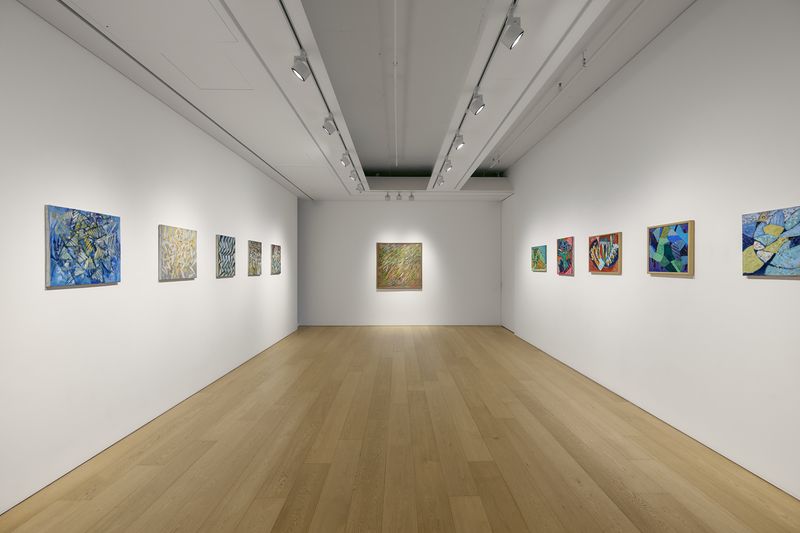
■ The canvas unfurled anew in ArgentinaThe second floor is devoted to 14 oil paintings from her years in Argentina, including ‘Jubilance,’ ‘Primal Vitality’ and ‘Song of My Soul.’ ‘Jubilance’ and ‘Primal Vitality’ translate impressions of South America’s vast natural landscapes into seed-like forms. These forms also appear in new works on the first floor, painted more than 20 years later.
View of the second floor of Kim Yun Shin’s solo exhibition ‘In the Continuum.’ Oil paintings from her years in Argentina hang on both walls. The work facing the viewer is ‘Untitled 1999-6.’ Photo by Lee Seung-heon, courtesy of Lehmann Maupin After moving to Argentina in 1984, Kim Yun Shin was captivated by the local wood and focused on sculpture for more than 10 years. According to a person familiar with the matter, she returned to painting in 1998 after securing a space at a local art academy where she could lay out her paintings. ‘Untitled 1999-6’ on the second floor was painted around that time.
The working methods Kim developed through sculpture carried over into her painting. The two works from the 1990s wood-sculpture series ‘Add Two Add One, Divide Two Divide One’ on display show the principles of addition and division that she drew from yin-yang thought. Just as she carves away the outside of a piece of wood to reveal its interior, she adds color to the canvas and then scrapes some away to divide the image.
[email protected] Jang In-seo Reporter