“Tariff pressure to persist ... Scrutiny of U.S. investment project selection and execution to intensify” [U.S. Midterm Elections]
- Input
- 2026-11-04 18:31:46
- Updated
- 2026-11-04 18:31:46
■ Outlook: Tariff pressure to persist
According to foreign media reports and other sources on the 4th, the Democrats regained both the House and Senate majorities previously held by the Republicans in the midterm elections held on the 3rd, local time. As a result, President Trump will have to pursue trade and industrial policies with an opposition-led Congress for the remainder of his term.
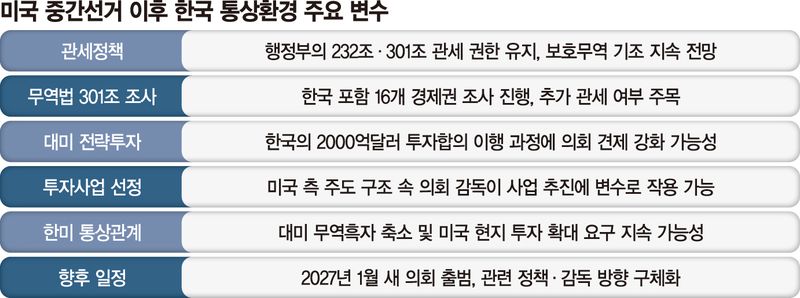
The shift in the balance of power in Congress is not expected to lead to an immediate change in tariff policy. The administration can exercise considerable authority over tariffs imposed under Section 232 of the Trade Expansion Act and Section 301 of the Trade Act, among other provisions. Analysts say it would be difficult to immediately repeal existing tariffs even if the Democrats control Congress.
In a recently published report, the Korea Trade-Investment Promotion Agency (KOTRA) forecast that the push to expand production in the United States and bring supply chains for key industries back under domestic control would continue even if the Democrats control Congress. This is because creating manufacturing jobs and reducing reliance on China for supply chains are common policy goals of both parties.
Cho Sung-dae, head of the Trade Research Institute at the Korea International Trade Association, also said at a seminar titled “Outlook and Market Entry Strategies After the U.S. Midterm Elections,” held last month, “Even if the Democrats regain both chambers in the midterm elections, the Trump administration’s America First trade policy, pursued through executive orders, is likely to continue.”
There are also expectations that, separately from the continuation of the protectionist stance, trade pressure specifically targeting South Korea could intensify. An immediate concern for South Korea is the Office of the United States Trade Representative’s (USTR) ongoing Section 301 investigation into structural overcapacity. With 16 economies, including South Korea, among those being investigated, the key question is whether South Korea can maintain the level of burden under the existing U.S.-South Korea tariff agreement if additional tariffs are proposed.
Professor Koo Ki-bo of the Department of Global Commerce at Soongsil University said, “The Democrats have traditionally tended to take a somewhat tougher line on trade pressure than the Republicans, so I think they will become somewhat tougher on the details. In areas such as semiconductors, I think pressure may intensify for South Korea to expand investment in U.S. factories further and reduce its trade surplus.”
■ $20 billion in investment in the U.S.: Congressional scrutiny a wild card
The new balance of power in Congress is also expected to affect the $200 billion strategic investment in the United States pledged by South Korea. Analysts say that as the Democrats step up scrutiny of the Trump administration, political factors could also emerge in the implementation of the existing investment agreement.
Tom Orlik, chief economist at Bloomberg Economics, said at the “2026 U.S. Midterm Elections and Macroeconomic Outlook” webinar hosted that day by the Korea Financial Investment Association that, as the Democrats focus on scrutinizing the Trump administration, the U.S. government’s acquisition of stakes in private companies and investment agreements with foreign companies could face closer examination.
This could also affect the implementation of the U.S.-South Korea investment agreement. Since the U.S. side plays a leading role in selecting projects for South Korea’s strategic investment in the United States, greater congressional scrutiny could affect the process of moving those projects forward.
An official from the Ministry of Trade and Industry said, “We will closely monitor developments in the U.S. Congress and administration and actively pursue outreach to ensure the stable management of U.S.-South Korea trade relations.” The official added, “On the basis of the agreements between the two countries, we will continue to pursue strategic investment in the United States and strengthen economic security cooperation and our strategic partnership.”
[email protected] Ji-young Park Reporter