“Hoarding to incur administrative surcharges of up to twice the gains” ... Government steps up efforts to make price stabilization more effective [Price Stabilization Act amendment gathers pace]
- Input
- 2026-11-04 18:31:23
- Updated
- 2026-11-04 18:31:23
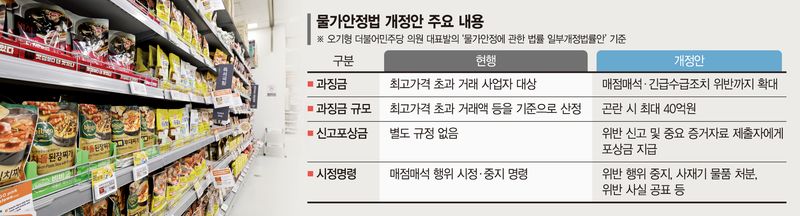
Relevant ministries said on the 4th that the Ministry of Finance and Economy is pursuing an amendment through a partial amendment bill to the Act on Price Stabilization, introduced by Democratic Party of Korea (DPK) lawmaker Oh Gi-hyoung. The amendment is being pursued through a lawmaker-sponsored bill rather than a government bill in order to shorten the time required for the legislative process. A ministry official explained, “We are pursuing the amendment through a lawmaker-sponsored bill, which moves through the process faster than government legislation.”
■ Administrative surcharges of up to twice the gains
The key provision of the amendment is to establish a legal basis for imposing administrative surcharges on businesses that engage in hoarding. Under the current law, penalties can be imposed only on businesses that sell goods above the maximum price set by the government. The amendment would also make businesses that hoard goods or violate the government’s emergency supply-and-demand adjustment measures subject to administrative surcharges. The aim is to hold businesses economically accountable for disrupting market supply and demand by stockpiling goods or failing to comply with government measures on supply and sales.
Administrative surcharges of up to twice the gains from a violation may be imposed. For example, if a business made 1 billion won from hoarding, it could face an administrative surcharge of up to 2 billion won. If there are no illicit gains or their exact amount is difficult to calculate, an administrative surcharge of up to 4 billion won may be imposed.
A system to reward people who report violations will also be introduced. It will cover people who report or provide information about hoarding or violations of emergency supply-and-demand adjustment measures and submit important evidence that can verify the violations. The government has allocated 31.3 billion won in next year’s budget for these rewards. The amendment will also establish a legal basis for corrective orders and enforcement fines. Authorities will be able to order businesses to stop violations such as hoarding and to release hoarded goods onto the market, and impose enforcement fines if they fail to comply. The maximum administrative fine for refusing, obstructing or evading an investigation will rise from 20 million won to 50 million won, while the fine for violating reporting or document-submission requirements will increase from 10 million won to 30 million won.
■ Inflation around 3% for six months
The government is pursuing the amendment to head off factors that could worsen market supply-and-demand uncertainty amid high inflation. While it is difficult for the government to directly control increases in global oil and raw-material prices themselves, it aims to prevent prices from rising further as businesses take advantage of supply uncertainty to hoard goods or artificially restrict sales. The burden of inflation has yet to ease. Cumulative consumer-price inflation from January to October this year was 2.7%, exceeding the government’s full-year forecast of 2.6%. In May and June, petroleum products drove inflation as global oil prices rose in the wake of the Middle East war; more recently, upward price pressures have spread to everyday items such as processed foods and dining out. If the inflation burden also grows while the economic recovery continues, led by strong semiconductor exports, it could weigh on both the recovery in consumption and the stability of people’s livelihoods.
However, because amending the law alone is unlikely to stabilize prices, effective enforcement is expected to be key. The impact of the penalties could depend on how broadly hoarding is defined and how the gains from violations are calculated. Some also say a system must be put in place to quickly detect violations and ensure that hoarded goods are actually supplied to the market. There are also calls for efforts to improve price-setting structures themselves alongside tougher penalties. Song Young-kwan, a senior research fellow in market policy at the Korea Development Institute (KDI), said, “Fundamental changes to the structure itself are needed to bring prices down. For food, that means lowering high tariffs, and in the energy sector, accelerating the transition to renewable energy.”
[email protected] Kim Chan-mi, Seo Young-jun Reporter