A Spider-Like Welding Robot Roams Ship Hulls; Robots Grill Meat, Play Table Tennis and Enter Everyday Life [2026 RoboWorld]
- Input
- 2026-11-04 18:29:45
- Updated
- 2026-11-04 18:29:45
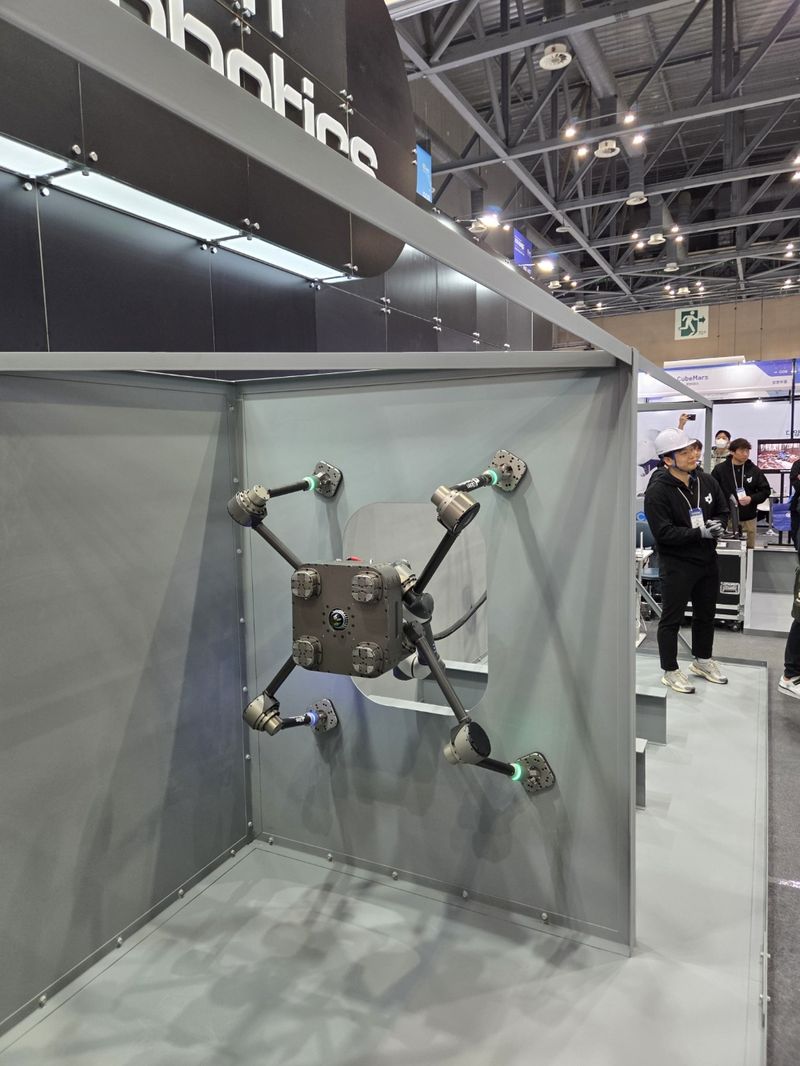
#. A four-legged robot clung to a vertical steel wall. It lifted one leg and attached it at another spot, then moved its other legs one by one. Its body looked as though it might fall away from the wall, but it moved while staying balanced on its magnetic feet. It looked like a spider climbing a wall. This was the quadruped robot ‘Diden Spider,’ unveiled by Diden Robotics. Using electromagnetic permanent magnet (EPM) technology, Diden Spider moves by attaching its feet to and detaching them from steel structures. It can clear obstacles up to 40 cm high and carry 30 kg of equipment. Kim Jun-ha, CEO of Diden Robotics, said, “In environments such as shipyards, where work has to be done not only on the floor but also on ceilings and walls, robots that can move more efficiently than people are needed.”
■ Quadruped Robots Navigate Tight Spaces Aboard Ships
The main themes at 2026 RoboWorld, held on the 4th at Exhibition Hall 1 of the Korea International Exhibition Center (KINTEX) in Goyang, Gyeonggi Province, were the full-scale adoption of physical AI in manufacturing and the commercialization of service robots for everyday settings, including food service, healthcare, rehabilitation and care. Technologies that go beyond simply following set routes or moving objects—enabling robots to balance like people, respond to their surroundings and perform complex movements—took center stage. It was clear that the era of commercially deploying robots in real-world industrial settings, including manufacturing facilities such as shipyards and in the military and public sectors, had arrived.
The ‘Diden Walker,’ which moves on two legs modeled on the human lower body, can navigate narrow spaces inside ships that are difficult for quadruped robots to enter. Its magnetic feet let it cross obstacles and work-access openings. Mass production is set to begin this December, with full-scale deliveries slated for next year. It is designed to carry a robotic arm on top and perform tasks such as welding. Kim said, “Ultimately, our goal is for a robot to move around a worksite with a robotic arm mounted on its back and even carry out welding.”
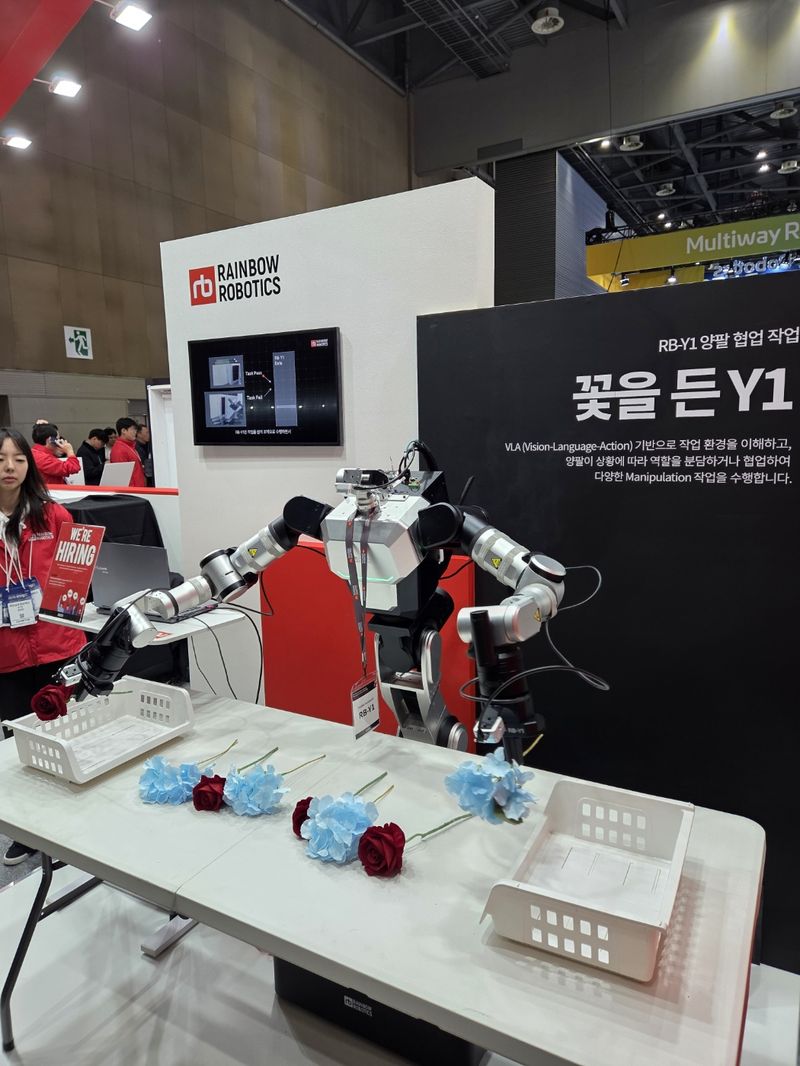
Rainbow Robotics’ booth featured its ‘RBQ Series’ quadruped robots: the ‘RB-Q10,’ which walks on four legs up stairs and along ramps; the ‘RB-Q10W,’ which uses wheels to travel quickly on flat ground; and the ‘RB-Q10A,’ which can open doors or throw balls with its robotic arm. Each robot specializes in a different function: walking, wheeled travel or task performance. Key targets include patrolling industrial facilities such as power plants and oil-refining and chemical plants; monitoring equipment at manufacturing plants and logistics centers; and inspecting structures at construction sites and in complex terrain. The robots can also be used to remotely monitor hazardous areas that are difficult for people to access or to explore disaster sites.
Rainbow Robotics began limited production of the RBQ Series this year and plans to produce 300–400 units next year. Heo Jeong-u, a director at Rainbow Robotics, said, “There is strong interest in adopting quadruped robots not only through government deployment programs but also overseas, including in the Middle East and Japan.” He added, “Our advantage is a lower price point than U.S.-made products.”
At the booth, the mobile, dual-arm ‘RB-Y2’ robot exactly mimicked the actions of the person operating it. It combines a mobile platform with two arms arranged in a configuration resembling a human upper body. Unlike quadruped robots that move on four legs, it is designed to carry out repetitive tasks in industrial settings, such as picking up and moving objects with both hands while moving around a workspace. Dual-arm robots designed for manufacturing also drew attention. At a booth jointly set up by Nau Robotics and the Daegu Gyeongbuk Institute of Science and Technology (DGIST), a robot combining a wheeled mobile platform with two robotic arms was also unveiled.
■ Taekwondo, Table Tennis... and Group Dances to K-Pop
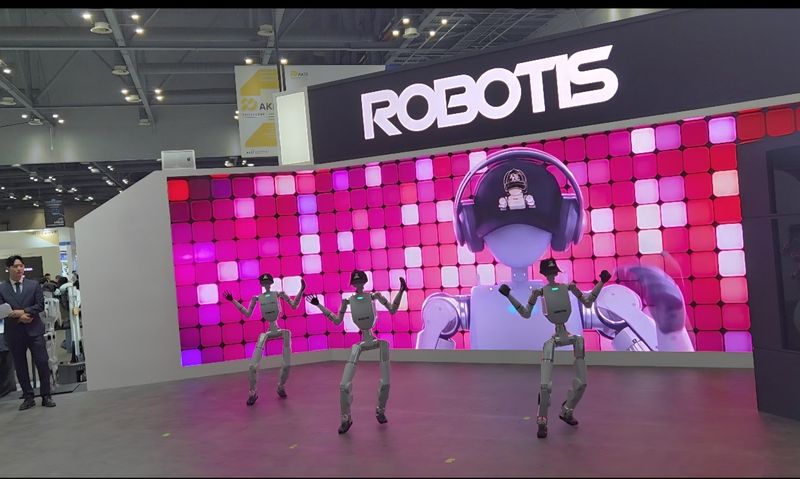
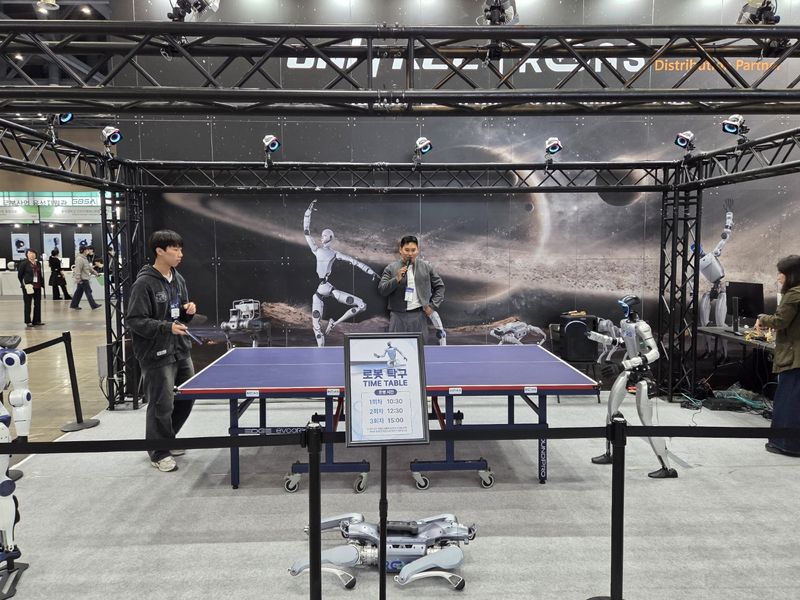
Unusual performances showcasing robots’ athletic abilities took place throughout the exhibition hall. At the ROBOTIS booth, three humanoid robots performed a group dance, moving their arms and legs to K-pop music. In a limbo demonstration that followed, a robot bent its knees and leaned its upper body back to duck under a horizontal bar. Three ‘IL BOT H2’ humanoids from IL Robotics also danced, making a heart shape above their heads and lifting one foot. China’s Unitree Robotics presented a table tennis match between a person and a robot. When a man stood at one end of the table holding a paddle, the robot opposite him bent its knees and extended an arm forward. The robot maintained its balance while performing table tennis movements. The demonstration showcased the humanoid’s precision-control technology, as it had to track the position and direction of a fast-moving ball and control its arm.
Visitors kept streaming into the Aniai booth, where the smell of grilling meat filled the air. When a staff member placed pork belly on the grill, the AI cooking robot ‘Alpha Grill Single’ automatically adjusted the grill temperature and cooking time according to its preset recipe. When cooking was finished, visitors sampled the freshly grilled meat. The robot can cook up to 200 hamburger patties per hour and up to 160 servings of thick-cut pork belly in an initial-grilling cycle.
AeiROBOT’s companion robot ‘Eddy’ drew attention for its ability to interact with people. When visitors stroked Eddy, which has ears and a tail, it came closer playfully. Asked to sing, it responded with a song. It can express 33 emotions, including laughing, crying and getting angry. Visitors could also try wearing robots themselves. Those who wore Hexa Robotics’ ‘Hector L20P’ back-strength-assist robot experienced its assistance while walking and lifting objects. Weighing 2.7 kg, the robot provides up to 12 kgf of assistance, reducing the strain on workers who repeatedly bend at the waist or lift heavy objects. Special Reporting Team
Special Reporting Team
[email protected] Yeon Ji-an, Jang Min-kwon, Yoon Hong-jip, Choi Hye-rim Reporter