Hyundai Motor: “Hydrogen isn’t a business you can do alone”... Joint growth in commercial vehicles and the supply chain is the answer
- Input
- 2026-11-04 17:50:24
- Updated
- 2026-11-04 17:50:24
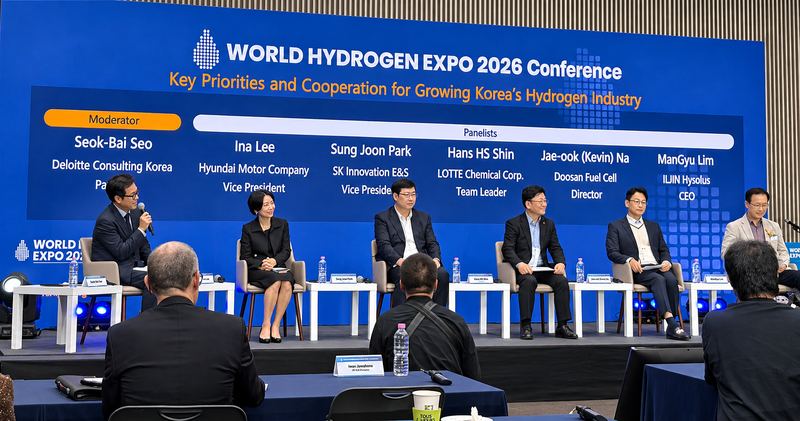
[Financial News] Hyundai Motor Company has presented hydrogen fuel cell electric vehicles as a key driver of demand across the domestic hydrogen industry ecosystem. The argument is that the expansion of hydrogen vehicle adoption will spur growth in storage tanks, refueling infrastructure, and the hydrogen production and distribution industries, so the entire sector needs to grow together. The government also plans to expand demand with a focus on hydrogen commercial vehicles and strengthen the foundation for clean hydrogen production, raising hopes that commercialization of the domestic hydrogen industry will gain momentum.
■ Hyundai Motor: “Hydrogen vehicles drive growth in the industrial ecosystem”
The Leadership Insight conference, which examined the state of the global hydrogen ecosystem and discussed its future, was held at World Hydrogen Expo 2026, which opened on the 4th at Exhibition Hall 2 of KINTEX in Goyang, Gyeonggi Province.Hyundai Motor Company Executive Director Lee In-a, who took part in the panel discussion that day, stressed, “Hydrogen isn’t a business you can do alone,” adding, “You can’t make hydrogen vehicles work by manufacturing cars alone; refueling facilities and hydrogen production have to be developed alongside them.” She explained that hydrogen mobility can create demand across the entire value chain, from production to storage, transportation, and refueling.
Lee cited the hydrogen fuel cell electric vehicle Hyundai Nexo as a prime example. “The Nexo’s cumulative sales have topped 50,000 units, which means that 150,000 hydrogen storage tanks from ILJIN Hysolus Co., Ltd. were sold alongside them,” she said. “As the mobility industry grows, companies in materials, parts, and equipment can grow with it.”
She went on to stress, “Hydrogen isn’t a business that one company or one country can undertake alone. The entire value chain needs to grow in a balanced way, and corporate investment can only happen with private-sector collaboration and sustained, stable government policies to support it.”
■ Government to expand hydrogen commercial vehicles and refueling infrastructure
The government also plans to extend its hydrogen vehicle adoption policy, which has focused on passenger cars, to heavy-duty commercial vehicles. Ko Hyeon, a section chief at the Ministry of Climate, Energy and Environment (MCEE), said, “Until now, hydrogen vehicle adoption has focused on passenger cars. Going forward, we will expand it with a focus on heavy-duty commercial vehicles such as buses and trucks, which have a greater impact on carbon reduction.”The government plans to increase the number of hydrogen refueling stations from the current level of about 460 to 660 by 2030, and to deploy at least 2,000 commercial vehicles, including hydrogen buses, each year. Ko explained, “Many stations are currently operating at significant losses because they mainly serve passenger cars. Expanding the rollout of heavy-duty commercial vehicles will also improve the operating conditions for refueling stations.”
The government will also strengthen the foundation for clean hydrogen production. It is pursuing the construction of a 50-MW water electrolysis demonstration complex and is considering a 100-MW-scale demonstration project in the 2030s. The strategy is to create demand for clean hydrogen in industries such as steelmaking and petrochemicals, while expanding domestic production capacity.
Park Seong-jun, vice president of SK Innovation E&S, pointed out, “For the hydrogen industry to grow sustainably, we first need to secure the foundations that will allow the supply chain to survive,” adding, “The rollout of hydrogen buses is slower than expected, and a rigid pricing structure has left many operators in the red.” He went on to stress, “Stable policy support is needed to prevent supply capacity from falling short when demand begins to expand in earnest.”
Lim Man-gyu, CEO of ILJIN Hysolus Co., Ltd., also said, “The hydrogen industry now needs to move beyond research and development and into a stage where companies can secure the economic viability to make actual profits,” calling for regulatory improvements, including expanded refueling infrastructure and the removal of redundant certifications for hydrogen storage tanks based on their intended use.
■ “Beyond hydrogen imports, the industry must secure a leading position”
Others also argued that boosting the competitiveness of the domestic hydrogen industry requires linking production with consumption and identifying new sources of demand.Shin Heon-su, a team leader at Lotte Chemical Corporation, said, “The market won’t grow on its own just because a lot of hydrogen is produced. The market can grow only when production and consumption are connected along the value chain and create a virtuous cycle.”
Na Jae-uk, a team leader at Doosan Fuel Cell Co., Ltd, identified artificial intelligence (AI) data centers as a new market for hydrogen fuel cells. He explained, “In the United States, a shortage of power for AI data centers is emerging as a bottleneck. Fuel cells can generate electricity directly on site, making them an alternative that can address power supply problems.”
The potential for growth in the global hydrogen industry was also highlighted. Ivana Jemelkova, CEO of the Hydrogen Council, said, “Investment in global hydrogen projects that have reached final investment decision (FID) has increased 13-fold, from $10 billion in 2020 to $130 billion today,” adding, “Of more than 570 projects, 90% are already under construction or operational.”
Uwe Remme, head of the Alternative Fuels Division at the International Energy Agency (IEA), cited high production costs and the difficulty of securing long-term purchase agreements as obstacles to the hydrogen industry’s growth, and stressed the importance of policy support, including compensation for price differences.
Seo Seok-bae, a Deloitte partner who chaired the conference presentations and panel discussions, said, “South Korea’s situation is such that it has to source at least 80% of the hydrogen it needs from overseas,” adding, “We need a strategy that goes beyond simply asking how much hydrogen to import and use, and instead takes equity stakes in overseas production projects and secures rights in the supply chain.”
He went on to stress, “Hydrogen is central to all three of our national strategic goals: reducing carbon emissions, energy security, and fostering industry. Specific policy measures are urgently needed to share the burden of price differences, provide policy financing for overseas projects, and expand domestic demand.”
[email protected] Kim Dong-ho Reporter