President Lee: “Public-led redevelopment moves faster and reduces corruption”
- Input
- 2026-11-04 17:32:56
- Updated
- 2026-11-04 17:32:56
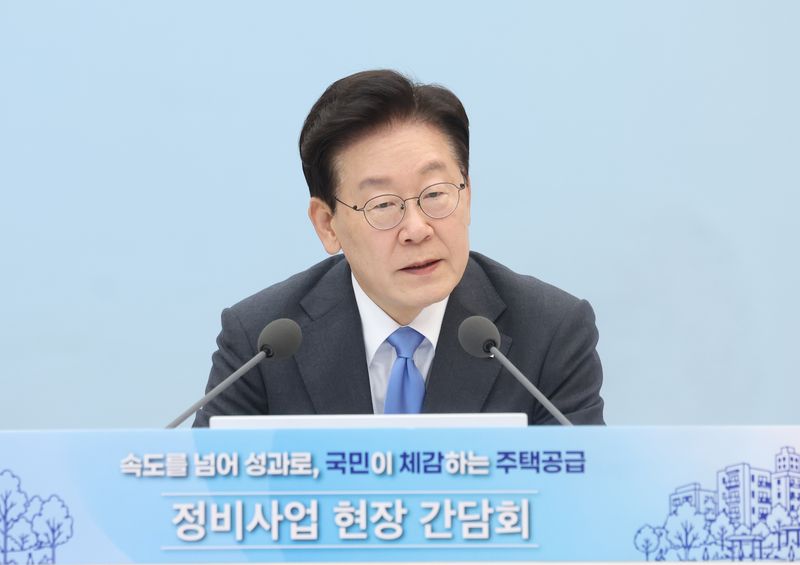
[Financial News] On the 4th, President Lee Jae Myung identified stabilizing housing prices in the Seoul metropolitan area as a key policy task and called for faster progress on redevelopment and other urban renewal projects. “I think it would be good to strengthen various incentives, whether through floor-area ratios or financial support, when projects are carried out early,” he stressed.
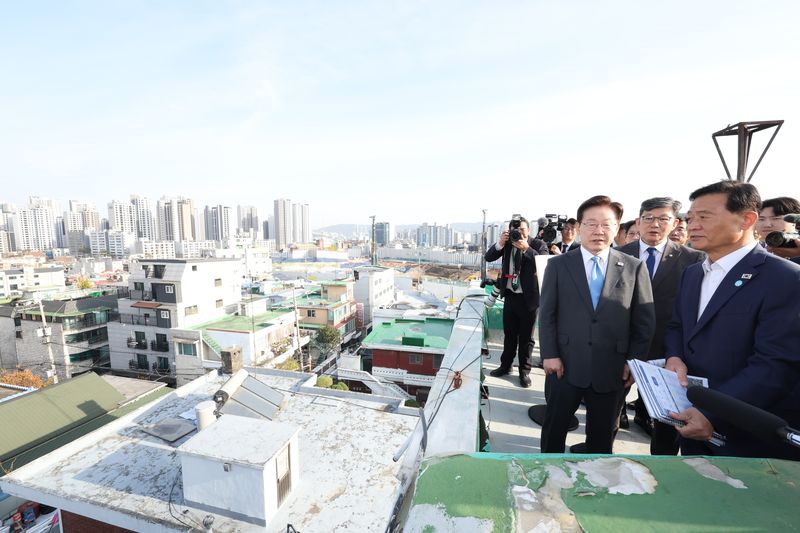
President Lee made the remarks at a field meeting on urban renewal projects held at the Jangwi 3-dong Community Service Center after inspecting the public redevelopment site in Jangwi 9 District, Seongbuk District, Seoul, that day. “From the government’s perspective, stabilizing housing prices in the Seoul metropolitan area can be called a core task more important than any other policy,” he said.
President Lee pointed to the prolonged delays in urban renewal projects and stressed the need to move them forward quickly. Recalling his experience as mayor of Seongnam, he said, “Urban renewal projects take far too long. Ten years is the norm, and sometimes they take 20 or even 30 years. I thought we needed to pick up the pace.”
He said public redevelopment was less susceptible to concerns about corruption and that government incentives could improve both the pace and viability of projects.
President Lee said, “The public redevelopment model clearly seems to have a number of advantages. Since the government has decided to provide various incentives, I think they could be of considerable help in terms of speed and project viability.” During his earlier site visit, he also stressed, in connection with redevelopment projects, “When the public sector does it, projects move faster and the potential for corruption is reduced.”
In particular, President Lee also called for a review of the system to ensure that projects are not delayed when members of a redevelopment association decide to switch a project already underway under the private-sector model to the public-sector model, while recognizing the procedures already completed.
He also called for the related bills to be handled promptly. “Swiftly processing bills pending in the National Assembly would greatly help move projects forward on the ground,” President Lee said. “It would be good if the chief of staff at Cheong Wa Dae could urge this as much as possible. It seems to be taking much longer than expected.”
Regarding the housing market, he identified concentration in the Seoul metropolitan area and a supply shortage stemming from past declines in permit approvals as major problems. “South Korea has a fundamental problem of concentration in the Seoul metropolitan area: land is limited, while the population keeps growing,” President Lee said, noting that this structure negatively affects housing prices. He added, “Since 2022, the number of housing permits has plunged, creating a supply cliff.” He also noted that although permits have recently begun to increase again, it will take time for that to translate into actual housing supply.
President Lee said, “People on the ground said that, realistically, the effects would not be felt until 2028 or 2029 at the earliest.” He said the government would therefore pursue balanced regional development and the supply of new residential land while also accelerating urban renewal projects in existing city centers.
President Lee stressed, “We will speed up decentralization from the Seoul metropolitan area and balanced regional development, and we are doing everything we can to increase the supply of new residential land wherever possible. We also need to pick up the pace on urban renewal projects.”
He also raised the need to support administrative procedures and expand incentives so projects can get underway early. “I think it would be good to strengthen various incentives, whether through floor-area ratios or financial support, when projects are carried out early,” President Lee said, adding that he would hear the participants’ views and take them into account in government policy.
[email protected] Choi Jong-geun Reporter