Cutting carbon capture costs... Soongsil University develops technology that boosts carbon dioxide separation performance 40-fold
- Input
- 2026-11-04 16:32:26
- Updated
- 2026-11-04 16:32:26
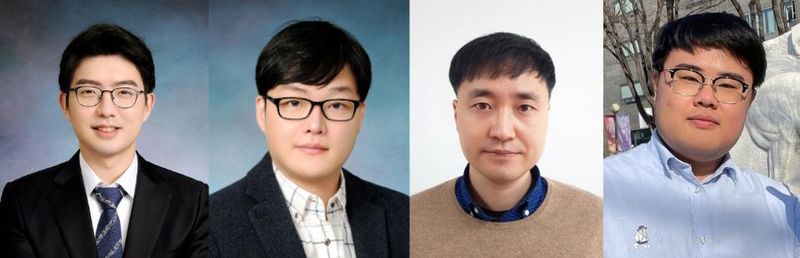
[Financial News] Korean researchers have developed next-generation membrane technology that can precisely filter out only carbon dioxide—the main culprit among greenhouse gases—from factory exhaust. By boosting separation performance at least 40-fold simply by mixing polymer materials, without complex equipment or processes, the technology is expected to significantly reduce future carbon capture (CCUS) costs. According to Soongsil University on the 4th, a research team led by Professor An Yun-ho of its Department of Chemical Engineering, working with teams led by Professor Lee Jong-seok of Sogang University and Professor Eom Gi-won of Soongsil University, developed a technology that uses polymer chains to finely control the size of the nanopores in porous (hole-filled) materials.
The porous material ZIF-8, previously studied for filtering out carbon dioxide, attracted attention because one gram had a surface area equivalent to more than half a soccer field. However, its flexible structure meant that its pores widened when gas actually entered, a limitation that made it difficult to precisely separate carbon dioxide and nitrogen, both smaller than 1 nanometer (nm).
The research team found a solution by mixing a flexible polymer material into the porous material. The principle is that polymer chains penetrate the pores inside the material while also wrapping around them, holding them in place so they do not widen arbitrarily. In effect, the material acts like a sieve, forming a fine mesh that filters out only particles of the desired size.
With this technology, selectivity in separating carbon dioxide from nitrogen rose dramatically to at least 40 times its previous level.
Professor An Yun-ho said, “We greatly improved performance simply by mixing a polymer into the existing membrane-manufacturing process, without a complicated and costly post-treatment process.” He added, “This technology will be used as a key means of improving the performance of various gas-separation membranes in the future.”
The research, conducted with support from the Ministry of Science and ICT, was published as an outstanding paper (Hot Paper) in the internationally renowned journal Angewandte Chemie International Edition.
[email protected] Kim Man-gi Reporter