First showdown in budget session over allocation of 162 trillion won Future Response Fund; local governments and education sector join in
- Input
- 2026-11-04 16:10:03
- Updated
- 2026-11-04 16:10:03
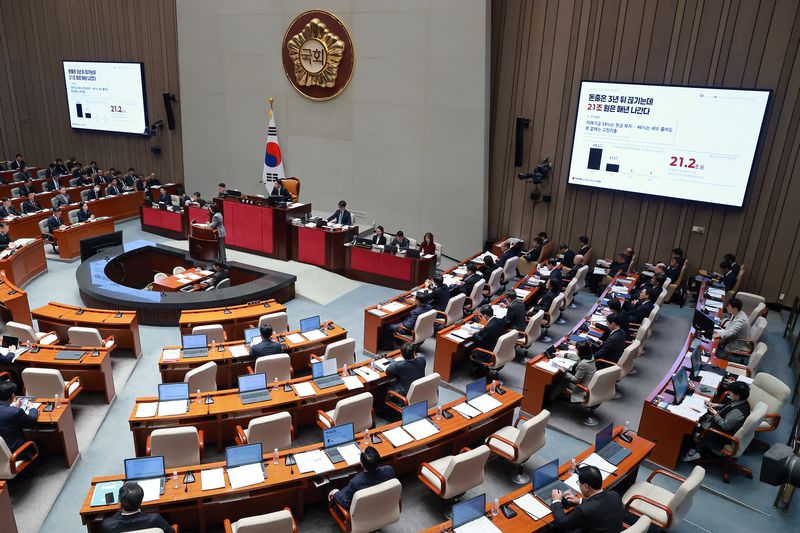
The National Assembly’s Special Committee on Budget and Accounts held a plenary meeting on the 4th and began comprehensive policy questioning on the government’s 2027 budget proposal. The day’s exchanges between the ruling and opposition parties focused on what to do with the 104.4 trillion won to be left in the fund. Na Kyung-won, a People Power Party lawmaker, pressed for a plan to finance ongoing projects that require about 21 trillion won a year, asking, “Additional tax revenue is expected to be zero from 2029. What will you do if the money runs out in three years?” Fellow party lawmaker Park Soo-young also noted that 94% of the fund’s 130 projects are multi-year projects and voiced concern about the fiscal burden after the semiconductor boom ends. The point was that, with national debt set to increase by about 106 trillion won net next year, the government should repay bonds first to reduce interest costs rather than build up surplus funds.
The Democratic Party of Korea, by contrast, argued that some tax revenue should be set aside when collections are high and drawn on when the economy weakens. Democratic Party lawmaker Ahn Do-geol compared major tax revenue shortfalls in the past with the recent surge in revenue amid the semiconductor boom, saying, “The problem is that it fluctuates so sharply.” Rather than spend all the additional revenue immediately or use it to repay government bonds, the argument was that funds should be kept in reserve to prepare for future shortfalls. Democratic Party lawmaker Lee Geon-tae also stressed the need for the fund, citing past cases in which local allocation tax and education grants were reduced because of tax revenue shortfalls.
The dispute over how to use the surplus funds also spread to the allocation of local grants. People Power Party members of the budget committee held a press conference that day and called for the 30.5 trillion won in local allocation tax being incorporated into the fund to be distributed to local governments as before. People Power Party lawmaker Yoon Jae-ok voiced concern about cuts to local finances, saying that while 30.5 trillion won in local allocation tax would go into the fund, only 15.3 trillion won would be allocated to local projects. Concerns were also raised within the ruling party that local governments would have fewer funds they could spend at their discretion. During that day’s comprehensive policy questioning, Democratic Party lawmaker Jeon Jin-suk noted that of the fund’s 15.2662 trillion won local account, only about 3.5 trillion won could be spent at local governments’ discretion, adding, “I don’t think we can avoid criticism that this constrains fiscal decentralization.”
After local allocation tax, opposition also continued over the money that goes to education offices. Under current law, 20.79% of domestic taxes is distributed to education offices as Local Education Subsidy Grants. But under the government’s proposal, some of the increased tax revenue would go to the Future Response Fund, potentially reducing the money available for education offices to spend. In response, the council of provincial and metropolitan education superintendents nationwide held a press conference at the National Assembly that day and proposed a compromise: keep the existing grant allocation ratio, but if grants rise by more than 5% from the previous year, put only two-thirds of the excess increase into the fund. The proposal was to support education finances from the fund if tax revenue declined. The superintendents said next year’s education budget would fall about 7 trillion won short of what was needed and called for the relevant legislation to be thoroughly reviewed by the National Assembly Education Committee.
[email protected] Jiwon Song Reporter