“Drama production down 30%” ... Why the K-drama industry is calling for production levels to recover
- Input
- 2026-11-04 21:39:26
- Updated
- 2026-11-04 21:39:26
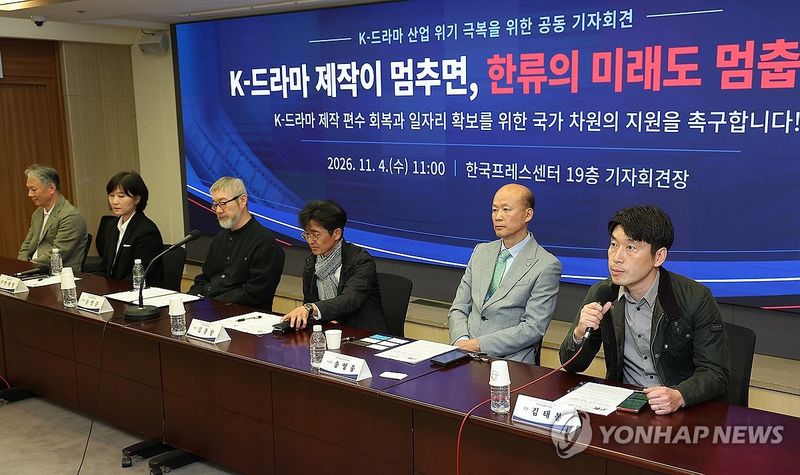
[Financial News] As the government unveils a blueprint to drive growth in related industries, including consumer-goods exports and tourism, through content such as K-pop and dramas, concerns are growing within the drama industry—the backbone of the Korean Wave—that “the industry could collapse.” Global hits continue to emerge, particularly on global OTT platforms such as Netflix, but the domestic production base is itself at risk of collapse.
Twelve organizations in broadcasting and drama, including the Korea Drama Production Association, held a joint press conference on the 4th at the Korea Press Center in Jung District, Seoul, and called on the government to make the recovery of annual drama production levels a national policy goal.
The key indicator of the crisis they cited was the number of productions. According to the association, domestic drama production fell by about 30% in just two years, from 141 titles in 2022. The industry’s concerns go beyond the decline in the number of shows. If production falls, leaving newcomers unable to gain experience and skilled workers departing the field, the industry’s very capacity to produce good dramas in the future will weaken.
Hits are being made, but the people who could make the next ones are disappearing
Asked that day why it was important to restore drama production levels, Song Byeong-jun, president of the Korea Drama Production Association, replied, “If there are 100 shows, the other 99 are far more important than the one successful drama.” He explained, “That’s because they attract talent, provide jobs, and allow diverse creative work to continue.” As numerous shows are made, new writers and actors are discovered, and crew members build up experience and skills. The point is that global hits are also born on that foundation.
Writer Park Hae-young, chair of the copyright committee at the Korea Television and Radio Writers Association (KTRWA), described how the crisis is playing out on the ground. “When a drama ends, you’re supposed to pass your assistant writers on to the next program or find them work there, but all the assistant writers who worked under me are out of work,” Park said. “Many assistant writers can’t find jobs.” Park said workers in the drama sector have begun moving into other fields, such as short-form and web-based content and games.
Kim Tae-bong, president of the Korea Broadcasting Cinematographers Association, also pointed out, “The biggest problem is a system that leaves crew members, who have built up years of experience and skills, unable to continue putting their accumulated expertise to use and with no choice but to leave the field.”
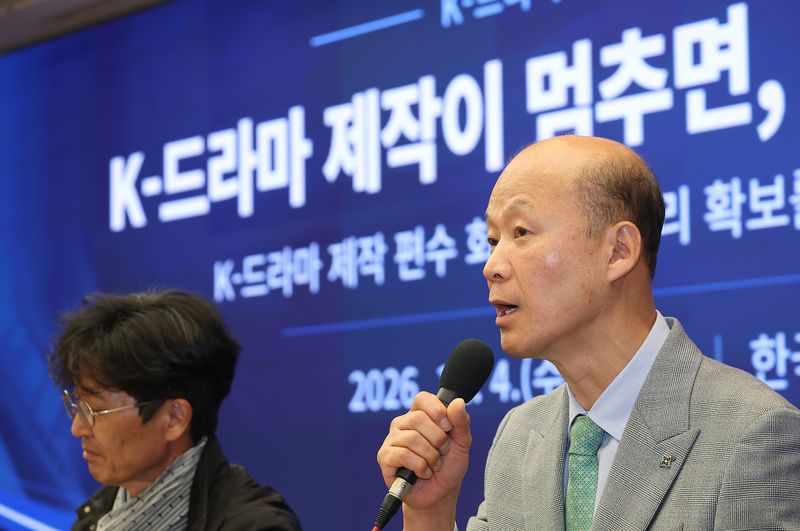
The Korea Broadcasting Performers’ Rights Association (KoBPRA), whose members include around 18,000 actors, voice actors and comedians, illustrated the crisis through declining royalties from secondary uses such as reruns. According to its chair, Song Young-woong, the association’s royalty collections fell from about 47 billion won in 2024 to about 34 billion won in 2025—a drop of roughly 13 billion won in a year. That amounts to a decline of about 28%.
Song stressed, “It wasn’t 1.3 billion won or 3 billion to 4 billion won that was lost—it was 13 billion won.” He also pointed out that, unlike traditional broadcasters, global OTT platforms such as Netflix use contracts that transfer rights in a lump sum, making it difficult for performers to receive separate royalties when their work is used again.
“200 billion won a year for five years” ... Support should cover production, programming and distribution
The drama industry also pointed out that government support budgets have actually been cut. According to the organizations, the Ministry of Culture, Sports and Tourism’s budget for broadcasting and audiovisual media in the 2027 government budget proposal fell by 4.5 billion won, from 91.8 billion won this year to 87.3 billion won. The Korea Media and Communications Commission’s budget for promoting broadcast content also declined by 4.4 billion won, from 16.8 billion won to 12.4 billion won. The organizations called for investment commensurate with the scale of the crisis, along with sustained policy support, as the production base comes under strain.
The industry’s proposed solution is a mid- to long-term investment and support system, with the government acting as a catalyst. Their joint statement called on the government to consider establishing a system worth 1 trillion won. The proposal is to invest a total of 1 trillion won over five years, at 200 billion won a year. Producing around 40 medium- and low-budget dramas—with production costs of about 800 million won per episode and about 10 billion won in total for a 12-episode series—would require around 400 billion won annually. The proposal is for the government to cover half of that amount. The association says the remainder could be covered by investment from platforms such as broadcasters and OTT services. Alongside government support, the industry also pledged to take steps of its own, including rationalizing production-cost structures and establishing fair production practices.
Park said that day, “My dream is to keep being able to watch entertaining dramas,” adding, “To make that possible, the priority is to build a foundation that allows us to keep producing dramas on our own, in line with the size of the domestic industry.” That would enable the K-drama ecosystem to remain self-sustaining even if global OTT platforms seek out other content and shift their investment elsewhere.
Song Byeong-jun said, “Organizations that sometimes hold different positions have agreed to speak with one voice because that shows just how urgent the current situation is.” He added, “Now is not the time to look back on past successes; it’s time to prepare for the next 10 years of K-dramas.”
Those attending the press conference included Kim Jong-chang, president of the Korea Drama PD Association; Song Young-woong, chair of the Korea Broadcasting Performers’ Rights Association; writer Park Hae-young, chair of the copyright committee at the KTRWA; Kim Tae-bong, president of the Korea Broadcasting Cinematographers Association; and Kim Ki-young, head of the Broadcast Staff Branch of the Hope Solidarity Labor Union.
[email protected] Shin Jin-a Reporter