Yoon’s suspended prison sentence upheld on appeal in ‘false statements’ case; People Power Party faces 39.7 billion won repayment
- Input
- 2026-11-04 15:12:39
- Updated
- 2026-11-04 15:12:39
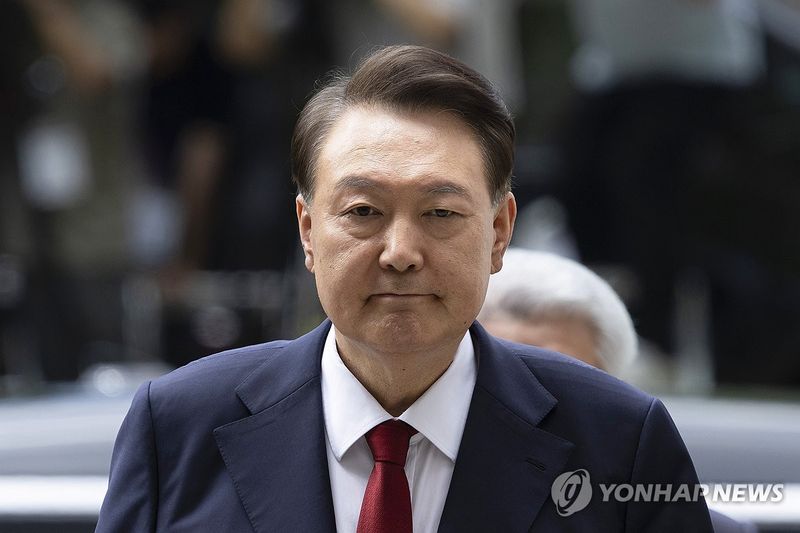
[Financial News] Former President Yoon Suk Yeol, who was indicted on charges of publicly making false statements about allegations related to the bribery case involving Woo Jin Yun, the former head of the Yongsan Tax Office, and Jeon Seong-bae, known as “Geomjin Bopsa,” during the 2022 South Korean presidential election, was given a suspended prison sentence on appeal as well. The prison sentence from the first trial—one that would invalidate his election if finalized—was upheld, increasing the likelihood that the People Power Party will have to return an amount totaling about 39.7 billion won in campaign expenses, its candidate deposit and other costs.
On the 4th, a three-judge panel of the Seoul High Court’s Criminal Division 2-1 (High Court Judges Baek Seung-yeop, Seung-tae Hwang and Kim Young-hyun) rejected the appeal by the former president, who had been indicted for violating the Public Official Election Act, and sentenced him to one year and six months in prison, suspended for three years, as in the original ruling.
The former president was accused of making a false statement at a Kwanhun Club debate on December 14, 2021, saying, “I did not officially retain him, nor was I really in a position to introduce him,” despite having introduced lawyer Lee Nam-seok in connection with the bribery case involving the former tax chief. The charges also included publicly making false statements after the Buddhist Leaders Forum event on January 17, 2022, when he told reporters that he had met Jeon through an introduction by a party official and had never met him together with his wife, Kim Keon Hee.
The panel found both statements at the heart of the case to constitute the public announcement of false facts. It noted, “Judging by the overall impression the remarks would have made on voters, the remarks at the Kwanhun Club debate would have been understood to mean, from both a legal and factual perspective, that he had not put the lawyer in touch with the former tax chief.” It continued, “In light of the contents of a 2012 media interview and records of calls and text messages made using a burner phone, it is established that the former president introduced the lawyer,” and rejected the defense’s claim that the defendant had given a false interview to protect former prosecutor Yoon Dae-jin.
Regarding the remarks about Jeon, known as “Geomjin Bopsa,” the panel also explained, “His wife, Kim Keon Hee, had maintained a close relationship with Jeon since March 2013, and it is also established that the defendant met Jeon through his wife’s introduction and received advice from him on major changes in personal circumstances, such as imprisonment or demotion, as well as current political issues.”
In particular, it ruled that “the explanation that he had met Jeon by chance during the election campaign and had never met him together with his wife before was clearly false and contrary to the objective facts.”
The former president’s side had argued that, when he made the remarks about Jeon Seong-bae, “he answered quickly as reporters fired questions at him in a frenzy,” and that “they portrayed his answers as false statements even though he could have simply gotten into the car without responding.” At trial, they also played video footage of the incident and used it in their arguments.
The panel, however, drew a distinction, saying, “The Kwanhun Club debate was not a back-and-forth between candidates but a format in which a single invited candidate answered questions from a panel, and the interview immediately after the forum was also a question-and-answer session with reporters.” It added, “Its nature differed from a typical candidates’ debate, where impromptu exchanges take place under time and format constraints, so this cannot be viewed as a misunderstanding of the law.”
Explaining its reasons for the sentence, the panel said, “The defendant’s remarks were key evidence for assessing his morality and fairness as a senior public official, and for determining whether there was a risk that behind-the-scenes groups would influence his future administration.” It noted, “Given that the presidential candidates were in a close race, with their approval ratings within the margin of error, the impact on the election was far from negligible.”
It added, “If judges reduce a sentence out of excessive consideration of the political fallout that could result if it becomes final, such as the invalidation of the election or a party’s repayment of campaign costs, sentencing could be distorted,” and said, “The lower court’s discretion in sentencing was exercised within a reasonable range.”
Under the Public Official Election Act, if a sentence of a fine of at least 1 million won for an election-related crime becomes final, the party to which the candidate belongs must return reimbursed expenses, the candidate deposit and other amounts. If the former president’s sentence becomes final, the People Power Party will have to repay 39.7 billion won.
The former president’s side said, “We take the panel’s ruling very seriously, but we see errors in the evidence and legal reasoning,” adding, “We will appeal to the Supreme Court as soon as possible.”
[email protected] Lee Chang-hoon Reporter