AI to Detect Weapon-System Failures; KAI Launches Development with a 29.3 Billion Won Investment
- Input
- 2026-11-04 14:44:20
- Updated
- 2026-11-04 14:44:20
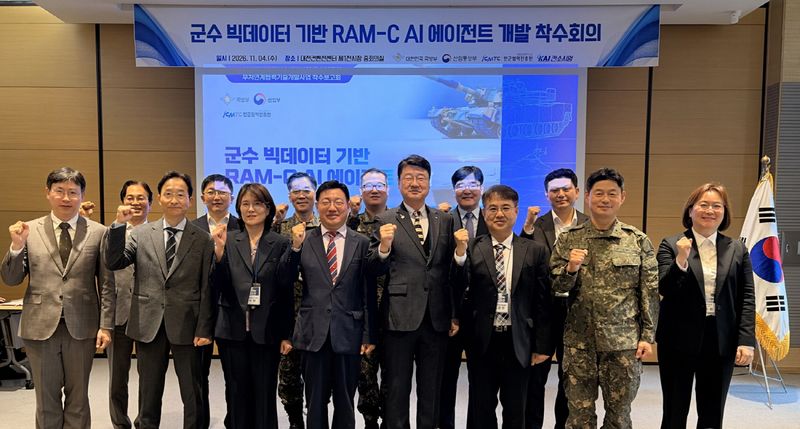
[Financial News] Korea Aerospace Industries (KAI) is developing an integrated logistics analysis platform that uses artificial intelligence (AI) to predict failures in weapons systems and manage maintenance and repair costs.
KAI said it held a kickoff meeting for the ‘RAM-C AI Agent’ development project at the Daejeon Convention Center on the 4th, attended by around 100 people, including officials from the Ministry of National Defense, the Ministry of Trade and Industry, the Civil-Military Cooperation Promotion Agency, the military and the government. The project is a cross-ministerial collaborative technology development initiative funded by the Ministry of National Defense and the Ministry of Trade and Industry and overseen by the Civil-Military Cooperation Promotion Agency of the Agency for Defense Development. The total project budget is 29.3 billion won, and development will take 48 months. KAI was selected as the lead research and development organization in September and signed an agreement with the Civil-Military Cooperation Promotion Agency.
RAM-C stands for Reliability, Availability, Maintainability and Cost in relation to weapons systems. It is a concept for evaluating operational efficiency and cost-effectiveness by analyzing data generated throughout a weapons system’s entire lifecycle, from acquisition through operation and maintenance, capability upgrades and retirement.
Through this project, KAI plans to build a platform that integrates and analyzes weapons-system operation and maintenance data and uses AI to predict the likelihood of failures, when parts need to be replaced and maintenance costs. In particular, it will develop conversational AI agent technology that searches and analyzes military logistics big data to provide information needed for maintenance and operations when users ask questions in natural language.
Demonstrations using actual weapons systems will also be conducted. KAI will form a domestic consortium and carry out phased demonstrations using operational, maintenance and sensor data from major Army, Navy and Air Force weapons systems, including the FA-50 light attack aircraft, the K2 Black Panther tank, the Maritime Surveillance Radar-II and naval vessels. Through this, it aims to verify the technology’s potential for field application and lay the groundwork for eventually expanding it across all branches of the armed forces.
KAI expects that once development is complete, the technology will be able to predict weapons-system failures in advance, minimize operational downtime and increase availability. The company said it could also strengthen its competitiveness in follow-on logistics support (MRO), including maintenance and parts supply for countries that purchase its weapons.
Park Gyeong-eun, executive vice president and head of KAI’s CS Division, said, “This research is significant because it will help us secure data-driven logistics decision-making technology that combines logistics data and AI to increase weapons-system availability and operational efficiency. Through demonstrations of weapons systems on land, at sea and in the air, we will improve the technology’s applicability in the field and expand its use to K-defense exports and follow-on logistics support.”
[email protected] Jung Won-il Reporter