“From exclusive products to dawn delivery”... Food companies compete through their own online stores in a 22 trillion won market
- Input
- 2026-11-05 14:30:33
- Updated
- 2026-11-05 14:30:33
[Financial News] Quarterly online shopping transaction value topped 74 trillion won, setting a new all-time high. The rapid growth of online grocery shopping played a major role, with food services and food and beverage products accounting for nearly 30% of the total. In response, major domestic food companies are focusing on attracting online customers by strengthening their own online stores with exclusive products and dedicated benefits.
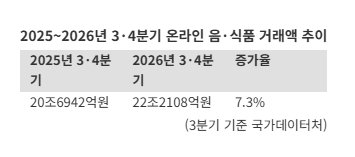
According to the Ministry of Data and Statistics on the 5th, total online shopping transaction value in the third quarter of this year rose 6.4% year on year to 74 trillion 431.9 billion won, the highest quarterly figure on record. Of that total, food services and food and beverage products accounted for 11 trillion 391.7 billion won and 10 trillion 819.1 billion won, respectively, for a combined 22 trillion 210.8 billion won. That was 1 trillion 516.6 billion won, or 7.3%, more than the combined total of 20 trillion 694.2 billion won in the third quarter last year, also a record high.
With online grocery spending rising sharply, food companies are moving quickly to revamp their own online stores to reduce their dependence on major e-commerce platforms and build direct relationships with loyal customers.
CJ CheilJedang has significantly expanded the product range and membership benefits of its official online store, CJ The Market. It has introduced exclusive products available only through its store, including thin-skinned Wang Gyoja dumplings and Hetbahn Cheonji Hyangmi rice, while broadening its curation to include outside brands as well as its own products. In line with the health-conscious trend, it brought in Grocery Seoul, a low-sugar bakery brand, and established a mutually supportive system to discover local brands that reflect the distinct character of each region and help them find sales channels.
Since May, it has received a positive response to The Dream, an experiential program offering coupons for CGV, TVING and Tous Les Jours or wellness kits, as well as hosting in-person cooking classes. As of September this year, the cumulative number of members had reached 4.876 million, up 15.6% from the same period a year earlier, while monthly active users (MAU) of its mobile app also topped 1.1 million. Cumulative sales from January to September this year were up about 11% year on year.
Ottogi is developing Ottogi Mall beyond a simple sales channel into a way to communicate with consumers. When customers request discontinued products that are hard to find on the market, the company takes those requests into account in managing its product lineup, and it runs a curation service that groups products around a specific theme each month. Last September, it opened Mat-it-da Hall, which showcases regional specialty brands, and has featured brands such as Jeju Dameum and Jukjangyeon. As a result, payments made through Ottogi Mall from January to September this year surged about 29% year on year.
Pulmuone has highlighted the delivery capabilities and artificial intelligence (AI) services of its official online store, #Pulmuone, as key differentiators. It is the only online store operated by a food company to offer all three services—dawn delivery, daily delivery and store delivery—allowing customers to choose how to receive their orders based on their needs. It has also introduced AI-powered product recommendations and review analysis, and revamped its user interface and user experience (UI/UX) to make shopping more convenient.
One factor driving food companies to strengthen their own online stores is that the more members they attract, the more consumer purchase data they accumulate in their customer relationship management (CRM) systems. Franchise headquarters can use this data to improve operational efficiency, including minimizing wait times at stores, and offer personalized membership benefits, building a stable revenue base.
A food industry official said, “By strengthening their own online stores, companies can save on fees paid to external retail platforms while directly obtaining consumer purchase data to use in planning new products and marketing,” adding, “Competition among own online stores will become even fiercer.”
[email protected] Park Kyung-ho Reporter