"Women Built South Korea's 'Apartment Republic'" [fn Insight]
- Input
- 2026-11-04 14:27:16
- Updated
- 2026-11-04 14:27:16
One in two Koreans lives in an apartment. According to last year's Population and Housing Census, 12.26 million households—54.5% of all ordinary households—live in apartments. Apartments make up 65.8% of all housing, or roughly two out of every three homes. Yet there is no satisfying answer to the question of “why.” The answer offered by Park Won-gap, a senior real estate expert at KB Kookmin Bank, was unexpected: “The apartment culture in our country is a culture created by women.”
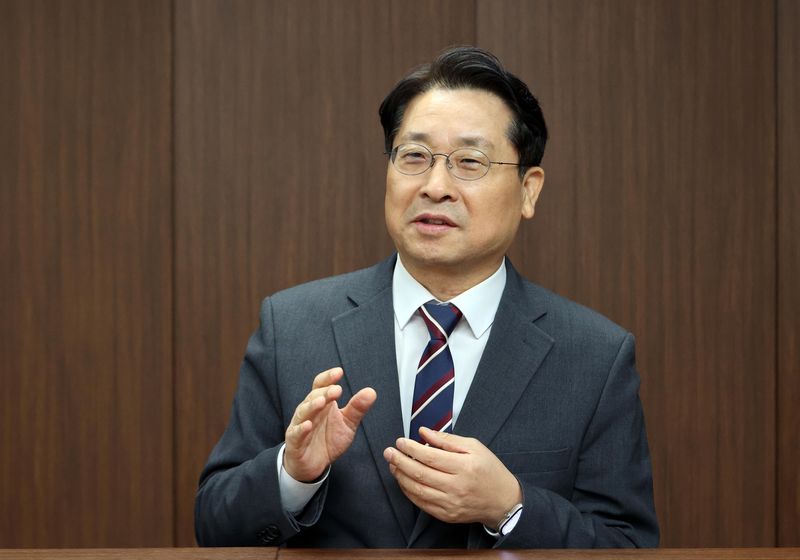
[Financial News] Park Won-gap, a committee member (Photo) met with Financial News on the 4th and traced how South Korea became a concrete republic, saying, “A society where only apartments are traded—not land, commercial properties or detached houses—has emerged, an ‘apartment-only society.’”
The 'Flight to Apartments' Driven by Unplanned Development in Gangbuk
The starting point was “who lived there first.” Park said that apartments remained unfamiliar places through the Chungjeong-ro Apartment in 1932, the Jongam Apartment in 1958 and the Mapo Apartment in 1962. The turning point was Hangang Mansion in Dongbu Ichon-dong. “The country’s first model home appeared there. A model home is a showroom that sells the dream that ‘I, too, would be happy if I lived there,’” he said. “TV actress Kang Bu-ja was the first to sign a contract, and as the upper-middle class embraced apartments at the time, they became a symbol of the middle class in Korea, though they were affordable rental housing for ordinary people abroad.” He compared this to “a cheap trifoliate orange abroad that comes to Korea and becomes a tangerine.”
The appeal of apartments was also relative. “Detached houses in London are designed around courtyards, but our detached houses are effectively three- or four-story multi-family and multi-unit buildings,” Park said. “Because unplanned development has left even cars unable to get in and living conditions are poor, people took refuge in apartments.” He added, “There’s a saying that even a wealthy neighborhood becomes a poor one if you build studio apartments. The idea of demolishing apartments and returning to detached houses, as in France, is unrealistic. Culture is irreversible.”
The Rise in Women's Status Created a Preference for Apartments
Women were the key force behind the “Apartment Republic.” Park called this “Sheconomy (She + Economy).” “The height of the kitchen determines women’s social status,” he said. “In hanok, heating and cooking were done together, so the kitchen had to be lower than the courtyard. But in apartments, the kitchen and living room are at the same level. In a compact space, efficiency and practicality take the place of patriarchal authority.” He said design changes that bring the kitchen into the living room, such as island counters, reflect the same trend. He described apartments as “convenience + premium”—the pinnacle of “convenience-premium.”
Safety was another factor. “The psychological basis for the shift toward apartments isn’t ‘value for money’ but ‘value for safety’—a willingness to pay more for safety, a housing mindset that prioritizes security,” Park said. “Women see not only the inside of the home but also the perimeter fence and vehicle gate as an ‘extended living room’ that needs to be protected. In that sense, the complex is part of the home, not outside it.” For the same reason, younger people see officetels as “mini apartments” and “concrete castles.” He said, “You can understand real estate trends only by looking at them through the eyes of young women, not from the perspective of an old fogey.”
Apartments Become Financial Products
Turning apartments into assets was the next step. “Apartments are, in practice, not real estate. They are standardized and uniform, so people even call them quasi-financial products,” Park said. “If the apartment next door sells for 1 billion won, it stands to reason that ours is worth 1 billion won too. That makes apartments highly liquid, and also more volatile than detached houses.” He added, “The supply of 2 million housing units in the 1990s strengthened the view of real estate as an investment. A recent paper finds that when people buy a home, they value its function as an investment asset (‘house’) 3.5 times more highly than its function as a place of refuge (‘home’). The values have been turned upside down.”
However, he pushed back against the conventional wisdom that money leaving real estate flows straight into the stock market. “Land compensation used to see 8 billion won out of every 10 billion won flow back into real estate, but now the figure is around 20%,” Park said. “Stocks are volatile assets, so the older people are, the more they tend to keep their money in deposits or short-term funds. It’s true that money is going into financial markets, but it’s hard to say categorically that it’s all going into stocks.” He summed up: “This is no longer an era of buying two homes; it’s an era of buying one and putting the rest into stocks.” Ultimately, he said, the choice depends on each person’s investment experience and ability to withstand volatility.
“The Trend Is Upward, but What’s Most Frightening Is How Much Prices Have Risen”
His outlook was close to cautious optimism. “Have you ever seen a capital city collapse while per capita national income is rising? Seoul’s competitiveness, built over 700 years, won’t disappear easily,” Park said. “The Cantillon effect, whereby increases in the money supply are first reflected in high-quality assets, also comes into play. The value of downtown areas doesn’t easily collapse.”
However, he cautioned against short-term overheating. “Some areas have risen 16% since the start of this year. The scariest thing in the world is when prices have risen a lot,” he said. “When prices become inflated, they are more vulnerable to external shocks.” Interest rates are another variable. “Interest rates are the gravity behind all asset prices,” Park said. “If the base rate is around 3.25%, the impact is limited, but if it reaches 3.5%, that changes the picture. There’s a precedent: during the high-interest-rate shock originating in the United States, actual transaction prices in the Seoul metropolitan area plunged 20%.” He also cited Canada, where housing prices fell despite a shortage of supply.
[email protected] Han Young-jun Reporter