K-Soju’s Status as an Export Favorite Wavers This Year ... Low-ABV Drinks Reshape Korea’s Liquor Export Landscape
- Input
- 2026-11-05 08:33:13
- Updated
- 2026-11-05 08:33:13
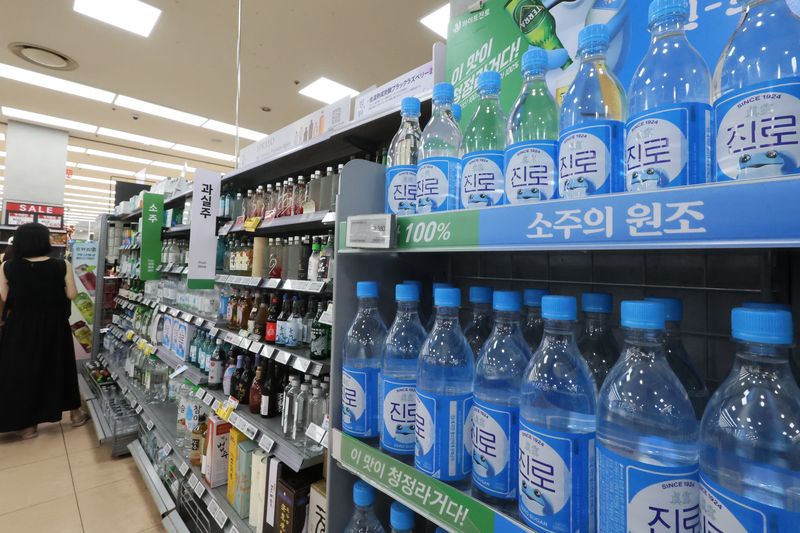
[Financial News] The global export landscape for Korean alcoholic beverages is changing rapidly. While growth in regular soju, long hailed as an export success amid the K-content boom, has slowed, beer and fruit soju (liqueurs) are driving performance and reshaping liquor exports. The global shift in drinking culture toward avoiding spirits and choosing lower-alcohol, easy-to-drink beverages is seen as a key factor behind the diverging fortunes of Korean liquor exports.
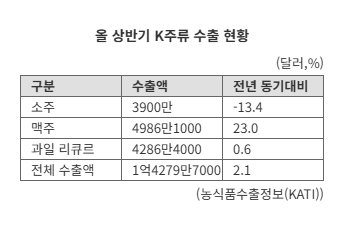
According to Agri-Food Export Information (KATI) on the 5th, total exports of Korean alcoholic beverages in the first half of this year reached $142.797 million, up 2.1% from the same period last year.
The leading contributor to the rise in exports was Korean beer. Beer exports in the first half of this year surged 23.0% year over year to $49.861 million. The increase reflected both greater awareness of K-culture and efforts by Korea’s liquor industry to expand its distribution networks in overseas markets.
Fruit soju (liqueurs), which has targeted overseas millennials and female consumers with a variety of fruit aromas and sweet flavors, also maintained steady performance. Exports of fruit soju edged up 0.6% year over year to $42.864 million.
Regular soju, by contrast, a leading product in Korean liquor exports, continues to struggle. Exports of regular soju in the first half of this year plunged 13.4% year over year to $39 million. Observers say it is unusual for regular soju, once a major export success, to post a double-digit decline.
This is seen as a result of a paradigm shift in the global liquor market. Around the world, a culture of “healthy drinking” and low-alcohol beverages is spreading, as people avoid excessive drinking and opt for lighter drinks.
Instead, demand is shifting toward beer with an alcohol content of around 4–5% ABV that is easy to drink, fruit soju made by mixing fruit juice with a soju base to lower its alcohol content, and canned RTD (ready-to-drink) beverages.
“There is a clear preference for low-alcohol beverages with added aromas and flavors over spirits, particularly among young local consumers in Southeast Asia as well as in North America and Europe,” an industry official said. “As these products enter major local distribution channels, the pattern of regular soju consumption, once centered on Korean neighborhoods and Korean restaurants, is shifting toward fruit soju and beer.”
Buoyed by growth in beer and fruit soju, total exports of Korean liquor have continued to rise for five consecutive years.
Exports increased from $246.875 million in 2021 to $276.42 million in 2022 and $293.413 million in 2023. They then reached $303.166 million in 2024 and $304.663 million in 2025, posting record-high results year after year.
However, there are also calls for an urgent overhaul of the sector if Korean liquor is to firmly establish itself as a global mainstream beverage.
“To move beyond soju as a single product, localization strategies need to be put in place, including developing low-alcohol products tailored to local consumers’ tastes and cultures, diversifying packaging, and expanding supply agreements with major local distribution networks,” an industry official said.
[email protected] Kim Seo-yeon Reporter