“Right Outside Our Home, Yet We Had No Idea” ... Moves to Curb Opaque Data Center Construction
- Input
- 2026-11-04 15:15:44
- Updated
- 2026-11-04 15:15:44
According to a partial amendment to the Building Act submitted to the National Assembly of the Republic of Korea on the 4th, 10 lawmakers, including Democratic Party lawmaker Han Jeoung-ae, introduced a bill on the 30th of last month to classify data centers as a separate building use and allow building permits to be denied if a project is unsuitable for the surrounding environment. The bill is open for public comment until the 12th.
The bill would require data centers above a certain size, to be set by Presidential Decree taking into account factors such as the capacity of power-receiving facilities, to undergo review by a building committee before applying for a building permit. Developers would have to hold briefings for nearby residents before applying for a review. The specific size threshold and format for the briefings would be set by Presidential Decree.
Building committees would review electromagnetic fields, noise and vibration, heat generation, fire risks, and impacts on the power grid, among other factors. The bill would also provide grounds to deny a permit following a review if a site is deemed unsuitable because of its impact on nearby residential and educational environments, regardless of its zoning classification. The relevant permit and review requirements would also apply when an existing building is converted into a data center.
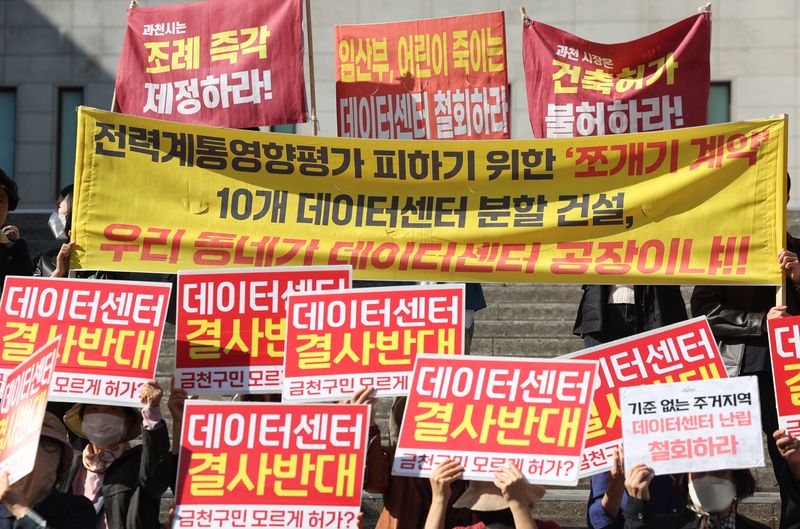
The legislation comes amid conflicts over data center construction. In Gwacheon’s Juam District, disputes over plans to build a data center have continued since the early stages of the project. Prospective residents of the nearby The H Adel Star apartment complex and others have demanded that the building permit be denied and that setback standards be established, saying the data center would be built about 50 meters from a residential area. Plans to build a data center on a site in Yangpyeong-dong, Yeongdeungpo District, about 1 meter from a row-house complex have also sparked controversy.
In Ichon-dong, Yongsan District, opposition was also voiced over a lack of advance notice during plans for a data center with a power-receiving capacity of 9.8 MW. At a residents’ briefing on August 6, most of the approximately 200 attendees walked out together, disrupting the event. Residents are concerned about noise and vibration from equipment operating 24 hours a day, as well as fire risks.
Residents object that they learn about projects only after building permit applications or reviews are already underway, leaving them little opportunity to have their views considered. Under current law, data centers are classified as a subcategory of broadcasting and telecommunications facilities. The law has therefore been criticized for lacking adequate mechanisms to separately assess impacts on residential and educational environments at the site-selection stage. The bill also identifies as an area for improvement the system that makes it difficult for local governments to deny permits on the grounds of impacts on the surrounding environment when statutory requirements are met.
Industry concerns have also been raised that stricter reviews could lengthen project timelines and overlap with existing permitting and environmental regulations. “The review criteria and processing times need to be clearly defined so that those of us carrying out projects can also have predictability,” an industry official said.
If passed, the bill would take effect six months after promulgation. The strengthened permit and review requirements would apply to relevant applications filed after the law takes effect.
[email protected] Choi Ga-young Reporter