K-drama, a driver of Hallyu exports, “at risk of collapse” ... 12 drama industry groups speak with one voice [Full text]
- Input
- 2026-11-04 13:52:16
- Updated
- 2026-11-04 13:52:16
[Financial News] Domestic drama production companies, writers, actors, broadcasters, producers and crew members have warned that the sharp drop in the number of productions could lead to the collapse of the industry, and called on the government and National Assembly to respond. They are calling for the recovery of annual drama production numbers to be made a national policy goal and for a long-term investment and support system worth 1 trillion won to be established.
“K-drama’s production base at risk of collapse”
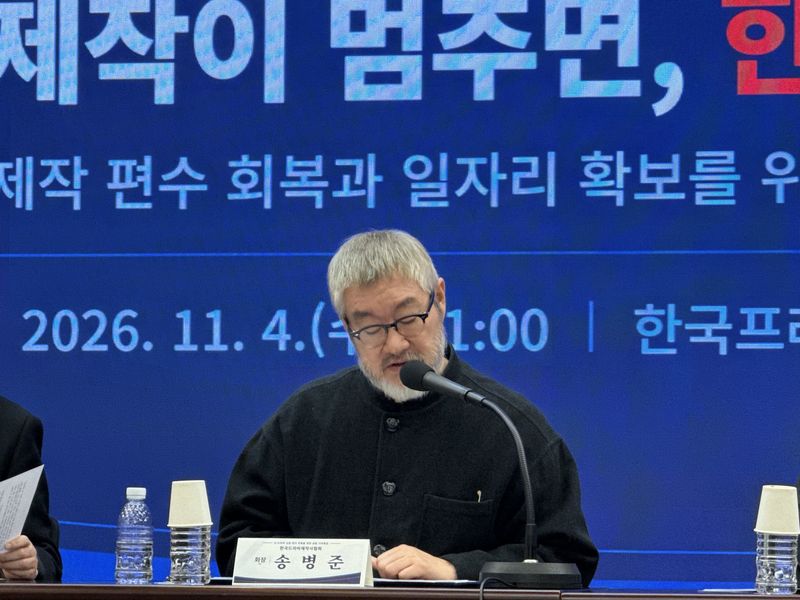
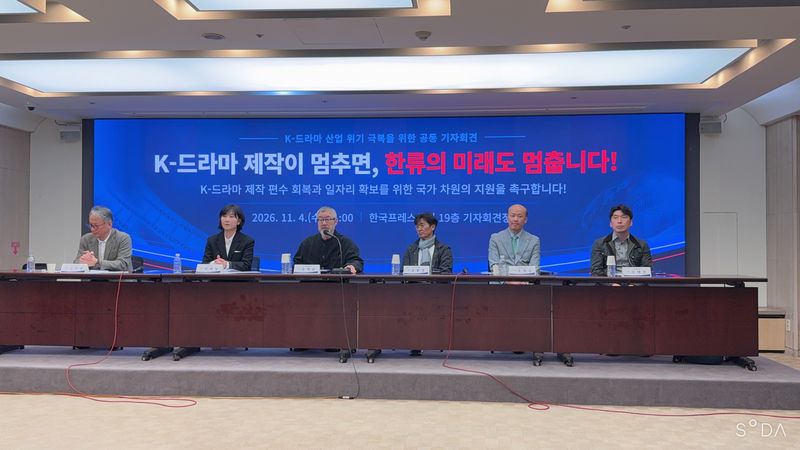
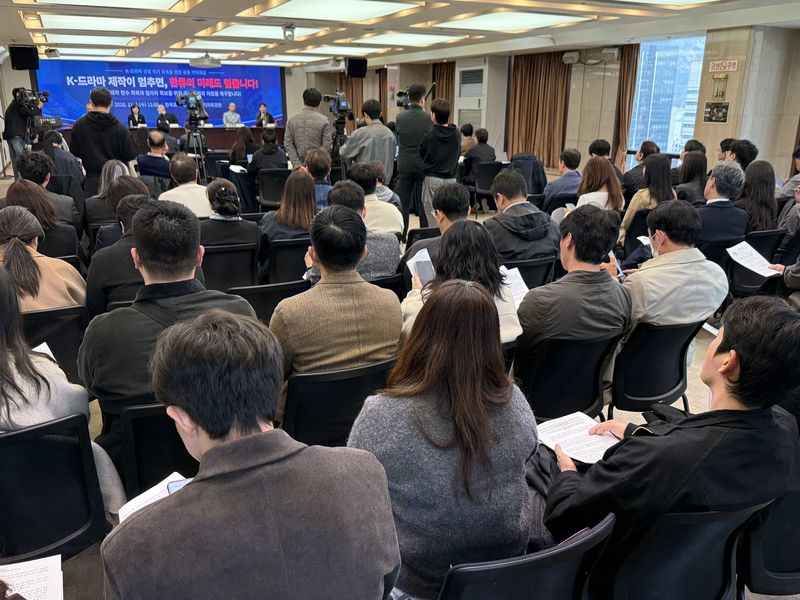
Twelve organizations involved in broadcasting and drama, including the Korean Drama Producers Association, held a joint press conference on the 4th at the Korea Press Center in Jung District, Seoul. They said, “The production base for K-drama is at risk of collapse,” adding, “This is a national challenge that Hallyu and the national economy must address together, beyond the business difficulties of a single industry.”
According to figures compiled by the Korean Drama Producers Association, the number of domestic drama productions fell by about 30% in just two years, from 141 in 2022. The organizations attributed the decline to a combination of factors, including rising production costs resulting from the production models of global over-the-top (OTT) services, reduced capacity among traditional broadcasters to invest in and schedule programming, and production companies’ difficulty securing intellectual property (IP) rights and subsequent revenue.
They expressed particular concern that the decline in production numbers was reducing jobs and creative opportunities, prompting skilled workers to leave and, in turn, weakening the production capabilities of the industry as a whole. They emphasized, “A rookie writer’s second project, a supporting actor’s first leading role, and an assistant crew member’s directorial debut were possible in an environment where projects were produced steadily,” and that “a production base that has once collapsed cannot be restored immediately just because market conditions improve.”
They called on the government and National Assembly to set the recovery of annual drama production numbers as a national policy goal; consider establishing a long-term K-drama investment and support system worth 1 trillion won; and pursue a coordinated response across relevant ministries while considering support for mid- and low-budget productions and emerging talent during deliberations on the 2027 budget.
Song Byeong-jun, chairman of the Korean Drama Producers Association, said, “The fact that organizations that sometimes have different positions have decided to speak with one voice shows just how urgent the situation is,” adding, “Now is not the time to look back on past successes, but to prepare for the next 10 years of K-drama.”
The full text of the joint press statement follows.
The drama industry, at the heart of K-culture, is on the brink of collapse
—We urge the government and National Assembly to make a decisive move for the next 10 years of K-drama
Drama is at the heart of K-culture and a key driver of economic spillover into various industries, including consumer goods exports and tourism. Interest in Korea sparked by K-drama spreads to food, cosmetics, fashion and tourism, increasing Hallyu’s economic value.
Yet domestic drama production is facing a serious crisis. The number of domestic drama productions fell by about 30% in just two years, from 141 in 2022. The decline is the result of a combination of factors, including rising production costs due to the production models of global OTT services backed by massive capital, reduced investment and programming capacity among traditional broadcasters, and production companies’ difficulty securing intellectual property rights and subsequent revenue.
The sharp decline in production numbers is a warning that the industry could collapse. As production falls, jobs and creative opportunities disappear, while the departure of skilled workers and production teams further weakens the industry’s overall production capabilities, creating a vicious cycle.
Drama production companies, writers, actors and performers, and broadcasting-related organizations have come together today, recognizing the seriousness of the current crisis and calling for urgent, effective policy action. K-drama’s production base is at risk of collapse. This is a national challenge that Hallyu and the national economy must address together, beyond the business difficulties of a single industry.
The industry has already reached its limit.
Production costs have soared, while the number of productions and businesses able to bear them has fallen.
Broadcasters’ capacity to schedule and invest has contracted sharply. Drama slots on the three terrestrial broadcasters fell from 91 in 2012 to 32 in 2023, and some channels have even stopped scheduling weekday dramas. Production costs can no longer be recouped through advertising revenue alone. In a system where investing more in dramas means taking greater losses, cutting production has become a rational choice for broadcasters.
The success of one production is not carrying over to the next. Production companies bear the risks of development and production but struggle to secure intellectual property rights and subsequent revenue. Writers, actors, performers and crew members cannot continue their careers without another project.
When a production falls through, the jobs and careers of the many people who could have worked on it come to a halt as well. A rookie writer’s second project, a supporting actor’s first leading role, and an assistant crew member’s directorial debut were possible in an environment where projects were produced steadily and opportunities to take on new challenges continued. Those leading K-drama today also grew through that pathway. If it is cut off, the next generation will struggle even to enter the industry. A production base that has once collapsed cannot be restored immediately just because market conditions improve.
K-drama’s value extends beyond drama itself. According to the Ministry of Culture, Sports and Tourism and the Korean Foundation for International Cultural Exchange (KOFICE), total exports related to Hallyu in 2025 amounted to $18.975 billion (about 25.616 trillion won), of which consumer goods and tourism exports accounted for $8.788 billion (about 11.8638 trillion won). These results were achieved through the combined efforts of various Hallyu content, with drama serving as a key driver of that momentum. The everyday life in Korea shown in dramas has sparked interest in food, cosmetics, fashion and tourism. Strengthening the production base for drama is a national investment that goes beyond supporting the content industry: it drives exports and tourism and enhances Korea’s cultural standing and national brand value.
So who will invest in new dramas and take on the risk of failure going forward? Broadcasters have lost their capacity to invest, domestic OTT services continue to face limits on profitability, and private investors’ expectations have fallen considerably. As each cuts investment to survive, the foundation for creating the next generation of productions is growing thinner.
The government has also continued efforts to strengthen the industry’s competitiveness, including expanding policy financing for content and supporting productions that secure drama intellectual property. But the current crisis has gone beyond what can be addressed by increasing funding for individual programs. With production numbers down nearly 30% in two years and broadcasters’ programming and investment sharply contracting, this is not a normal period but a serious crisis. At its core, the crisis lies in the very production base of the industry being shaken.
Even so, policy remains stuck in the inertia of normal times. In the government’s 2027 budget proposal, the Ministry of Culture, Sports and Tourism’s budget for broadcasting and audiovisual media fell by 4.5 billion won, from 91.8 billion won in 2026 to 87.3 billion won in 2027. The Korea Media and Communications Commission’s budget for promoting broadcast content also fell by 4.4 billion won, from 16.8 billion won in 2026 to 12.4 billion won in 2027. Given the scale and economic contribution of the broadcasting and audiovisual industry, with sales of about 25 trillion won and exports of about 1.6875 trillion won (about $1.25 billion), government support remains insufficient.
During the same period, Japan made the overseas expansion of live-action content, including drama, a national strategy, setting a target of at least 250 billion yen in exports by 2033 (about 2.25 trillion won) and requesting five times this year’s budget for related programs for next year. There is a clear difference between how a competing country is responding to the crisis and how we are responding. What is needed now is bold, strategic investment commensurate with the scale of the crisis, along with sustained policy measures that make a tangible difference to the industry and a coordinated, whole-of-government response.
As the government and our society focus on K-drama’s success, we cannot help but ask whether they also fully recognize that the industry that made that success possible is now in the midst of a serious crisis.
If the scale of the crisis has changed, so too must the scale and nature of the response. We therefore urge the government and National Assembly to take the following steps.
First. The government should set the recovery of annual drama production numbers as a national policy goal. Productions across a range of genres, including mid- and low-budget projects as well as major productions, must be made on a sustained basis. Restoring production numbers means protecting jobs in the industry and growth opportunities for emerging talent.
Second. We ask the government to actively consider establishing a long-term K-drama investment and support system worth 1 trillion won. New investment funds, with the government acting as a catalyst, are needed to offset broadcasters’ reduced capacity to schedule and invest and the downturn in private investment. This investment should target the production base of the drama industry as a whole. It should be strategic investment that restores the cycle of investment, production, distribution, revenue recovery and reinvestment, rebuilding the entire industry ecosystem. A foundation should also be established to ensure that productions receiving investment can be scheduled and distributed in partnership with domestic broadcasters and OTT services. We propose that the government, broadcasters and production companies jointly design the funding period, composition of funds and operating model.
Third. The government and National Assembly should recognize the crisis in the drama production industry as a national policy challenge and mount a coordinated response. The relevant ministries—the Ministry of Culture, Sports and Tourism and the Korea Media and Communications Commission (KMCC)—should consult with production professionals and begin designing a long-term investment system, while the National Assembly should consider support for mid- and low-budget productions and emerging talent during deliberations on the 2027 budget.
We, too, will fulfill our responsibilities. We will rationalize production cost structures and establish fair production practices.
Now is not the time to celebrate past successes. It is time to prepare for the next 10 years of K-drama. If we fail to intervene now as the foundations crumble, the success of K-drama, loved around the world, will not last much longer.
We urge the government and National Assembly to respond. Our industry will also join them on that path.
November 4, 2026
Korean Drama Producers Association, Korean Drama PD Association, Korea Broadcasting Performers’ Rights Association (KoBPRA), KBAU, Korea Broadcasting Actors Association, Korea Television and Radio Writers Association (KTRWA), Korea Broadcasting Channel Promotion Association, Korea Broadcasting Cinematographers Association, Korea Broadcasters Association, PP Council of the Korea Cable TV Association, Korea PD Association, Hope Solidarity Union Broadcasting Crew Branch
[email protected] Shin Jin-a Reporter