To Stop “Fake” K-Food, KOMSCO Sets Out to Promote Government Certification System
- Input
- 2026-11-04 13:41:31
- Updated
- 2026-11-04 13:41:31
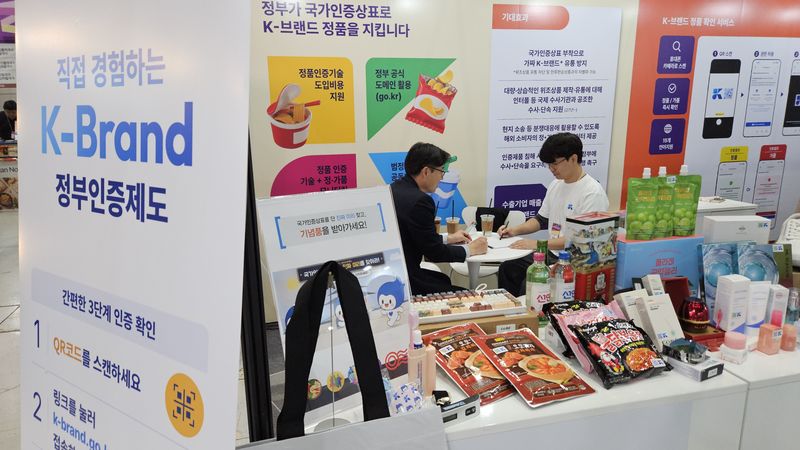
At the exhibition, KOMSCO will showcase examples of participating companies’ products bearing the National Certification Mark. It will also explain how the system works and how it can be applied by individual companies. Participation has been confirmed by major Korean companies including Samyang Foods, CheongKwanJang, Amorepacific and LG Household & Health Care. Companies interested in adopting the system can visit the exhibition during the event to see the actual National Certification Mark and how it works, and consult on how it could be applied to their products.
According to the Organisation for Economic Co-operation and Development (OECD), the scale of global distribution of counterfeit K-brand products was estimated at about 11 trillion won in 2024. The resulting losses are estimated to have reduced sales at Korean companies by 7 trillion won and eliminated 14,000 jobs. The Ministry of Intellectual Property began fully implementing the system early last month. The government has registered the National Certification Mark, whose rights it shares with companies, in around 70 countries, including Europe, China and ASEAN member states.
The K-Brand Government Certification System was introduced to prevent losses from counterfeit goods overseas and to support a government response if such losses occur. When the National Certification Mark is affixed to a product, consumers overseas can use a smartphone camera to check whether it is genuine without installing a separate app. The results are linked to the government’s real-time monitoring system, and if infringement is confirmed, the government directly asks local authorities to investigate and crack down on it, suspend customs clearance and take other measures. In effect, a government-wide response system has been established to address overseas counterfeiting, an issue that individual companies had difficulty tackling on their own.
Participating companies can receive support covering up to 50% of the cost of adopting product-authentication technology, up to a maximum of 200 million won per company. Eligible recipients are exporting small and medium-sized and mid-sized companies that meet the requirements. The actual amount of support varies depending on the company’s size, the type of project, the review results and the available budget. Large companies can also participate, but must cover the full cost of adopting the technology themselves.
Applications and further details are available through the K-Brand Government Certification System Application Portal. Applications are open until 6 p.m. on the 9th.
KOMSCO President Sung Chang-hoon said, “The K-Brand Government Certification System is designed to ease the burden on companies of responding to counterfeit goods overseas and to protect the brand value of Korean companies.” He added, “Visitors to the Food Week Korea exhibition can see the actual National Certification Mark and how it works, and consult on suitable ways to apply it to their products,” and, “We hope many exporters will take an interest and participate.”
[email protected] Kim Won-jun Reporter