The shadow behind South Korea’s ‘top academic performance’
- Input
- 2026-11-04 12:00:00
- Updated
- 2026-11-04 12:00:00
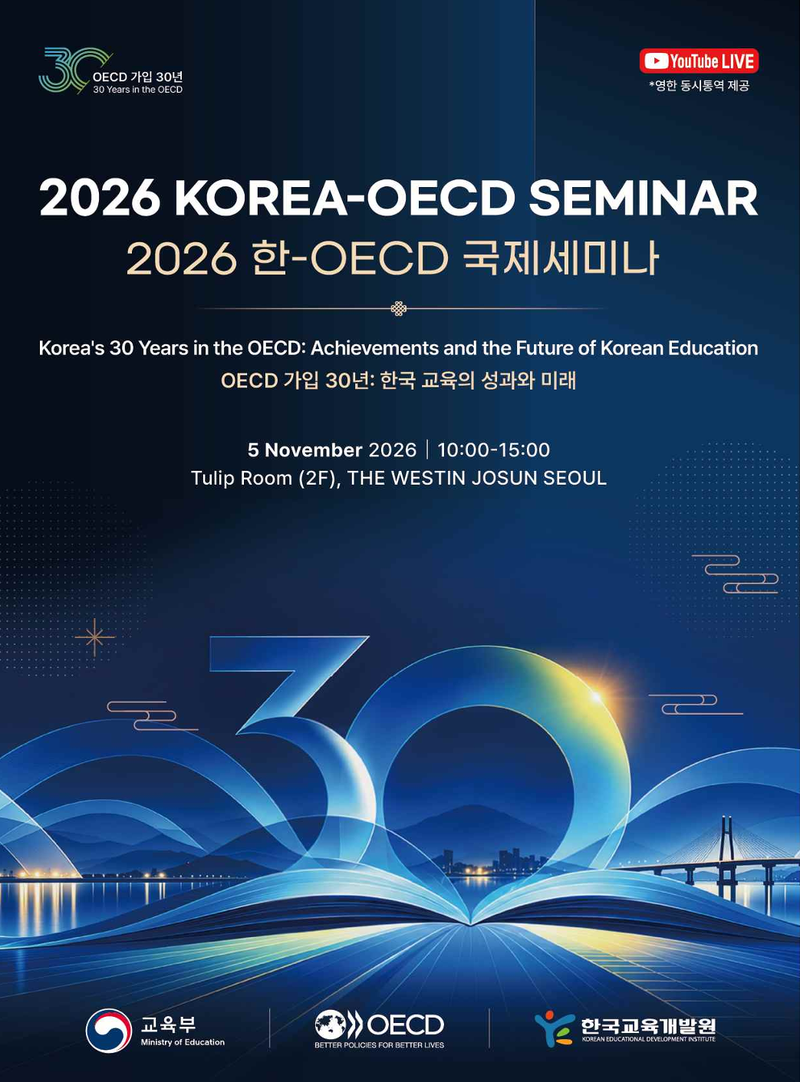
[Financial News] South Korea has achieved world-leading levels of academic performance in the 30 years since joining the Organisation for Economic Co-operation and Development (OECD), but has recently been found to face new challenges, including declining reading skills among students and widening achievement gaps. The Ministry of Education and the Korean Educational Development Institute said on the 4th that they would hold the “2026 Korea-OECD International Seminar” at The Westin Josun Seoul in Seoul on the 5th, marking the 30th anniversary of South Korea’s OECD membership, to discuss these achievements and challenges in Korean education.
The event will look back at achievements over the past 30 years while focusing on the future direction of Korean education as it enters a period of major transformation amid the spread of artificial intelligence (AI) and a declining school-age population. A key topic will be how to move beyond the knowledge-transmission-centered education emphasized to date and foster holistic education that supports each student’s growth, as well as the future competencies needed in the digital age.
Andreas Schleicher, OECD Director for Education and Skills, who will deliver the keynote address, will speak positively of South Korea’s high university enrollment rate and strong academic performance while also examining the recent decline in reading achievement and the effects of digital device use on learning. Kim Moon-hee, president of the Korea Institute for Curriculum and Evaluation, will then use data from the Programme for International Student Assessment (PISA) to analyze changes in Korean students’ achievement and the widening academic gaps between socioeconomic groups and among students.
An afternoon panel of experts will present four strategies for responding to demographic change resulting from low birth rates and the spread of AI technology. Domestic and international experts, including Stanton Wortham, dean of the Lynch School of Education at Boston College; Youngtae Cho, head of Seoul National University’s Population Policy Research Center; SK hynix Vice President Park Han-ul; and Seoul National University of Education Professor Shin Seung-gi, will explore solutions from changes to school spaces to developing talent needed by industry and changing teachers’ roles.
Minister of Education Choi Kyo-jin said, “Over the past 30 years, our education system has broadened opportunities to learn and strengthened students’ learning capabilities,” adding, “Going forward, building on these achievements, we will support every student so they can fully realize their potential in a changing environment.”
[email protected] Kim Man-gi Reporter