Opposition Budget Committee Vows to Cut “Cash Handout” Spending, Including Youth Future Savings and EV Rollout
- Input
- 2026-11-04 10:55:49
- Updated
- 2026-11-04 10:55:49
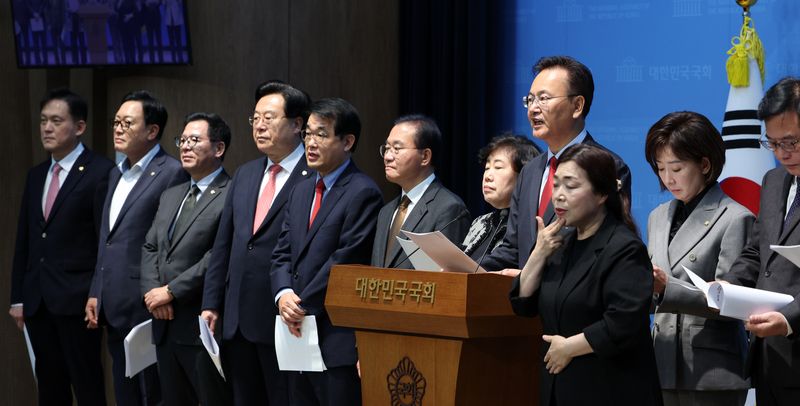
[Financial News] As the People Power Party lawmakers serving on the National Assembly’s Special Committee on Budget and Accounts entered the budget review process in earnest on the 4th, they vowed to “thoroughly scrutinize the budget and sweep out all unnecessary spending.” In particular, they said they would sharply cut budgets involving trillions of won, including those for Youth Future Savings, the electric-vehicle rollout program, artificial intelligence (AI) and renewable energy.
Rep. Yoo Sang-bum, the opposition’s secretary on the Budget and Accounts Committee, held a press conference at the National Assembly Communication Center that day and criticized the government, saying, “The administration is on a spending spree while the people are drowning in debt.” He said, “A look inside [the budget proposal] reveals a ‘hopeless’ budget filled with projects that are ‘largely impossible’ to carry out.” He explained that the government’s budget proposal totaled 820.9 trillion won, or 925.3 trillion won including 104.4 trillion won in surplus funds in the Future Fund. He called it “an anomalous scale with no precedent in constitutional history.”
The government and ruling party plan to establish the 162-trillion-won Future Fund and set aside excess tax revenue from the semiconductor industry. They intend to use the fund to invest in industrial growth and share the resulting gains. The government and ruling party say the 104.4 trillion won in surplus funds would be used if fiscal capacity deteriorates later due to tax revenue shortfalls or other factors.
The People Power Party, however, argues that the 104.4 trillion won in surplus funds should be used to repay national debt. Rep. Jo Bae-sook said, “It would be right to use all of it to repay government bonds and return it to future generations,” and demanded, “When exactly will we repay the government bonds and ease the burden on future generations?” The party also said local government grants should be normalized. Rep. Yoon Jae-ok said, “The government diverted 30.5 trillion won in local allocation tax that should have been distributed, making it revenue for the Future Fund. But spending from the fund’s local account amounted to only 15.3 trillion won, and 15.2 trillion won vanished.” He added, “Looking at the local account, the government cut local allocation tax to other cities and provinces and used those funds to funnel 3.5 trillion won exclusively to Gwangju and South Jeolla under the pretext of integration.”
They are determined to cut some government programs, labeling them “cash handouts” or “showboating” budgets. Rep. Park Soo-young stressed, “We will also make sure to overhaul budgets addicted to increases, which ask for more money while failing to properly spend what they already have.”
The People Power Party flagged the following as “for our own circle” spending: cooperative projects (81.9 billion won), social solidarity economy projects (63.3 billion won), the Committee for Basic Society (3.7 billion won), and budgets related to Frontier AI (47 trillion won). Rep. Um Tae-young then said, “The National Police Agency has allocated 45 billion won to a crime prevention program, saying that because the prosecution’s investigative powers are being abolished, it will shift frontline patrol officers to investigative roles and fill the resulting gap with 300 four-legged robots that have no on-site response capability, at 150 million won each.” He added, “There is also a budget for a North Korean-style ‘five-household responsibility system’ that shifts duties government officials should perform to mutual surveillance among citizens.”
Programs cited as populist spending included the Youth Culture and Arts Pass (792.5 billion won), Youth Future Savings (1.7 trillion won), general-type purchased rental housing (238 billion won), and a support program for hotel construction in regional metropolitan cities (152.3 billion won).
They emphasized, “The People Power Party will thoroughly scrutinize and cut problematic programs and unnecessary budget items from the people’s perspective,” adding, “We will give top priority to using the funds secured in this way to reduce the burden of national debt and address people’s livelihood difficulties that the government has failed to attend to.”
[email protected] Lee Hae-ram Reporter