High school seniors’ late surge outpaces repeat test-takers
- Input
- 2026-11-04 10:32:25
- Updated
- 2026-11-04 10:32:25
[Financial News] With anxiety rising among test-takers about two weeks before the College Scholastic Ability Test (CSAT), an analysis has found that a higher proportion of current high school seniors improved their scores on the actual CSAT compared with the September mock exam than did graduates, including those retaking the exam. This is attributed to current students’ late surge, as they are able to focus on studying for the CSAT after applications for early admissions are submitted.
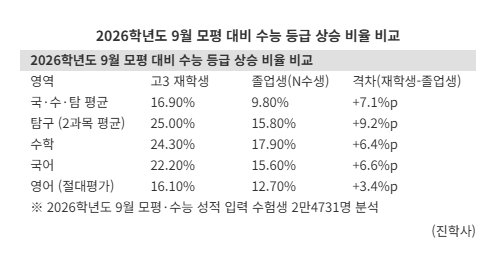
On the 4th, Jinhaksa analyzed score data for 16,977 current high school seniors and 7,754 graduates among 24,731 test-takers. Based on average grades in Korean, math and inquiry subjects, 16.9% of current students improved their grades on the CSAT, 7.1 percentage points higher than the 9.8% of graduates who did so.
Current students also outperformed graduates in every subject area. In inquiry subjects, where the average of two subjects was used, the grade improvement rate was highest at 25.0%: one in four current students improved their grade on the CSAT compared with the September mock exam, while the rate for graduates was just 15.8%, a gap of 9.2 percentage points. Current students also had a higher improvement rate in math, at 24.3%, than graduates, at 17.9%, a difference of 6.4 percentage points. In Korean, the rates were 22.2% for current students and 15.6% for graduates, a gap of 6.6 percentage points. Even in English, which is graded on an absolute scale, current students led by 3.4 percentage points, with rates of 16.1% and 12.7%, respectively.
The improvement among current students was particularly pronounced in the middle-grade range, from grade 2 to grade 4. Among students with a grade 3 in math, 28.7% of current students improved their grade on the CSAT, compared with 23.0% of graduates, a difference of 5.7 percentage points. For grade 4, the rates were 34.2% and 28.8%, respectively, a gap of 5.4 percentage points. In Korean, too, the improvement rate for current students was about 3.8 to 4.0 percentage points higher than that for graduates across every grade from 2 to 4.
Jinhaksa attributed this trend to changes in test-takers’ circumstances after applications for early admissions are submitted. After September, once high school seniors have finalized their school records and completed their early admission applications, they are finally able to focus solely on the CSAT. Graduates, by contrast, have generally been able to concentrate on preparing for the CSAT earlier, so their scores tend to change less in the final stretch, the analysis said.
Woo Yeon-cheol, head of Jinhaksa’s Institute for Admissions Strategy Research, emphasized, “As the CSAT approaches, current students can easily feel intimidated by the pressure of competing with repeat test-takers, but scores on the September mock exam do not automatically translate into CSAT results. The strength of repeat test-takers does not mean current students’ scores will fall, so there is no need to limit your own potential during the time remaining.” Woo continued, “Now is the time to thoroughly review and reinforce what you have already learned, rather than study new material, and to check the types of questions you repeatedly get wrong and how you manage your time.” He advised students to “build up your test-taking skills by practicing with the actual CSAT timetable so you can perform consistently at the exam venue.”
[email protected] Kim Man-gi Reporter