KOSPI turns lower after failing to hold early gains in the 1% range; KOSDAQ also breaks below 700
- Input
- 2026-11-04 10:27:12
- Updated
- 2026-11-04 10:27:12
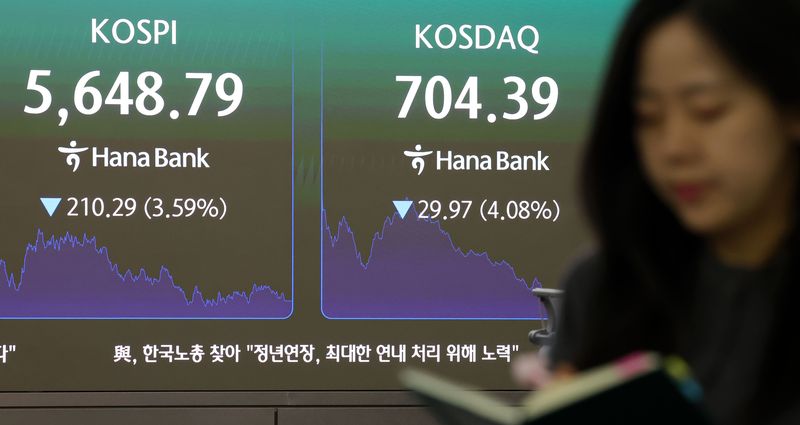
[Financial News] KOSPI, which had been gaining early in the session, gave up all its gains and turned lower. It opened higher, buoyed by a rebound in U.S. technology stocks and bargain hunting after recent sharp declines, but the index retreated again as heavy foreign selling came in.
KOSDAQ also extended its losses, sliding below 700. Before hopes of a rebound could even take hold, renewed weakness across domestic markets is weighing on investor sentiment.
According to the Korea Exchange (KRX), as of 10:18 a.m. on the 4th, KOSPI was down 29.13 points (0.52%) from the previous trading day at 5,619.66.
The index, which had climbed to 5,740.55 at around 9:33 a.m. that day, turned lower in less than an hour. After giving up all of its early-session gains of more than 90 points, it has continued to extend its losses.
Selling pressure is driving the index lower. At the same time, foreign investors had net sold 499.2 billion won in the KOSPI market. Individual investors and institutions net bought 238.1 billion won and 83.5 billion won, respectively, but that was not enough to absorb the foreign selling.
Although bargain buying is flowing in, the continued outflow of foreign funds is seen as putting a brake on the index’s rebound.
Large-cap stocks are also mostly weak. Samsung Electronics was down 0.91% at 217,500 won, while SK hynix was down 2.52% at 388,000 won.
LG Energy Solution plunged 5.92%, while Samsung SDI fell 3.99%. Weakness across large-cap semiconductor and secondary battery stocks is adding to downward pressure on KOSPI. Some stocks, by contrast, are holding onto gains, with HD Hyundai Heavy Industries up 2.43% and Hyundai Motor Company up 0.63%.
The situation in the KOSDAQ market is worse. The KOSDAQ index was down 8.67 points (1.23%) from the previous trading day at 695.72, falling below 700.
The index, which had been above 706 early in the morning, fell rapidly. In the KOSDAQ market, individual investors net bought 89.7 billion won, but foreign investors and institutions net sold 60.5 billion won and 10.6 billion won, respectively, driving the market lower.
Earlier, domestic markets had looked to strength in major U.S. AI-related stocks and the appeal of lower prices after recent sharp declines as drivers of a rebound.
The KOSPI forward price-to-earnings ratio (PER) stood at 3.96 times, its first drop below 4 times since June 2000, also raising hopes for bargain hunting. But the quick reversal of early-session gains showed that lower valuations alone may not be enough to overcome selling pressure in the market.
Caution ahead of the U.S. midterm elections, uncertainty surrounding U.S.-Iran negotiations and the burden of rising U.S. interest rates also remain. Analysts say that for strength in U.S. technology stocks to lead to a sustained recovery in domestic markets, buying—particularly in large-cap semiconductor stocks—will need to continue, and foreign investor flows will also need to improve.
[email protected] Kang Jung-mo Reporter