This airline swings to a 54.9 billion won profit... Analysts say its stock will rise another 50% [Shareholder Club]
- Input
- 2026-11-04 10:36:07
- Updated
- 2026-11-04 10:36:07
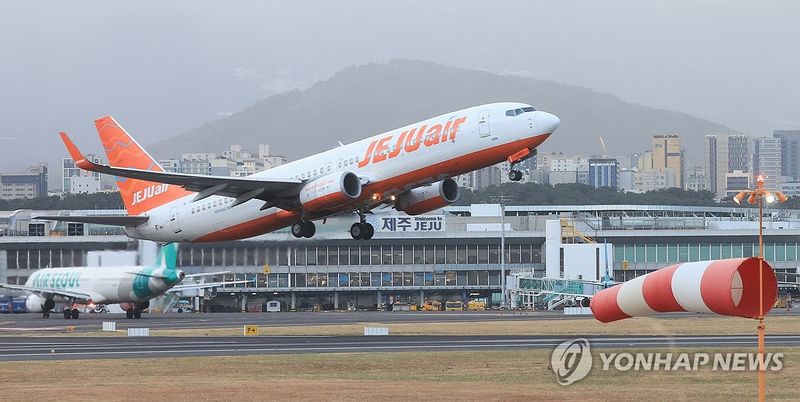
[Financial News] Jeju Air returned to profitability sooner than the market expected, as revenue rose with a recovery in demand for travel to Japan amid a weaker yen. Brokerage analysts expect the yen’s weakness to continue through the winter peak season and have been raising their target prices in succession.
According to the securities industry on the 4th, Korea Investment & Securities upgraded its rating on Jeju Air from “Neutral” to “Buy” for the first time in two years and set a target price of 8,600 won. iM Securities raised its target price from 7,000 won to 8,000 won, while Hanwha Investment & Securities lifted its target from 6,500 won to 7,500 won. Hana Securities resumed coverage with a target price of 7,500 won. Compared with the previous day’s closing price of 5,720 won, the potential upside is 31–50%.
The recent, sustained weakness in the yen contributed to these assessments. That day, the won-yen exchange rate at Hana Bank, based on its benchmark rate, stood at 848.11 won per 100 yen, down 6.76% from three months earlier. With Japan routes accounting for 40% of Jeju Air’s passenger revenue, the airline is considered the biggest beneficiary of the weak yen.
Passenger traffic on Japan routes up 29%... Operating profit 7–8 times consensus
Jeju Air’s third-quarter revenue on a standalone basis rose 32.2% to 489.6 billion won. Operating profit came to 54.9 billion won, marking a return to profitability from a loss of 59.9 billion won in the same period last year. It was the highest third-quarter figure on record, exceeding market consensus by 7–8 times. Net profit reached 203.2 billion won, boosted by foreign-currency translation gains and gains on aircraft sales. This wiped out accumulated deficits and brought the debt-to-equity ratio down from 1,134% in the second quarter to 395%.
Japan routes drove the results. According to iM Securities, Jeju Air carried 3.7 million passengers on its Japan routes from January to September this year, up 28.9% and outpacing market growth of 20.6%.
Choi Go-un, an analyst at Korea Investment & Securities, said, “Demand for travel to Japan is in better shape than during the initial reopening boom.” Analyst Park’s assessment is that profitability was lifted by stable fuel costs and the won-dollar exchange rate, as well as a growing share of aircraft purchased directly.
“Winter is peak season for LCCs... They’re benefiting from a yen at historic lows.”
Brokerage analysts said they were even more optimistic about the outlook. Analyst Choi said, “The stock has rebounded at least 30% since August, but its forecast price-to-earnings ratio (PER) for 2027 is still just 6 times,” adding that it was “half the 2024 average before the Muan Airport accident.”
Choi added, “Winter is the peak season for low-cost carriers (LCCs), and they earn 50–60% of their annual operating profit in the first quarter,” emphasizing that “they are heading into the most important season of the year for their business with the benefit of a yen at historic lows.”
Park Su-young, an analyst at Hanwha Investment & Securities, also said, “The stock’s sharp short-term rise may be a concern, but there is still room to climb,” and recommended buying whenever the share price pulls back.
Next year’s operating profit is expected to rise to 122.3 billion–145 billion won, up from about 100 billion won this year. Analyst Park raised the forecast for next year from 138 billion won to 145 billion won, saying, “Market expectations for fourth-quarter and next year’s earnings remain conservative.”
However, Hana Securities applied a target multiple 40% below the historical average, citing the lower growth prospects for LCCs and the possibility that Jeju Air could lose its position as the industry’s No. 1 carrier.
[email protected] Kim Hee-sun Reporter