[Park Dong-chang's Barefoot Walking Studies] <37> Barefoot Walking: Escaping Depression and Anxiety
- Input
- 2026-11-05 13:39:43
- Updated
- 2026-11-05 13:39:43
South Korea has maintained the dubious distinction of having the highest suicide rate among OECD member countries for 23 years, since 2003. According to recent 2025 statistics from the Ministry of Data and Statistics, suicide is also the leading cause of death for everyone from their teens through their 40s. In particular, suicide accounts for 53.5% of deaths among people in their 20s—more than half. It is impossible to deny that this is an extremely serious situation.
At the National Assembly last August, Rep. Kim Gyo-heung also pointed to the severity of the suicide problem in South Korea, stressing, "This is a disgrace before the world, a sinful situation. We must solve it," and raising his voice to say the current situation must no longer be left unaddressed. In response, Health and Welfare Minister Jeong Eun-kyeong said, "Suicide is a social disaster," and said the government would strengthen interministerial cooperation based on the National Suicide Prevention Strategy drawn up last September.
The problem, however, is that for the past 20 years, no one has proposed a solution grounded in an accurate analysis and insight into the causes. They have merely talked about the need to devise measures or the imperative of resolving the social-disaster situation. As a result, the suicide rate has not declined.
Modern life relentlessly drives us all, and it is also all too common for absurd and unjust events in the world to plunge us into a swamp of anguish and stress. If we successfully overcome the many stressors arising from our differing economic and social circumstances, stress can instead become a new opportunity for challenge and growth. But when we fail to do so, we pay a heavy price in frustration, grief, and even suicide.
The problem is that most people suffering from such pain, unable to find a fundamental solution, turn to medication. Some become addicted to psychotropic drugs and sink into an even deeper pit of despair from which it is difficult to escape.
The hormone in our bodies associated with stress is cortisol. According to the Doosan Encyclopedia, as stress increases, cortisol secretion either rises or becomes unstable; anxiety and agitation persist, and symptoms such as chronic fatigue, chronic headaches, and insomnia follow. Normalizing cortisol secretion and preventing excessive secretion could therefore provide a fundamental solution to anxiety and suicide associated with stress.
In a paper by Dr. Morris Ghaly titled “The Biological Effects of Grounding the Human Body During Sleep, as Measured by Cortisol, Subjective Sleep, Pain, and Stress Levels,” published in an American journal of alternative medicine in October 2004, he reported that before grounding, the 12 participants showed widely varying patterns of cortisol secretion. By contrast, a graph of their cortisol levels after two months of grounding showed that levels had stabilized to a remarkable degree, with nearly identical results across all participants.
In other words, after two months of grounding, 11 of the 12 participants fell asleep more quickly, while 9 of the 12 reported feeling restored and recharged, along with reduced anxiety, depression, and irritability. They further testified that they not only fell asleep more quickly, but also felt more refreshed than before when they got out of bed in the morning.
The clinical trial results above suggest that stabilizing the secretion of cortisol, the stress hormone, may not only fundamentally reduce stress, anxiety, depression, and irritability, but may also be a fundamental measure for suicide prevention. They point to the path forward: grounding oneself with the earth in daily life—in other words, walking barefoot.
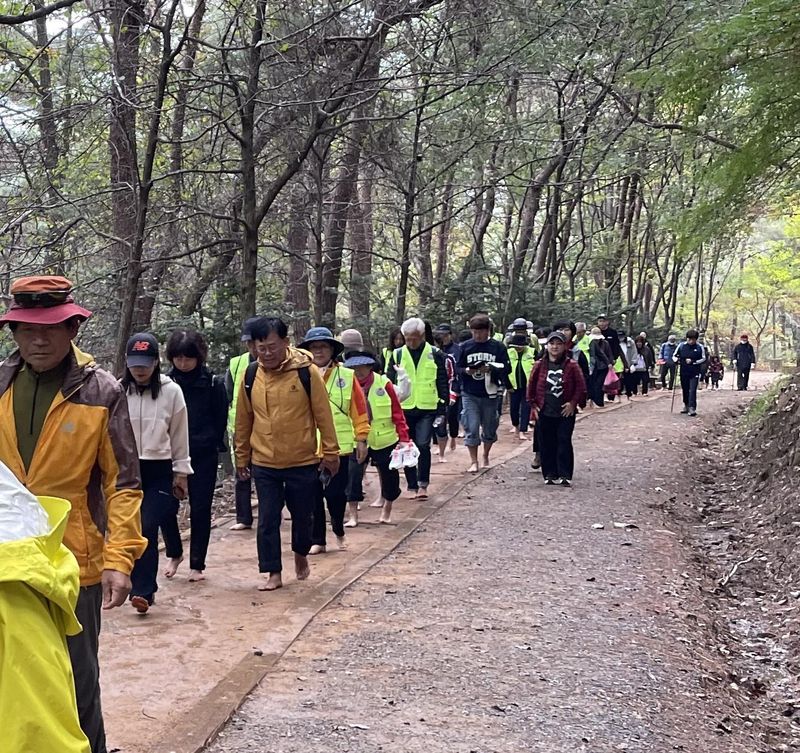
Not long ago, a woman in her late 70s who belonged to the Seoul Songpa branch of the Barefoot Walking National Movement Headquarters said she had frequently felt suicidal while living in a daze and taking medication for 15 years for insomnia, depression, bipolar disorder, and other problems brought on by a difficult family situation. Then, one day three months ago, she dipped her bare feet into the loess foot bath at Seokchon Lake in Jamsil. After walking barefoot on loess paths for two to three hours every day, she was able to sleep without medication after just three days. She later testified through tears that she had stopped all her medication within a month and regained a healthy life within three months.
In fact, anyone who seeks out a forest trail, a nearby barefoot-walking path, or a loess path, and walks barefoot to ground themselves, can dispel anxiety and depression and regain happiness as if a clear spring were welling up. Naturally, they can also escape suicidal urges and find psychological and mental stability. Barefoot walking shifts the direction of our everyday consciousness away from negative thoughts such as anxiety, depression, and anger toward peace, joy, gratitude, and happiness, positively resetting our mindset.
Over the past decade or so, the life-saving barefoot-walking campaign of the Barefoot Walking National Movement Headquarters has helped usher in an era in which at least 2 million people walk barefoot. Around 3,000 barefoot paths and loess paths have been created across the country, with unprecedented barefoot-walking trails and natural healing sites spreading nationwide like a web. At the same time, countless cases have been reported of barefoot walking helping heal chronic physical illnesses, as well as psychogenic conditions such as anxiety, depression, panic disorder, and obsessive-compulsive disorder.
This shows that people across South Korea can now seek out barefoot paths, loess paths, forest trails, and coastal paths near their homes and walk barefoot to build healthy, happy lives. The fundamental conditions are already in place to address the surge in suicide rates stemming from anxiety, depression, panic disorder, and obsessive-compulsive disorder. No additional national or social spending is needed. People need only take off their shoes and step onto the many barefoot-walking paths throughout the country. This applies to young adults in their 20s and 30s, as well as people of all ages.
The government, the National Assembly, and society as a whole must therefore focus on barefoot walking as a simple, easy, harmless, and cost-free fundamental solution, and join forces nationwide so that everyone can actively put it into practice. The Healing Tourism Industry Promotion Act has now recognized barefoot-walking paths by law as key healing tourism resources, granting them legal standing as a means of promoting the mental, physical, and social health of the public. The fundamental solution to escaping the stigma of having the highest suicide rate in the OECD lies right beneath our feet, on barefoot-walking paths.
Park Dong-chang, chairman of the Barefoot Walking National Movement Headquarters
[email protected] Sun-Min Jung Reporter