From Hydrogen Production to AI Cities: Hyundai Motor Group Unveils Its “Hydrogen Ecosystem” Vision
- Input
- 2026-11-04 10:00:00
- Updated
- 2026-11-04 10:00:00
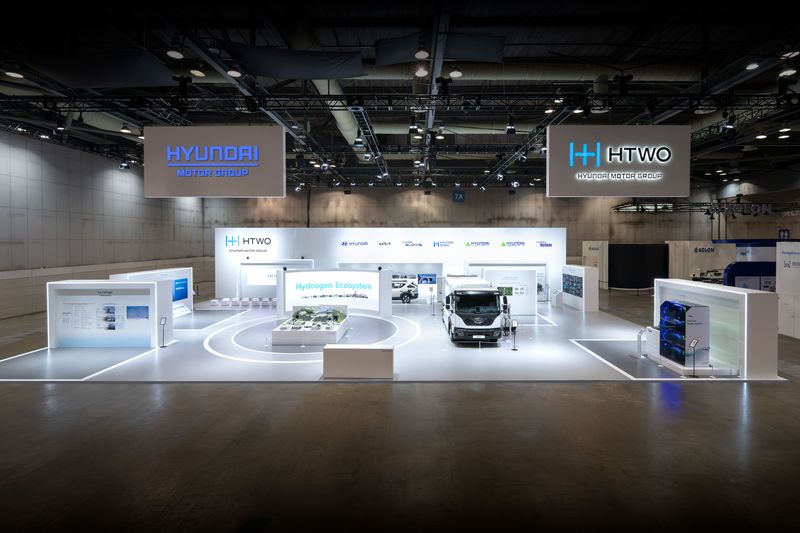
[Financial News] Hyundai Motor Group is stepping up efforts to build an integrated hydrogen ecosystem spanning production, storage, transportation and use. The group aims to expand the hydrogen supply base with a 5-MW electrolyzer module and technology that produces hydrogen from waste resources, while broadening its applications beyond passenger and commercial vehicles to rail and industrial cities. In particular, it has fleshed out a vision for a future industrial city centered on the Saemangeum AI Valley, connecting hydrogen, renewable energy and data centers.
■ Expanding Hydrogen Production with 5-MW Electrolysis
Hyundai Motor Group unveiled an integrated solution covering hydrogen production infrastructure, mobility and the development of a hydrogen ecosystem at World Hydrogen Expo 2026 (WHE 2026), which opened on the 4th at Exhibition Center 2 of the Korea International Exhibition Center (KINTEX) in Goyang, Gyeonggi Province.Around 190 companies and institutions from 12 countries are participating in the event, which runs through the 6th. Hyundai Motor Group has set up a 720-square-meter exhibition hall, where it is focusing on the group’s technological capabilities and commercialization strategies across the hydrogen value chain, from production to use. Hyundai Motor Group Vice Chairman Chang Jae-hoon also visited the venue that day, touring the group’s exhibition hall and booths of major participating companies to review hydrogen-related technologies and business developments.
The most prominent technology on display is proton exchange membrane (PEM) electrolysis. Hyundai Motor Group exhibited an existing electrolyzer stack and, for the first time, demonstrated how 12 stacks can be combined to form a single 5-MW electrolyzer stack module (ESM).
A single ESM can produce about 700 metric tons of hydrogen annually. Connecting multiple modules in parallel can enable expansion into a large-scale electrolysis plant with a capacity of hundreds of megawatts. Hyundai Motor Group currently operates a 1-MW containerized demonstration facility in Gwangju and is pursuing additional demonstration projects in Boryeong, Buan and Jeju.
The group also highlighted hydrogen production from waste resources as a core business. It introduced Waste-to-Hydrogen (W2H), a circular resource model centered on HTWO Energy Cheongju that converts waste into hydrogen for local production and consumption. The group also presented a biogas-based hydrogen production facility in Paju and a project in Indonesia, emphasizing the potential to build hydrogen supply chains tailored to local conditions.
■ Expanding Beyond Hydrogen Vehicles to Rail and Industrial Cities
In hydrogen applications, the group outlined a strategy to expand its business beyond passenger and commercial vehicles to rail, logistics and urban infrastructure.In the mobility sector, the group unveiled the 2027 Hyundai Nexo and, for the first time, a fuel cell system for commercial vehicles with enhanced durability for long-distance operation. It also displayed a model hydrogen-electric locomotive and a flat-type fuel cell module, showing the potential to extend the technology to mass transportation, including rail.
The group also presented technology to improve the operational efficiency of hydrogen commercial vehicles. The integrated fleet management system BlueLink Uptime Care analyzes real-world vehicle operating data to minimize downtime caused by breakdowns and support reliable vehicle operations.
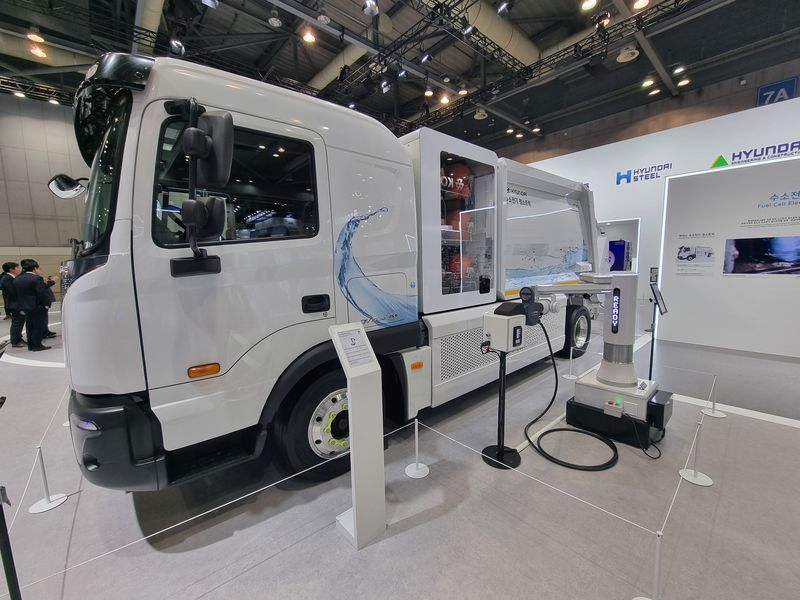
At the venue, the group also demonstrated an automatic charging robot for hydrogen fuel cell vehicles (ACR-H) using vision AI. The robot independently identifies a vehicle’s charging port, opens its protective cap and connects the charging connector. The technology is designed to improve charging convenience and operational efficiency as the adoption of hydrogen commercial vehicles expands.
Test drives of the Universe hydrogen fuel cell bus and The New XCIENT hydrogen fuel cell truck will also be available through the 5th. The group also unveiled the Elec City hydrogen fuel cell low-floor metropolitan bus, which is under development ahead of the mandatory introduction of low-floor metropolitan buses in 2027, showcasing mobility technologies for people with reduced mobility.
Hyundai Motor Group also presented a vision for using hydrogen as a key energy source for future industrial cities. A scale model illustrated a future industrial city centered on the Saemangeum AI Valley, connecting renewable energy, hydrogen, AI data centers, robotics and urban infrastructure.
Under the model, electricity and hydrogen produced using renewable energy would be supplied to AI data centers and robot manufacturing plants. The group also presented scenarios for developing hydrogen ecosystems tailored to the needs of different industries, including urban living, port logistics and manufacturing. The aim is to go beyond supplying hydrogen production equipment and develop integrated business models suited to the characteristics of each region and industry.
The group is also working to expand global cooperation. Hyundai Motor Group is participating in the international conference Leadership Insight, held that day, to discuss ways to boost investment in hydrogen projects and advance international cooperation. Hydrogen Council CEO Ivana Jemelkova will present an update on global hydrogen projects and the investment outlook, while Hyundai Motor Group and other major South Korean companies explore ways to expand their businesses.
A Hyundai Motor Group representative said, “At this exhibition, we will present the group’s integrated hydrogen solutions, from production and mobility to applications in urban and industrial settings, and expand opportunities for cooperation with customers and partners. Building on our hydrogen production capabilities, we will identify a range of applications and provide solutions optimized across the value chain, turning them into tangible businesses.”
[email protected] Kim Dong-ho Reporter