Diplomats and foreign media visit ‘Baekdudaegan Seed Vault’ ... “Its value for biodiversity conservation highlighted”
- Input
- 2026-11-04 10:40:31
- Updated
- 2026-11-04 10:40:31
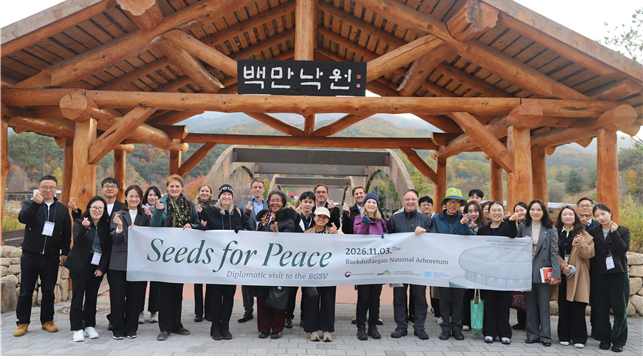
The Korea Arboreta and Gardens Institute (KAGI), an agency under the Korea Forest Service (KFS), announced on the 4th that it had invited about 30 people, including diplomats from member states of the United Nations Memorial Cemetery in Korea, to visit the Baekdudaegan Global Seed Vault at Baekdudaegan National Arboretum on the 3rd.
The visit was organized as a follow-up initiative to a memorandum of understanding signed last February by KAGI and the United Nations Memorial Cemetery in Korea Management Office. It was intended to express gratitude to the countries that dedicated themselves to the freedom and peace of the Republic of Korea during the Korean War, and to share the value of conserving plant diversity in an era of climate crisis.
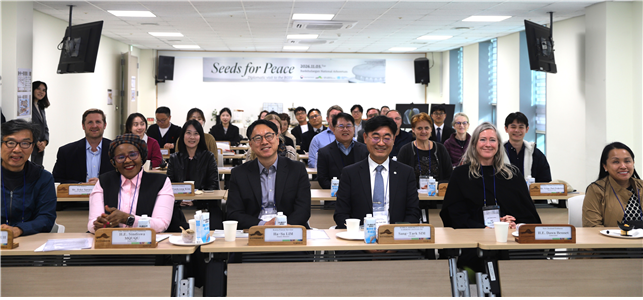
“Building on the Republic of Korea’s successful experience in reforestation, we will strengthen cooperation with the international community to conserve forest biodiversity and, together with the countries that fought in the war, safeguard precious plant resources for future generations,” said Lim Ha-su, Deputy Administrator of the Korea Forest Service.
Located at Baekdudaegan National Arboretum in Bonghwa County, North Gyeongsang Province, the Baekdudaegan Global Seed Vault preserves wild plant seeds over the long term in preparation for the loss of plant genetic resources due to climate change, war and other causes. Fully operational since 2018, it is the world’s first permanent storage facility for wild plant seeds and features an underground tunnel-style storage structure. The underground storage chambers are kept at minus 20 degrees Celsius and a relative humidity of 40% or less at all times. As of September this year, 297,955 seed samples from 6,410 domestic and foreign wild plant species are safely stored there.
There are only two seed vaults in the world: Norway’s Svalbard Global Seed Vault and Korea’s Baekdudaegan Seed Vault. Unlike Svalbard, which mainly stores seeds of food crops, the Baekdudaegan Seed Vault is the only permanent storage facility of its kind, collecting and preserving endangered wild plant seeds from around the world. As ecosystem destruction caused by global warming has accelerated in recent years, the policy and academic value of the Baekdudaegan Seed Vault’s work to protect biological resources across national borders has earned high regard internationally.
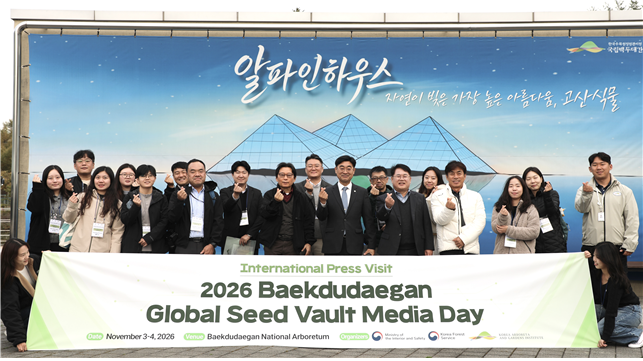
A 10-member foreign press corps representing eight media outlets from four countries, including China, Japan and the United States, took part in the event and reported on Baekdudaegan National Arboretum and biodiversity conservation sites. The outlets included China’s Xinhua News Agency and People’s Daily, and Japan’s Nishinippon Shimbun and Shukan Bunshun.
On the first day, the journalists toured major display gardens, including Wildflower Hill and the Rock Garden, as well as Alpine House, a facility for the conservation and research of alpine plants. They reported on the collection, storage and conservation of alpine plants and projects connected with local communities. At the Seed Vault, they showed keen interest in the long-term preservation system for wild plant seeds. On the second day, they toured Tiger Forest, where they could observe the ecology of Siberian tigers, then visited a youth village in Bonghwa County to learn about examples of local crisis response and mutually beneficial cooperation through gardens.
“This Global Media Day was a meaningful opportunity to introduce directly to overseas media our country’s efforts and achievements in conserving forest biodiversity,” said Shim Sang-taek, chair of KAGI. “We will continue working to systematically conserve forest biological resources and use them sustainably, while continually expanding communication and cooperation with the international community.”
[email protected] Kim Won-jun Reporter